
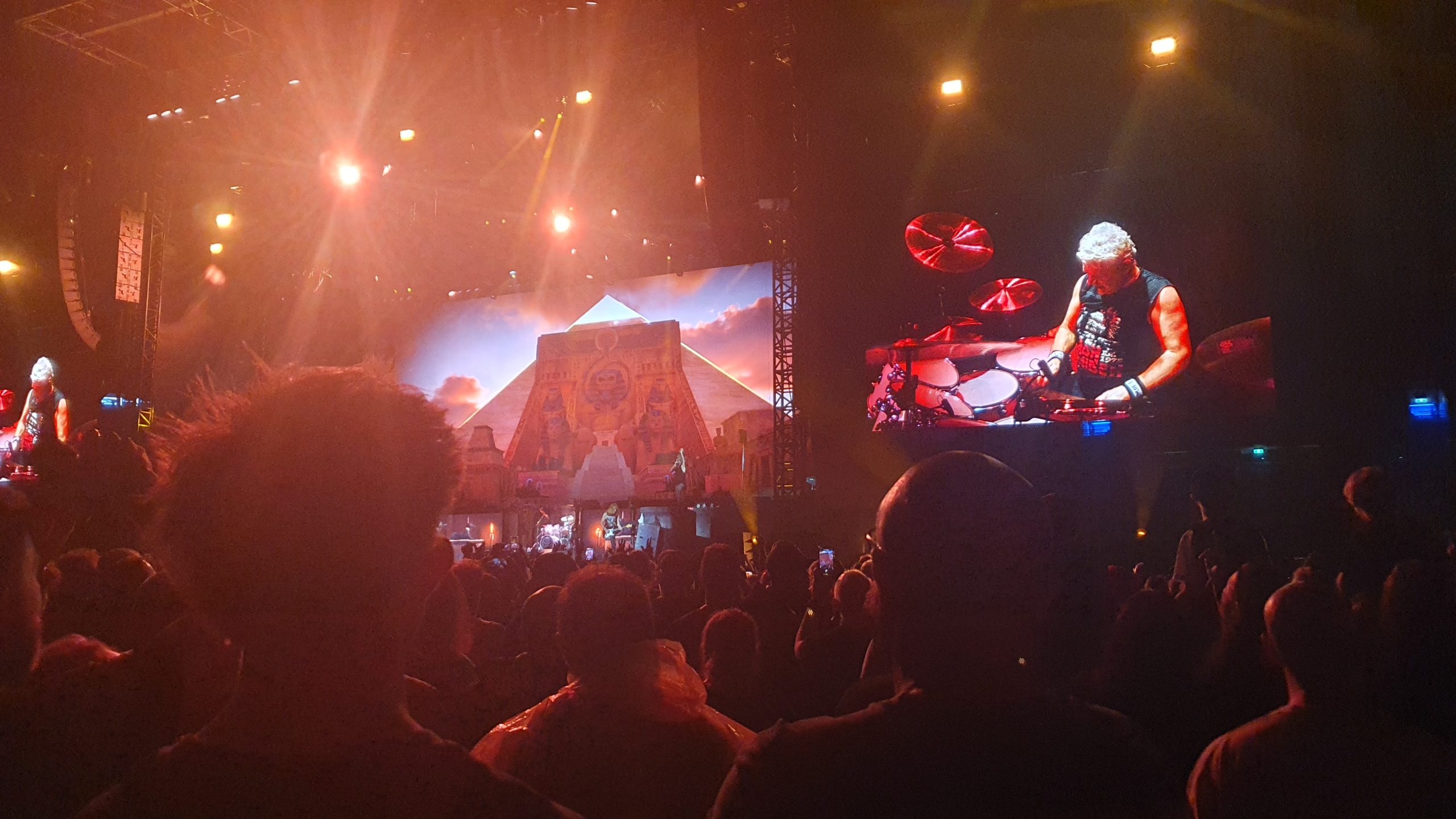
Megadeth and Iron Maiden performed in Sydney on the 15th.
I arrived at Moore Park at 5:30pm, so I could enjoy all usual pre-show experiences. These include “paying $14 for a cup of Hahn SuperDry” and “wandering around the stadium six times because I thought Gate A was Gate 1” and “staring at sound wedges suspended a hundred feet in the air, wondering what happens if they forget to plug one in and if anyone gets fired when that happens.”
The 42,500 capacity Allianz Stadium is a huge metal, glass and stucco exclusion zone, shaped like a football and sized like a suburb. While smaller than the 115,000 capacity Accor Stadium (which Taylor Swift sold out during the Eras Tour), it’s still sufficiently huge that the queues are so long you cannot see what you’re queuing for. It’s like playing a lootbox game where your prize might be a bathroom or some food or the show you paid to see. Feeling lucky? Get in the queue.
(Or maybe everything was signposted and I’m blind. I do remember staring at a sign that seemed to read “we do not serve alcohol to minions”. Fair, those yellow tic-tac guys don’t look like they’d handle alcohol well.)
It reminds me of queuing in Soviet countries. During the perestroika years, citizens would tend to join any queue they saw, because it meant a shop had something. “Get in the biggest queue you can find” is a surprisingly robust strategy.
Then done was done. I took my place on the General Admission floor.
it was time… for death. For a million deaths.
Megadeth
The crowd erupted as Dave Mustaine and company launched into “Hangar 18”. Mustaine’s shoulder-length hair is red, but when light shined down, it fluoresced to albino-white sheets. He looked like a vampire, clawing at his guitar.
Megadeth used to be one of my favorite bands. I heard an AMV on Youtube with “99 Ways to Die” on it, and was amazed by how snarling and hateful the singer sounded. Like a cartoon character.
Dave Mustaine is an intense person. I think he’s a genius, if a volatile and unstable one, and Megadeth is an extension of his fiery, self-destructive character. The band doesn’t sit still, second-guesses itself constantly, exists in a cycle of fracture, chaos, and reinvention, makes mistakes, and still occasionally hits gold. Megadeth’s many failures seem as necessary as its successes.
Mustaine’s 1983 firing from Metallica is among metal’s most notorious origin stories and is likely remembered out of proportion to its significance. Mustaine had already matured as a guitarist and songwriter (he has claimed Metallica songs as late as “Leper Messiah” contain his writing), and it’s hard to imagine him staying in a band where he couldn’t rule the roost. I expect he would have left soon on his own.
But yes, much of Megadeth’s career—the early Bay Area speed and aggression, the later genre-mixing, the commercial alt rock turn in the 1990s—could be read as him trying to outmuscle, outmaneuver, and outperform the band that had flung him out.. Kanye West is one of history’s most divorced men. Mustaine is among history’s most kicked-out. A sense of competition with Metallica (sometimes friendly, oftentimes not) permeates a lot of what he does.
Yet, what defines Metallica? Their stability. Load or The Black Album (whatever you think of their musical quality) are works from a band that has chosen a direction and is following it to the end. Metallica is a massive oil tanker that needs six miles to turn.
Megadeth is more like a raft lashed out of driftwood. Fast, nimble, but dangerous. The seas are stormy, the captain’s mad, the sextant long ago washed overboard, the crew is plotting mutiny. There’s a gripping sense of adventure—of “anything might happen”—to Megadeth’s chaotic story.
In 45 years, just four people have left Metallica. One did so by dying. Another was Dave Mustaine, who could get kicked out of an empty room. In nearly the same period, Megadeth has had twenty-six members leave. The two bands are not the same.
Though I remained a Megadeth fan, I drifted away in recent years. Their last few albums weren’t as good as I’d hoped, their best days appeared over, and Dave Mustaine’s ranting lyrics were starting to head in an Infowars direction (though the “Al-CIA-da” line in “Dance in the Rain” is hilarious.)
I wasn’t aware that Megadeth’s latest album hit #1 in Australia. Luckily, Mustaine rectified my ignorance. “#1 in Australia, and in America!” he crowed, before launching into “Tipping Point”. I half expected him to pull up Wikipedia on his phone and prove it to us.
Starting a show by bragging about your sales numbers is a very Dave Mustaine moment. I found it endearing. He cares extremely hard. He really, really wants to win. The correct amount of narcissism is not zero.
Good on Dave—great that he finally achieved his dream!
* * *
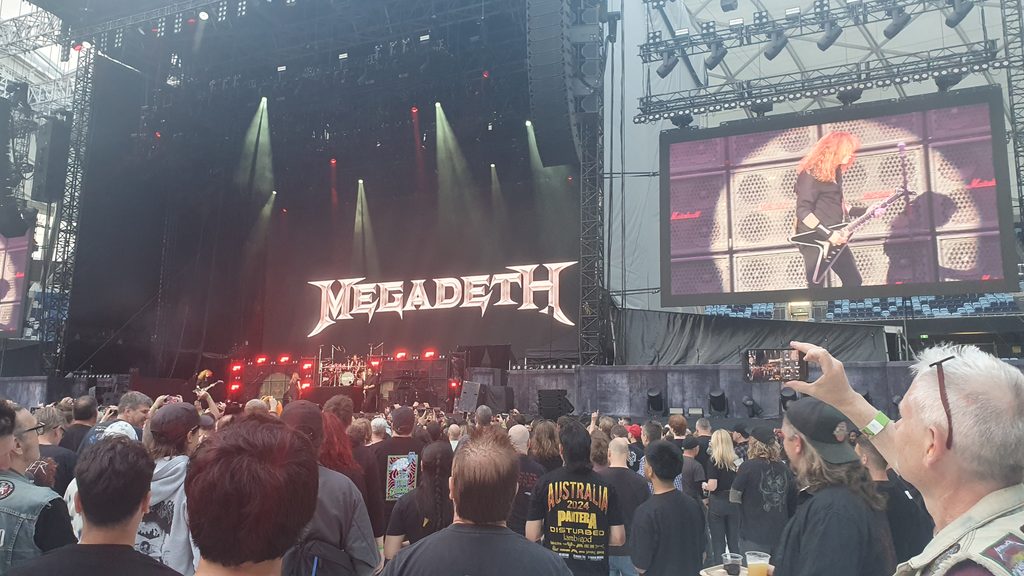
The mix from the pit was pure dripping shit.
Maybe our tightly-packed bodies absorbed sound. Maybe the sound engineer was a deep state operative, determined to stop Mustaine’s truth bombs from landing. But frankly, I couldn’t hear very well (or very much).
The legendary Marty Friedman guitar solo on “Tornado of Souls” was audible as a tinnitus-like squeal. The iconic “Hangar 18” chord progression (Dm Bb Bdim C6/9) didn’t sound like a chord progression or even like music: it was an atonal din like a battleship sailing straight into an enormous angle-grinder. The sharp jugular-slash of “Holy War”‘s riff became fuzz. The cool Spanish flamenco segue to “…The Punishment Due” just…barely existed. It was like half the notes evaporated before reaching our ears.
Megadeth is a band defined by blazingly technical guitar work. Mustaine has worked with some of the best axemen in the business (Marty Friedman, Chris Poland, Chris Broderick, Kiko Loureiro), and he’s skilled enough to shred right along with them. In this regard he clearly surpasses Metallica’s James Hetfield (who is a great rhythm player but capable of only basic lead work.) At times I felt like I was playing a “guess the Megadeth song” game based on loud/quiet dynamics.
Unexpectedly, James LoMenzo’s bass proved the most comprehensible source of melody and structure, shining out of the murk like a lighthouse. The heavy swing and bounce of “Symphony of Destruction”‘s low end came through great, with a sea of bodies swaying along with it.
Night came, and an ashen rain started to fall. The overhead lights shined through a galaxy of falling raindrops. Mustaine’s wry “…and now for a song about the weather!” got a laugh. (“Tornado of Souls”, you brainlet.)
This set had to wear many hats. It was Megadeth’s “farewell” tour. A closing of the book, representing the scope of their history and the legacy they’d like to leave behind. But it also had to contain all the obligatory hits. It also had to sell the band’s latest album, the self-titled Megadeth.
To make matters worse, Megadeth was Iron Maiden’s opener, which meant the set was cut down significantly in length. Something had to go, and a lot of things did.
Megadeth’s softer side was not present. No “A Tout le Monde” or “Trust” or any of their 90s alt rock hits. Most of their later discography went unplayed. Other than “Tipping Point”, the most recent song was from 1992 (!).
Dave Mustaine mentioned that this may be his last time touring in Australia. I wasn’t aware of this—Megadeth, technically, is finished. The band will disband after this final tour.
But if it’s any consolation, Megadeth breaking up is not the same as another band breaking up.
It already happened in 2002. Then Dave changed his mind, and here we were, rain drenching our ponchos, with the jarring stop-starts of “Peace Sells” racing through the crowd like a sonic virus. “What do you mean I don’t believe in God? / I talk to Him every day!” Dave Mustaine can’t make up his mind. This recurs throughout Megadeth’s turbulent saga, often to the benefit of fans.
Yes, he has health issues. Spinal trouble, throat cancer, and Dupuytren’s contracture (which I hope is less agonizing than it sounds). But it’s still hard for me to imagine an event that can take out Megadeth. Dave Mustaine dropping dead? Well, that would prove a small setback, I grant. But surely the band would be back after a few years. Somehow.
Long live Megadeth. Glad he got to #1 and lived to tell about it.
Megadeth setlist (typed from memory)
- Hangar 18
- The Conjuring
- Tipping Point
- Sweating Bullets
- Tornado of Souls
- Symphony of Destruction
- Peace Sells…But Who’s Buying?
- Holy War…The Punishment Due
(Looking at the real setlist on Setlist.fm, I got pretty close.)
Iron Maiden
Megadeth left, and the stage went dark. A “please respect the band by keeping your phone in your pocket” message filled the stadium screens.
In retaliation, a dickhead next to me whipped out his phone, set the screen to max brightness, and started defiantly shining it in circles over the crowd, like a prison searchlight.
I didn’t hope this man had a bad evening. I am above such pettiness. I instead hoped he had a flawed one. An imperfect one. Hopefully Iron Maiden skipped his favorite song or something. That’s what you get, you contemptible weasel.
We waited in near-darkness for a long time. Iron Maiden’s road crew had an enormous stage setup to assemble, and Megadeth had inconsiderately left 4×12 Marshall stacks all over the stage.
Then it was time for the Run For Your Lives World Tour.
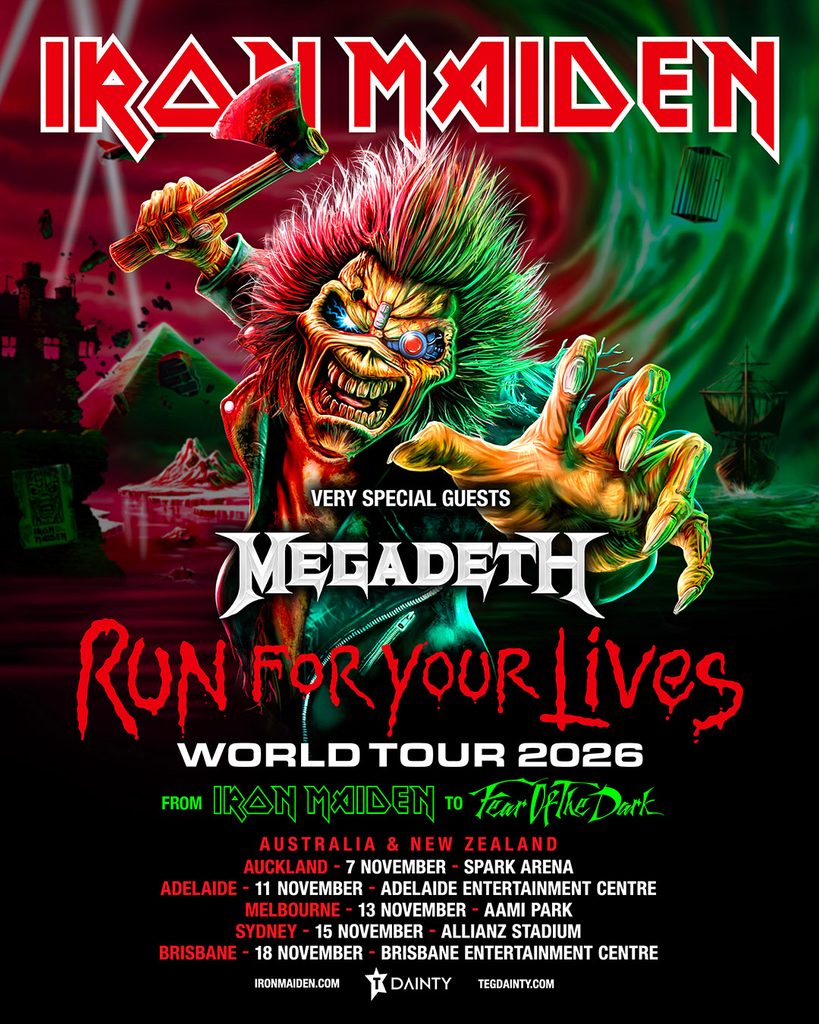
This tour was advertised as a showcase of the band’s history up to Fear of the Dark. A more accurate description would be “Iron Maiden’s discography from Iron Maiden to Seventh Son of a Seventh Son…plus the 1993 song “Fear of the Dark” as an encore.” I guess they ran out of words on the poster.
The evening was focused like a laser on Iron Maiden’s first seven albums. Their classic run, this contains the work that built their name and fame, and likely most of the songs fans want to hear. The band also brought out a deeper cut or two. We heard “Infinite Dreams”, which Bruce Dickinson stated was being performed for the first time ever in Australia.)
(Then he shamefully fact-checked himself. “…well, aside from yesterday, when we did it in Melbourne.” )
I wonder, what will Iron Maiden do next? The logical next step is a “Walk For Your Lives” tour—a 3.5 hour stage show focusing on their recent albums. Can’t wait. I wonder which two songs they’ll play?
Ha. They have long songs. Got their ass. That wasn’t just a terrible joke, it was a non-fan’s terrible joke. It’s like joking about David Bowie and coke, or the Beatles and Ringo. Making that joke confirms that you are “outside the room”. A dullard who sees only the surface of things. A driveling pajock knave who looks at the night sky and sees just a bunch of glowing dots.
So let me deny allegations that I am a lightweight. I am a big Iron Maiden fan who is highly knowledgeable. I just love their mascot, Jack Skellington. Man, why does their singer sound so different on the first two albums? Did he have a cold or something? And what’s the deal with “The Number of The Beast”? I don’t want to alarm anyone but I think the lyrics have Satanic implications.
Anyway, here was the setlist.
(from tape) Doctor Doctor (UFO)
(from tape) The Ides of March
- Murders in the Rue Morgue
- Wrathchild
- Killers
- Phantom of the Opera
- The Number of the Beast
- Infinite Dreams
- Powerslave
- 2 Minutes to Midnight
- Rime of the Ancient Mariner
- Run to the Hills
- Seventh Son of a Seventh Son
- The Trooper
- Hallowed Be Thy Name
- Iron Maiden
Encore:
(from tape) Winston Churchill’s Speech
- Aces High
- Fear of the Dark
- Wasted Years
(from tape) Always Look on the Bright Side of Life (Monty Python song)
It was interesting to note which album’s stocks were riding high or low.
1981’s Killers and 1982’s The Number of the Beast got heavy workouts, with three songs apiece. 1980’s Iron Maiden and 1988’s Seventh Son of a Seventh Son (traditionally something of a “forgotten” album) were represented twice.
1984’s Powerslave dominated the evening. The band played four songs from it—”Powerslave”, “Aces High”, “2 Minutes to Midnight”, and “Rime of the Ancient Mariner”—note that two of these are lengthy epics. Measured in minutes, between a quarter and a third of Iron Maiden’s set was the Powerslave show.
Other albums were losers. One song off 1983’s Piece of Mind. No songs at all from 1990’s No Prayer for the Dying (fine by me). “Fear of the Dark” was the only song from the 90s they played. It appeared that Somewhere in Time (another “overlooked” album from their famed classic period) would also be forgotten, until “Wasted Time” brought the curtain down.
What does Iron Maiden mean to me, and to heavy metal?
Megadeth is an important band, without which metal would be poorer. Iron Maiden is a foundational band, without which metal would not exist. Or it would exist, but not close to how it exists now.
What did they give to metal? Grandeur. Storytelling. Even their first album—rough, raw, cheaply produced, a label clearly positioning them as a punk rock band—they have a bigness and ambition. You don’t get many Edgar Allan Poe-themed songs on a Sex Pistols record.
Their music is what Lawrence of Arabia is to film. Kitsch, hammy, almost overwhelming in its color and scale. Daunting and slightly draining to experience. They make music that can fill days or weeks or perhaps even lifetimes.
Yet they have a humble working class ethos. There is no sense that they are smirking at or disrespecting their material, or being ironic about it. They seem to be genuinely stirred and moved by the subjects limned to life, and hope for the same impact on you.
Some things descend from the angels, others crawl from the mud. A rough band from Leyton, Iron Maiden is the latter. Bruce Dickinson alone has a degree. Dave Murray, Adrian Smith, and Nicko McBrain all dropped out of school. Multiple albums were recorded in Steve Harris’s goddamn barn out in Essex.
But even the humblest Precambrian lifeform might someday sprout wings and fly, and whatever their origins, Iron Maiden have ascended to the stars. They’re a good example of conservative art. They have the same desire to explore life and death and meaning (through history, and poetry, and film) as JRR Tolkien and CS Lewis did.
(This is one reason why 90s Maiden loses me—suddenly there’s a lot of social commentary, much of it trite and small, Cheap shots at easy targets, like tabloids and televangelists and football hooligans. It’s as if an angel tried to rip off its wings and crawl around in the mud for a while.)
On a musical level, they are one of the most heavily imitated bands of all time. The choppy harmonized guitars of modern melodic hardcore and related genres is straight from Iron Maiden (or via the scenic route from Sweden’s In Flames, who got it from Iron Maiden.)
The harmonized guitars. The “gallop”. The blurring of duties between rhythm and lead guitar, between bass and treble clef. The sky-riving high notes. Then there’s the “Iron Maiden album structure”—start on a fist-pumping crowd-pleaser, end on a grand epic—which is obviously not theirs, but so associated with them in heavy metal that it may as well be.
Bassist and primary songwriter Steve Harris is an astonishingly active musical presence, just as prominent as the dueling leads of Adrian Smith and Dave Murray (and Janick Gers). (And yes, the lion-haired Harris did his “drop to one knee and fire his bass like a machine gun trick” frequently—and each time, cheers filled the air.)
Iron Maiden and Megadeth feel a generation apart. Megadeth seems like TNG to Iron Maiden’s TOS: the sort of band that would only form after Iron Maiden breaks up.
Yet…this isn’t true at all!
They existed at the same time, did they not? Iron Maiden’s recording career began just a few years prior. They were both at the peak of their creative firepower at the same time.
Maybe it’s because although Iron Maiden clearly inspired all of heavy metal (for Metallica they’re particularly important—the layered clean guitars of “Fade to Black” and the progressive nature of “Call of Ktulu” are obviously built off an Iron Maiden chassis), this influence never went the other way. Iron Maiden was never inspired by heavy metal.
For fifty years they stuck to their cloud, ignoring the trends scarring and shaping the soil around them.
Metal drummers (starting from 1983 or so) began using twin bass drums, but Nicko McBrain has used one for his entire career (aside from a one-off experiment on Dance of Death.) The “guitar shredding” hysterics of the mid-late 80s (pinch harmonics, sweep-picked arpeggios, Floyd Rose abuse) never appeared in Murray and Smith’s repertoire. The band has resolutely stuck to standard tuning (aside from Janick Gers, who I believe “drop tunes” to DADGBE).
Iron Maiden has ignored basically every trend in popular music. Yes, there were synth guitars on Seventh Son and a rawer approach in the 90s (I understand this was a concession to a restless Bruce Dickinson, rather than an attempt to court grunge or alt rock markets as such.)
This has made Iron Maiden timeless. Suspended in cryonics while the world ages past them. This immunity to style and fashion has aged them extremely well, giving them a margent-encrusted stateliness and antiquity. Age has not rusted their metal, merely dulled it to a beautiful pale-green patina.
Bruce Dickinson was a fantastic frontman on the night. Just astonishing. It became clear to me that Iron Maiden simply won every lottery at once when they hired him.
This 68-year-old man charged around the stage all night long—interacting with props, changing costumes, doing pantomimed performances (he’s a frustrated theater kid at heart!), all while nailing piercing high notes written for someone fifty years younger.
The first two screams in “Killers” were maybe flat, but the third sounded dead-on. And again, my ability to hear high notes was compromised. (I will say that the mix sounded far better during Iron Maiden’s side of the bill, with the lead guitar interplay having a real sensitivity.)
Between songs, he charmed the crowd with patter. ribbing the guys who’d paid for seats. (“Are you lot alright up there? Under your big concrete umbrella?”) Bruce Dickinson is both erudite and charismatic, introducing each song as a thematic experience in a way that perfectly set the tone. Bruce Dickinson did not steal the show. He earned it fair and square.
The overall presentation of the show was dazzling. The overhead screens displayed a mix of Derek Riggs’ timeless art, somewhat less timeless CGI animation, and terrible AI slop that looked like TikTok ads for scam games where you save a guy from the lava.
Rain fell in thick, suffocating sheets. Those with ponchos and plastic sheets hugged them closer. Those without stamped and thrashed and headbanged to stay warm.
As the pit drowned, Dickinson remarked that it was an appropriate time for “Rime of the Ancient Mariner.” “Water water everywhere, and not a drop to drink.” Apparently, if you are a heavy metal band, there are worse things you can do than write a song about adverse weather!
(I disagree with Bruce. There is water you can drink. It’s called “Stadium Water” and costs $6 for a tiny bottle but you can definitely drink it, if you are so inclined.)
As the show neared its end, I was wet and cold. When the stage went dark, I decided it was over, and began to make my way out.
Whoops. Encore time. I decided to still leave. Luckily, the queue out of the General Admissions pit was crowded. I got to hear “Aces High”, “Fear of the Dark”, and “Wasted Years” on my way out of the stadium, onto Moore Park Rd beyond.
Adrenaline kept me awake until 3:00am.