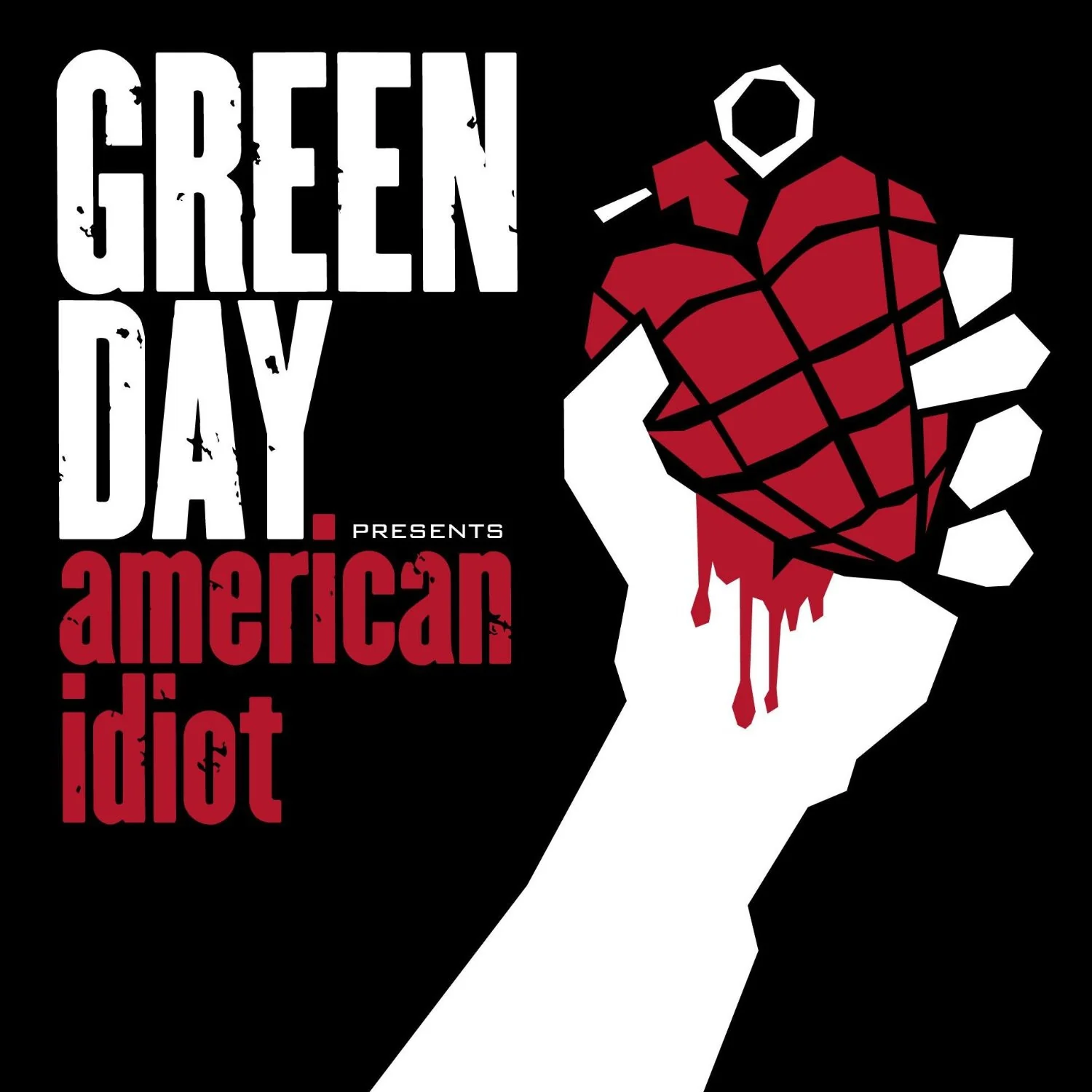
In 2004, George Bush campaigned for re-election. Musicians wrote songs about it. And about about him. “Songs about how he was cool and awesome and doing a great job?” Well, you’d think so but in many cases it was the opposite, actually.
At the time, I was a poster on a gaming forum. I remember watching a 3-page thread erupt overnight about something called American Idiot by Green Day. It was controversial, although few people had a clear grasp on why. A long, annoying “debate” followed—unsullied by the slightest contact of anything resembling a fact—about whether the album was offensive, or to whom it was offensive, or whether *all* Americans were being called idiots, or just *some* Americans, or whether it even mattered, and so on. The band’s name was spelled twelve different ways—I got a kick out of “Green’s Day”.
This was my first (indirect) exposure to protest art and the (non) reaction it usually inspires. I was watching gamers perform rote poses of shock, indignation, and defensiveness they’d seen in others, while clearly not actually caring that much. Many had evidently not heard the album, and were relying on second hand outrage. A provocative gesture had just rocked mass culture: that much was clear. They knew they had to react. But the provocation had no meaning for them.
This aligns with an oft-repeated claim about the Bush years: the kids were fucked. Vast teeming numbers of the young were politically disengaged, if they even cared, they were stuck repeating the talking points of others, mimicking the shadows of outraged adults on Plato’s wall. A friend of mine once said “it’ll suck when they make Boomer-style documentaries about our generational moment—instead of the Beatles and Woodstock, it’ll be about Bush and financial crimes.” He had a point. By 2004, Bush stood revealed as a thousandfold joke, and the case for war was sagging like piss-soaked paper before our eyes. Vietnam 2.0 could and should have produced Counterculture 2.0—an articulate, mobilized, and ultimately successful youth reaction to the war. We could actually top the boomers—we could stop the war before it even began! Wouldn’t that be nuts? Wouldn’t that be crazy?
It was. None of that happened. On the eve of war, a massive protest came and went and achieved nothing. Subsequent ones were much smaller. They also achieved nothing. Soon after, the antiwar movement fizzled out, as though it was a dead carcass and nobody had the energy to keep carrying it forward. Bush did not win in Iraq, but he won against us. Coalition forces would remain in Iraq for the next nine years.
No, nobody would cite any part of the Iraq war as America’s finest hour. And obviously kids are not to blame. But the failure of the protests is particularly depressing to think about. Why did they fail so miserably? What had changed since Vietnam?
Conscription, I guess. The antiwar protests of the 60s and 70s were fueled by the draft: as a service-age man, you couldn’t remain unengaged. Vietnam could easily become your war. In the years following Operation Rolling Thunder, thousands of young men were going overseas and filling coffins, millions more scrambled to secure college deferments, and you were ignorant about Vietnam at your mortal peril. People had to care, because politics (as the cliche goes) cared about them. The defining act of protest became the burning of a draft card.
But active conscription ended in 1973, and the threat of dying in a ditch in Buôn Ma Thuột disappeared. Youth vote turnout collapsed. Throughout the 1960s, the youth vote turnout stood at around ~35% for congressional elections. It dropped nearly ten percentage points in 1974, and continued to fall from there. War in foreign countries became an increasingly abstract thing—I remember the joke about Iraq was that America couldn’t find the country they were invading on a map. A decades-long dumbening process had rippled like an earthquake through Gen X: they’d dropped out, but had failed to turn on or tune in.

(Another thing: the Vietnam war escalated over many years, and the protests slowly snowballed to match it. Organizers like SANE and the Young Socialist Alliance received years of runway with which to build networks, scale up logistic capacity, and learn valuable lessons about putting bodies in front of gears. By contrast, the Iraq protests were rapidly-organized and front-loaded in attendance: their massive initial size proved unsustainable. After a gigantic protest on 15 February 2003, numbers fell off a cliff. It didn’t help that the initial stage of the invasion went really well, with the Coalition taking Baghdad after three weeks. Could it be that things would work out, after all? No. It couldn’t.)
And by 2003-2004, the internet was maturing into its current form: a ruiner of everything. It cheapened the value of protest art and satire, making rebellious gestures easy and meaningless. There’s only about six different jokes you can make about Bush, and if you had a 56k modem, you too could hear them repeated a dozen times a day. It got to the point where I just didn’t want to hear anything at all about Iraq or war or US politics. It just seemed like a radio tuned to static: with no signal and no meaning poking through the hiss. The Vietnam protests benefited from this lack of an omnipresent scream-machine. One Timothy Leary speech or Mickey Mouse in Vietnam is a rare, valuable artifact. A million is just a sea of noise. The nonstop news cycle around Iraq felt like a dry-run for Trump Derangement Syndrome. If I see Trump’s face on a news story, I click off. I’m sorry. I’ve had enough. His name exists in a numbed-out part of my brain, worn dead through overuse, and has ceased to mean anything. I will talk about American Idiot now.
There are two ways you can look at this record. The first is as a piece of music. On that front, it’s great! I fully listened to American Idiot on a car drive the other day. It has fine, fine, fine songs. Particularly “Holiday” and “Boulevard of Broken Dreams” (which I remember hearing before). No complaints there.
I know a guy who was friends with Billie Joe Armstrong growing up, and reports that he’s actually a guitar prodigy who plays the music he plays as a conscious choice. I believe this. There’s all these subtle fingerprints all over the music (and a fussy sense of perfectionist micromanagement), which you hardly notice because of how violent, visceral and blood-drenched Rob Cavallo’s mix is. There is incredible craft on display here. It’s not kids fooling around, it’s smart adults dressed up as kids fooling around. The album is all the better for it. Would that the Iraq war itself had been this thoroughly planned.
But American Idiot is also a protest album. What is it protesting? For that, we turn to the lyrics of its infamous title track:
Overseas, yeah, we tryna stop terrorism
But we still got terrorists here livin’
In the USA, the big CIA
(…)
Why are there pieces of love that don’t belong?
Nations droppin’ bombs
Chemical gases filling lungs of little ones
With ongoing sufferin’ as the youth die young
So ask yourself, is the lovin’ really gone?
(…)
A war is goin’ on, but the reason’s undercover
The truth is kept secret, and swept under the rug
If you never know truth, then you never know love
Actually, those are lyrics to “Where is the Love” by the Black Eyed Peas. Mangement regrets the error. Here are the lyrics to “American Idiot”.
Don’t wanna be an American idiot
One nation controlled by the media
Information age of hysteria
It’s calling out to idiot America
Welcome to a new kind of tension
All across the alienation
Where everything isn’t meant to be okay
Television dreams of tomorrow
We’re not the ones who’re meant to follow
For that’s enough to argue
Okay, what is this song saying? There’s a new kind of tension. Tension over what, though? Is it a good or a bad thing, that people are feeling tension? Is the band for or against said tension? I don’t know.
Lyrically, I was struck by how…unconnected to reality the album seems. It’s just punches slung out in a dark room. Billie Joe never sounds that angry, and never sounds like he’s singing about anything in particular. Yes, I’m sure he was (and is). But the intense clarity of message you get on Vietnam-era protest records (like Phil Ochs) is not present on *American Idiot*. No wonder the gamers on that long-moribund forum were confused. Heard out of context, you’d never guess “American Idiot” was about the 2004 election. In 2016, Billie Joe Armstrong made the song about Trump by changing literally *two words*. For better or for worse, the song was always a cipher.
For me, it’s “worse”. Slamming 3-chord pop punk doesn’t really benefit from subtlety. Fuck abstract interpretation, I wanna know which Coalition-owned IPC pipelines Green Day want their fans to bomb, you get me?
The closest Billie Joe Legweak gets to naming and shaming the guilty is his mention of the “redneck agenda”, plus a “faggot” or two. (I learned while writing this that he is bisexual).
But does this connect with its target? I am unsure. George Bush was not a yee-haw cowbow redneck: he ran on compassionate conservativism. Yes, in February 2004 he supported a constitutional amendment banning gay marriage, but also supported civil unions—his views on gay marriage were broadly in line with the mainstream opinion of the Democratic Party (including Barack Obama and Hillary Clinton) circa 2004-2008. It’s difficult to find quotes from him on the subject, beyond rote pablum about how the institution of marriage must be respected. It simply wasn’t a major cornerstone of his campaign or his presidency. Certainly not a stick to beat him with on the same scale as, say, the intelligence failure in Iraq.
It’s also striking that American Idiot—for all its anti conservative bombast—is musically as conservative as it gets. Ignore the lyrics: if music could vote, this album voted for Bush and then wore a fake mustache to vote for Bush a second time.
The title track is a shameless Sex Pistols nostalgia-fest: Johnny Rotten’s vocal rhythm (“I don’t wanna holiday in the sun” -> “don’t wanna be an American Idiot”) sung over the main riff of “Pretty Vacant”. It’s followed closely by a song called “Holiday”, just in case the album’s musical forbears aren’t clear.
Which strangely, they aren’t. The album is sold as the force that brought pop punk back to the mainstream, but it actually has a surprising amount of conceptual, rock opera storytelling as well. It’s more of a piece with Meat Loaf and Bruce Springsteen than, say, Blink 182 (let alone DRI or Black Flag). “Jesus of Suburbia” is a collage of musical quotes slashed out with a Bowie knife (I noticed references to “Life on Mars?”, “Time”, and “Moonage Daydream”). You could rebuild the bulk of this album out of 1972-77’s scavenged parts. Is this the voice of the downtrodden youth? The most recent musical reference is to Oasis’s “Wonderwall” in “Boulevard of Broken Dreams”.
To be clear, I have no qualm with conservative music. We should honor and respect the traditions of the past (as said Bush about marriage)…but I have to be honest: Green Day seldom live up to their inspirations, and direct comparison usually does not flatter them.
Green Day are not the Sex Pistols, and the title track’s forced, direct comparison does not flatter them. “American Idiot” is a force to be reckoned with in isolation, but if you’ve heard John Lydon’s glottal-reinforced “ANTI-CHRISSSSTT-UGHH”—with epenthesis *spat out* like a wad of phlegm in his throat—it sounds so square you could play chess on it. Billie Joe Armstrong is certainly no Meat Loaf in the vocal department; and where Jim Steinman really leans his whole ass into Wagnerian rock opera shtick, Green Day seem to lose interest in theirs halfway through. And attempting to imitate Bowie is a contradiction of terms—Bowie’s whole persona was a lifelong spirit-quest to not ever sound like himself.
The album was a success, and largely rescued pop punk from the clearance bin. (It was a runway for My Chemical Romance’s The Black Parade in particular, and I remember Sum 41, Good Charlotte and Avril Lavigne also doing solid trade in its wake). I am not sure it takes much courage to be a punk band and strike a generic “fuck the government” pose. Not after The Dixie Chicks and Willie Nelson took their anti-Bush messaging into the lion’s den of the Nashville country music market. But maybe bravery wasn’t the point.
I kept hoping for a more concrete and focused lyric. Instead, they’re more like Mad Libs you fill in with your own anger. (If anything, conspiratorial tropes about media mind control have aged uneasily in the Trump era). These are very much what you’d expect the lyrics of a Bush protest album to sound like, if it were written by 14 year old kids on a videogame forum whose level of cultural engagement was “whats a green day??” It is angry in a way that feels shallow and rote and fill-in-the-blanks.
The charitable read is that Billie Joe wanted to respect the listener’s anger. He didn’t want to crowd out their anger by forcing his own upon them.
The uncharitable read is that he felt that getting too specific would alienate people (across the alienation) and perhaps invite actual censorship. So he played it safe and made a record about confusion and ignorance instead. Which is fair: both are common reactions to war, and not even wrong reactions. How did you first hear about 9/11? Someone came up to me and blurted “A PLANE HIT A BUILDING IN AMERICA AND A MILLION PEOPLE ARE DEAD!” Tally up the carnage of the next decade, and he wasn’t far wrong.