
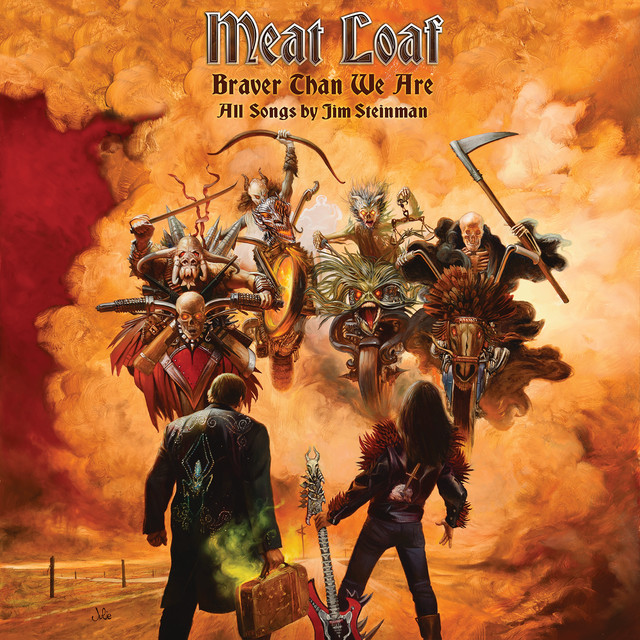
The final album by Michael “Meat Loaf” Aday and Jim “Jim Steinman” Steinman arrives bedecked in heraldry. It knows it has to matter. It pulls out all the stops. It brings back Ellen Foley and Karla DeVito. There’s “All Songs by Jim Steinman” glaring off the cover with point-making intensity, with “Desmond Child was taken out back and shot” in small print (wait, it’s not on yours? It’s on mine. Mostly because I added it in Sharpie.). Every work of art might turn out to be your last. Both men clearly sensed—maybe knew—that this was the end.
Even if you agree with producer Todd Rundgren’s view of Bat Out of Hell (Interview Q: “Do you ever put on the record and listen to it?” Todd: “Not much.”), it’s impossible to see the Julie Bell cover art—two figures vs the apocalypse; a giant with his slumped shoulders Atlas-huge and Atlas-weary, and a scrawny brave lion with his hair blowing behind him—without feeling a sting of sadness. What an incredible forty-year partnership these men shared.
And so it is with regret that I pronounce the Braver Than We Are a bin fire. If you love it, you’ll have to love it for both of us.
I knew he was sick. I still wasn’t prepared for how bad Meat Loaf sounds on this record. On Dead Ringer his voice was only worn-out and haggard, here he sounds like Mr Burns. Hearing him mutter and cough and bark through songs is demoralizing experience, turning his glorious last stand into a glorious last sit (amusing witticisms like that are the reason I am known as a “card” at parties), and sucking the panache from lyrics because you can hardly understand what he’s saying.
I am not exaggerating. This is awful. There’s a moment in “Souvenirs” (after “…cold cold night”) that’s just “Guhh-buhhh-gahhh” lip-flap that I couldn’t in a million years decipher without a lyrics sheet, plus a conspicuous cut in the audio where two salvage-job vocal tracks were spliced together. “Only When I Feel” has some of the most horrendous singing I have ever heard on a record (“End-less…payyyyyeen!”). I am just in awe of the fact that *this* was the best recording they could get out of Meat Loaf. *This.*
It doesn’t help that Foley and DeVito still sound fantastic and whenever there’s a duet they just flash-burn him to a skeleton like the Terminator 2 kid clutching the chainlink fence. On “Paradise By the Dashboard Light” Foley was a stronger presence than Meat, but that was a deliberate choice and made sense in a battle-of-the-sexes story where she had the upper hand. On “Going All The Way Is Just The Start” she steals the show from Meat in a way that isn’t planned. She’s singing against a decrepit singer whose vocal range is so limited it’s more like a vocal melee. Of course, it’s not hard to do that when you’re mixed twice as loud. It’s not every day you hear a record where the the backing vocalists are louder than the singer.
Jim Steinman described Meat Loaf’s vocals as “heroic”, which is a courteous way of saying “he’s trying as hard as he can”. [1]Steinman’s blog is written the same way his music is. Long and emphatic and with lots of capitalization. But that brings me to a question that I assume I won’t like the answer to: what did Steinman do here, exactly?
Braver *doesn’t sound like a Steinman record*. The bombastic Phil Spector 2.0 loudness and opulence (the wall of sound gilded and plated in titanium) is absent, backup vocals aren’t layered the way Steinman would do it, and so on. Then you see the credits, where Steinman is credited as a “Creative consultant” and think “oh, right”.
Quoting a Jim Steinman message board post from “steven_stuart” (who seems to know what’s up).
It’s basically a Paul Crook production. These days it’s difficult for Jim to actually produce in a studio but he can still produce when he sends Rink [sound engineer Steven Rinkoff – ed] to the studio as his representative. But a while ago Jim said that Rink hasn’t been invited to get involved. It’s Paul Crooks show but Meat will keep mentioning Jim because it’s good for publicity. I am sure that Jim is commenting through emails though. I think Meat said that. But I think this album is going to be more of a Dead Ringer than another BOOH. Although I like Meat a lot, so I hope it works. Especially since it could be his very last album. Meat is one of the great icons of rock. He deserves respect.
The thing Steinman certainly did not do is write tons of new music. Every song on Braver is at least several years old, and much of it is far older. The earliest tracks date back nearly half a century, and were the first he ever wrote.
Song by song:[2]I attempted to research this with Claude Opus 4.6, a large language model. It delivered spellbinding reams of novel information, such as the fact that “Going All the Way (A Song in 6/8 … Continue reading
– “Who Needs The Young” was written in 1968, when Jim was a student at Amherst College. It was composed for *The Dream Engine* (1969) and became “In der Gruft” (“In The Crypt”) for 1997’s *Tanz Der Vampire*.
– “Going All The Way Is Just The Start” is a medley of “Draußen ist Freiheit” (“Outside Is Freedom”) / “Stärker als wir sind” (“Stronger Than We Are”) / “Das Gebet” (“Say A Prayer”) from various versions of *Dance of the Vampires/*Tanz Der Vampire*. Basically, the lead chorus melody (which originally comes from “Sail On Haym” in Steinman’s 1970s play *Little Friend from Front Street*) is “Draußen ist Freiheit”, the “*sometimes it’s the flesh…*” bit is “Stärker als wir sind”, and *”say a prayer…”* is “Das Gebet”. I am a bit uncertain about which segments date from which run of the play.
– “Speaking in Tongues” was (supposedly) written for the 2007 musical adaptation of the 1990 John Waters film Cry-Baby. Information about this is scarce. Jim Steinman claims the bridge was rewritten for this release.
– “Loving You’s a Dirty Job (but Somebody’s Gotta Do It)” is from 1985, and is found on Bonnie Tyler’s 1986 album *Secret Dreams and Forbidden Fire.*
– “Souvenirs” is from the 1973-1974 anti-war play *Souvenirs* (later retitled to *More Than You Deserve*.)
– “Only When I Feel” is apparently part of a larger composition that also spawned “If It Ain’t Broke, Break It”. I believe it was written in 2003, along with Jim Steinman’s other contributions to Suri Krishnamma’s film *Wuthering Heights*.
– “More” is (as all TRUE goths know) from My Chemical Romance’s 2006 album *The Black Parade*
– “Godz” is “The Song of Defencelessness” from Steinman’s 1972 student production of Brecht’s The Good Woman of Szechuan. It was later used in an unfinished conceptual rework of *The Dream Engine* called *Neverland*. “Godz” shares a title with a composition from the 1972 musical *Rhinegold*. This is a musically unrelated piece. It was also performed as “Great Boleros of Fire” (amazing title, also) on the *Bat Out of Hell* tour.
– “Skull Of Your Country” is “Come in the Night” from *The Dream Engine*, where it exists in the libretto as “Invocation and Formation of the Tribe” (and it was also famously reused in Bonnie Tyler’s “Total Eclipse of the Heart”).
– “Train of Love” is another The Dream Engine piece, apparently from an attempted 1970 production of the play.
So, that’s a lot of very old songs.
“What else is new?” you might ask. Steinman was always rock’s biggest recycler: his “use every part of the ox” approach extended to melodies, leitmotifs, themes, lyrics, and entire songs, which would appear over and over, in different formats and mediums, decade after decade. Steinman fans enjoy this little easter egg hunt, tracking the evolution of bits of music down through the years. It’s no different to how a painter would work—returning to the same themes over and over, emphasing and de-emphasing certain features, always seeking perfection, never quite getting there.
But the truth is, Steinman worked this way out of practical necessity. He wrote at the speed of molasses dripping down a tree trunk. There’s an extensive list of one-time clients—from Def Leppard to Bonnie Tyler—who ditched him just because they got sick of waiting for the Steinman lightning to strike. Even *Bat Out of Hell II* only has about four new songs.
And yes, it’s fun to notice the changing context of Steinman’s music. (A vivid example is “Who Needs the Young”, which was written by a young man and repurposed by an old one). Few rock composers allow you to see their work flux and mutate in front of the public eye like this. His music could feel almost like a continuous thing: ideas and motifs rippling and resurfacing like flotsam decades later. Anger at the smallmindedness of the Vietnam war turning into anger at smallmindedness in general, and a desire to create the biggest and loudest art possible. A desire to top Phil Spector and Richard Wagner at their own game. A desire to peel off the face of even the blandest, most milquetoast acts (Air Supply, Westlife) and find something braver than they were underneath. An admirable interest in performance as a unifying thread over human history, transcending stylistic trends. Few producers had his ambition, or his hit rate. Steinman was probably the best songwriter to have ever lived at writing in the style he did. When he came up with music, he typically hit it out of the park. But he simply was not productive enough for a mainstream music industry that demands 40-60 minutes of new material every few years, and had to bulk up his catalogue with old music. That’s reality.
It’s also reality that you will not find anything as excellent as “Bad For Good” and “Paradise by the Dashboard Light” and “Total Eclipse of the Heart” and “Ravishing” and “Faster Than the Speed of Night” and so on. Instead, you will find covers sung by a man with a very bad voice, plus various very old works from his college-era theater productions that don’t work on an alleged rock album. “Who Needs the Young” is not even a song, it’s a bizarre bit of tin-pan alley slapstick. Was it necessary for the world to hear this? On a Meat Loaf record? This doesn’t feel like Steinman recontextualizing his work for a new audience, new medium, or new interpreter. It feels like “Steinman raking through his trunk for old sheet music to mail to Paul Crook.”
I don’t believe Steinman changed anything much in these songs: most of the alterations would have been Paul Crook’s work. And they were clearly only “changed” to 1) be easier for Meat Loaf to sing and 2) smooth over stylistic deficiencies. For example, “Godz” now has its piano line replaced by a snarling guitar lead over a stroppy martial beat. That’s fun. I don’t hate it. But it’s clearly a producer trying to toughen up a ballad-heavy album with some token Jack Black “meh-tuhhlll” heaviness.
Even if we accept all this, I just don’t find these songs compelling examples of Jim’s craft. “Going All The Way Is Just The Start” is a good song that needed to be great. It occupies the slot that “I’d Do Anything for Love” did, and although energy does build at times, that goddamn crowdkiller of a chorus just hits the song like a shovel to the face, stopping its momentum dead. And I have never particularly loved “Loving You’s A Dirty Job”. In the late 80s Steinman started to lean into AOR blandness that didn’t suit him and overall hasn’t aged that well (“It’s All Coming Back to Me” is another egregious case). “More” has chugging guitar riffs thrown in. Great. It also loses the sparseness that made the original Sisters of Mercy song compelling.
Meat Loaf was always a parody (Todd Rundgren produced Bat out of Hell was because he was sick of hearing Bruce Springsteen on the radio and thought Jim Steinman was making fun of him) that became serious and heartfelt. Here, sadly, it collapses back to parody. Very, very sad to listen to.
References
| ↑1 | Steinman’s blog is written the same way his music is. Long and emphatic and with lots of capitalization. |
|---|---|
| ↑2 | I attempted to research this with Claude Opus 4.6, a large language model. It delivered spellbinding reams of novel information, such as the fact that “Going All the Way (A Song in 6/8 Time)” (what the fuck??) was “Originally written for the Bat Out of Hell stage musical”—a musical first performed in 2017, the year *after* the album came out, but which Opus dated to the “1970s–80s”. It was packed with more subtle, plausible errors like “The Dream Engine (his [Steinman’s] NYU thesis project)”—Steinman studied at Amherst in Massachussets, not NYU. Most entries were padded out with useless filler like “Possibly connected to Steinman’s catalog of early unreleased material”…thanks for the help, Slopus. Truly you are the wind beneath my wings. I was stumped by how utterly incompetent it seemed…then realized that internet search was off. I allowed Opus to use the internet, and it assembled a fairly accurate list from sources online…but still footgunned itself repeatedly, got like half the dates wrong, and fell into every conceptual trap it could, like claiming that “Loving You’s A Dirty Job” is from 1986 when it was actually released on LP in 1985, and mixing up “Godz” with the different “Godz” from *Rhinegold*. It was not reliable enough. I could quickly see I’d need to fact-check everything it said, which meant I might as well just research the songs by hand, which which I ended up doing. Do not use 2026-era AI to research things. |