 It’s true, I am nerdy. But not “rolls a twenty-one sided die while mumbling about dexterity” nerdy. We’re talking “Batman, isolated from the world in his Fortress of Solitude” nerdy. I’m nerdy to the extreme.
Just how nerdy am I? Well, let’s count the ways.
I own torrented copies of the following Star Wars films: The New Hope, The Emperor Strikes Back, A Phantom Menace, Assault of the Clones, and Return of the Sith. I still have to get that other movie (Revenge of the Jedi, or whatever), but I was running out of space on my DVR and needed to leave room for the Holiday Special.
Torrents, by the way, are secret hacking devices that access a site called The Pirate Bay using a hacker protocol called “IP Pinging”. The owner of The Pirate Bay then buys a copy of the thing you want, and streams it to your computer. Very cool. It’s easy to blur the line between right and wrong when you use a torrent, but that’s just part and parcel of living in a digital cyberpunk world. When I torrent something, I wear black sunglasses, and pretend there’s green text crawling up them like in the Wazowskis’ Matrix movies.
How batfucking insanely awesome are those movies? The special effects are just off the hook. In particular, the wire work is so intricate that it’s easy to forget that Neon, Brinity, and Murpheus are plastic mannequins. They look exactly like real people, especially when delivering lines like “if you take the blue suppository, you wake up and believe whatever you want to believe. If you take the red suppository, I show you how deep my rabbit hole goes.”
I discovered a plot hole, however. If Ne-Yo is the One, why don’t the machines just invent a Two?
I also love Star Track. There’s something about the character of Charles Xavier that really resonates with me, like we were destined to be friends but have been separated by a layer of cellulose. His moodiness. His cool. His quick wit, always ready with a snappy verbal riposte like “live long, and prosper.” Ouch, get some ointment for that burn! Star Fleck also makes it easy to see who the good and bad guys are. For example, the villains usually wear red shirts, so you can cheer when they die.
But that’s just the very peak of the bottomless abyss of my nerdiness. Harry Potter, The Big Bang Theory, Avatar (the cartoon, not the Peter Jackson movie), you name it, I’m there, wearing the T-shirt, getting to second base with the official licensed hugging pillow, bumping official nerd bands like Weezer on my Beats By Dre, holding forth on how it went to shit five episodes before the debut of the season 1 premier.
People ask me “hey, you’re so nerdy, don’t you ever find that it puts people off?” Well, I’d be lying if I said I don’t sometimes conceal the true depths of my geekiness, like how I read JRR Token’s Lords of the Ring books. Yeah, he ripped off the idea of elves and orcs from Dungeons and Dragons, but who cares, they’re so much fun! Lately I’ve been learning Sindarin, the Elvish language. Here’s some of my homework: ??????????. Get on my level.
 They say time is like a wheel, and that if you follow it for long enough you’ll get back to where you started. Sometimes it seems like the wheel has a broken axle, and that time isn’t moving at all: yesterday is the same as today, which is the same as tomorrow.
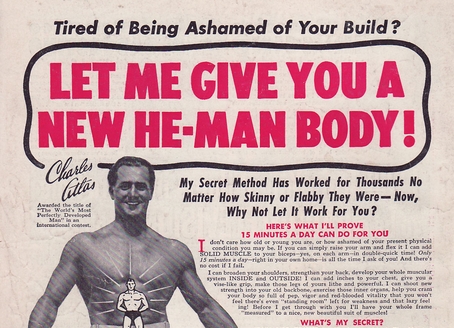
In the 20s, an Italian musclehead called Charles Atlas started selling a muscle building course. “What’s my job? I turn wimps into men!” His comic ads were in every newspaper – a dweeb gets sand kicked in his face by a bully, who calls him scrawny and steals his girl. Said dweeb then invests in Charles Atlas’s magic muscle course, bulks up, returns to the beach, KO’s the bully, and gets his (somewhat used) girlfriend back.
Atlas’s product (“Dynamic Tension”) was a few flimsy sheets showing you how to do isometric holds and static push-ups and so forth. Slightly useful for improving your cardiovascular system, close to useless for building muscle. Did Atlas himself use Dynamic Tension to build his physique? No. He lifted weights. But he knew there was no money to be made in selling barbells and dumbbells.
Atlas was given to calling himself “the world’s most perfectly developed man” which was not a truth claim but a title. In the 1920s Atlas was the winner of a bodybuilding contest in New York (defeating a motley bunch of piano movers and beer hall bouncers in the process). The contest was a financial failure, and the promoter did not host it again. Since nobody could win the title from Atlas, even when he was a frail geriatric he was still technically “the world’s most perfectly developed man”.
In the sixties there was a similar scam aimed at women called the “Mark Eden Bust Developer”, which purported to increase one’s breast size through exercises. These “exercises” took about 22 hours per week. A guy called Arthur Jones tracked down the creator of this system and asked how he’d arrived at that number. His reply was “Well, you and I both know that a few minutes of such exercise a week will produce all of the results that are possible; but when we told women that, we were getting requests for a refund from about forty percent of the customers. But, since we changed the instructions, we are now getting requests for a refund from only about two percent of the customers.”
Back in the bodybuilding world, a pair of Jewish entrepreneurs called the Weider brothers were climbing to ascendancy (Joe Weider was the husband of legendary pinup queen Betty Brosmer, as well as the man who brought Arnold Schwarzenegger to America). Other people might debate whether they were outright crooks or brilliant entrepreneurs – I think they were both at the same time.
Joe Weider wanted everyone to think that he was a muscular superhunk under his cable-knit sweater, and…er…appearances were against him. So he took a sculpture of a bodybuilder (Robby Robinson), and literally replaced Robby’s head with his own. Meanwhile, Ben Weider tried to give their business a scientific facade by talking about the “Weider Research Clinic”, where supposedly every bodybuilding discovery worth knowing was made. It’s well documented that no such place exists. Bob Gadja once told a funny story about visiting the Weider’s headquarters, seeing a door marked “Weider Research Clinic”, and opening the door. It was a broom closet.
Thankfully nobody falls for these scams any more. Anyone want a 0 calorie energy drink?
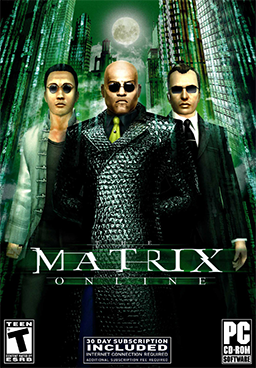 It’s times like these that I remember The Matrix Online.
Back in the day, The Matrix was the shit. Yes, nothing says high quality like fecal matter with a definite article, but the movie lives up to hype. Say what you will about Keanu’s acting, or the apparent plot holes (how does Cypher get into the Matrix, why can’t Agent Smith “hack” more bullets into his gun, etc), the Matrix kicks ass and induces excitement deep in my pyloric valve.
The trouble with success is that it can leave you unprepared for subsequent failure. Four years later, we were watching confused critics struggle with the overlong (and unsatisfying) The Matrix Reloaded. Most of them missed the boat with the first movie, and they were anxious not to seem like out-of-touch old fogeys a second time. The glowing reviews for a mediocre sequel must have struck a chord of “we can do no wrong” in the Wachowskis’ heads, and so they plunged ahead with some very questionable media ventures.
The third, final, and shit awful Matrix movie left a lot plot points unexplained, but that was okay, we were told, because the story would continue with The Matrix Online PC MMO. It probably seemed like genius at the time. You’d play in an interactive world of “red-pilled” humans, with the story of Zion and Machine City and the Merovingian continuing on around you – and you could be an active participant, if you liked. It was going to be the wave of the future, films and videogames becoming an inseparable braid.
It launched. It flopped. And five years later, it was cancelled. At a time where World of Warcraft had ten million subscribers, TMO’s player base had dwindled to just five hundred active accounts. What went wrong?
1. They got Monolith Productions to create the game. I’ve been playing Monolith games since 1997 (not continuously, there were some bathroom breaks), and I speak with authority when I say they’re the most inconsistent company on earth. Blood is good. Claw is good. Get Medieval is bad. Shogo is bad. Blood II is bad. Gruntz is good. Sanity is bad. No-One Lives Forever is good. Aliens versus Predator 2 is good. No One Lives Forever II is bad. Tron 2.0 is good. Contract JACK is bad. FEAR is good. Condemned is bad. And so on. It’s like someone’s tossing a coin.
2. The Matrix Online, by most accounts, falls into the bad column. I haven’t played it, but people tell me that it’s like a spiritual descendant of the two sequel movies – glossy, superficially well put together, but cold, unfocused, and unengaging. Apparently the game had bugs right until the very end. It’s normal for MMOs to launch with bugs. But TMO still looked like an alpha, right up until someone pulled the plug.
It’s an interesting study in the difference between games and movies. The Matrix Online was a bust, and that marked the last time anyone ever made a videogame based off the Matrix. It seems crazy. The Matrix franchise is tailor made for videogame treatment. Many games now copy the Matrix‘s distinctive visual style by default. But with games, you only get one shot.
Meanwhile, the Wachowski’s are sitting on an ever-growing pile of box office bombs, and yet they’ve received a $175 million budget for their upcoming movie. Hollywood still hasn’t caught up to the fact that The Matrix was a fluke and the Wachowskis will probably never do anything worthwhile ever again.