Helloween’s 2007 release sees them reborn for the second time in as many decades. They became the power metal Jesus, except they did it twice. Which makes it even better. (With due respect to J-Man, is it too much to ask to die two or three times, just to put the issue beyond doubt? One resurrection may just be luck.)
It’s among their most aggressive albums. Although it doesn’t have the downtuned crush of The Dark Ride or the demented aggression of Seven Sinners, it’s still a fury. Guitars are thick and rip at you like hypersonic winds. Every song seems on the verge of stripping its bolts with sheer energy. Charlie Bauerfind gives it a rough-and-ready “too much” production style that the songs really lean into.
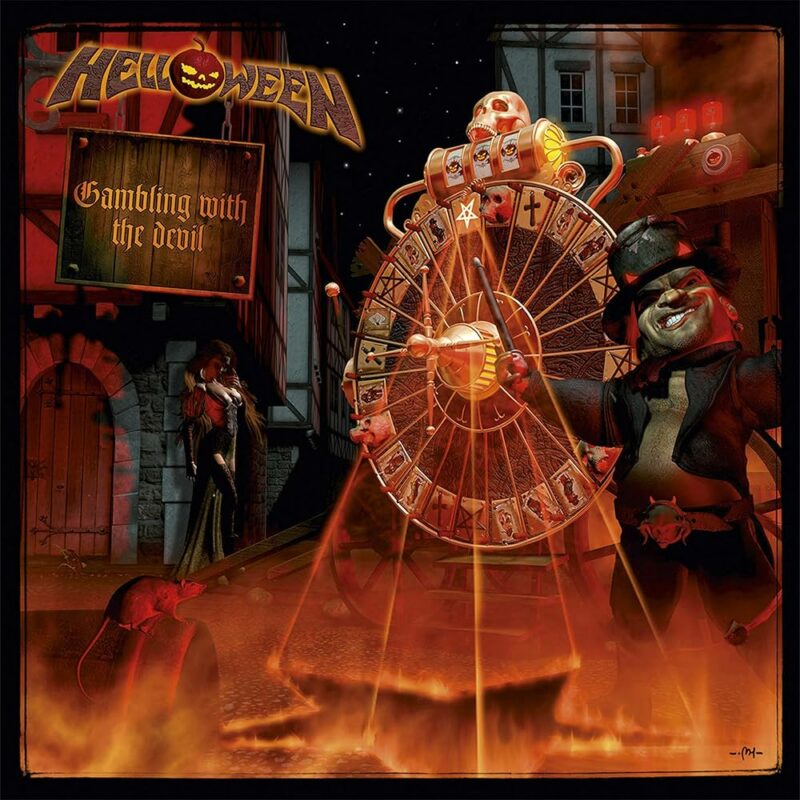
To be clear, Gambling is not a full return to form. There are still too many cooks per square inch of kitchen, some blatantly weak tracks, and far too much fiddling with the dials (the syrupy keyboard tone Matthias Ülmer attempts on “Final Fortune” is a self-conscious modernism that doesn’t make sense with the raw Marshall tone of the guitars). And the album cover is, of course, decrepit. The pentagram on the floor doesn’t even match the one on the roulette wheel. Satan’s leaving their asses on read.
2007 was also the year I began listening to power metal. My first Helloween song was “As Long As I Fall”, this album’s lead single. And I hated it. About two years later, I gave the band (and this album) another try, and realized it was the worst song on the album. There’s some truly sublime stuff on here.
Opening song “Kill It” is so simple it makes “Mrs God” from the last album sound like progressive rock, but it thrashes hard and destroys your neck. The black metal-inspired bridge (??) is a creative idea that absolutely works, which is not something I say often about the band’s creative experiments.
The greatest track of the album—perhaps the greatest post-2000 Helloween song—is the fast and melodic “The Saints”. Someone should piss-test this song. It just isn’t normal. It just explodes out of the gates with heavy, modern riffwork, the verses contort and build, the chorus is straight out of 1989, and the duelling guitar solos showcase every trick Sascha Gerstner and Michael Weikath know as they swing axes at each others’ heads. Anything you could possibly enjoy about Helloween, past or present, is in this song. A marvel.
The lyrics seem to be referencing legal corruption, and are delivered with snarl and bite by Deris. The microphone probably had to be destroyed after he expelled so much venom onto it. He was an unusual choice to replace Michael Kiske, but tracks like “The Saints” make powerful arguments that he was the right choice.
Sascha Gerstner’s “Paint a New World” and “Dreambound” are more speed material, with the second being the better of the two. Deris’s “The Bells of the Seven Hells” is an agitated uptempo thrasher with a diabolic vocal performance. “IME” is another great Deris-penned track, full of angst and piss and rage.
A large pile of bonus songs round things out, some of them better than the actual songs on the album. “Find My Freedom” is a great faster track. “See the Night” opens with “Born into a neighborhood that ain’t exactly rich / Never knew his father and his mother was a bitch!”. Which is, uh, better than I could write in German, I suppose. “We Unite” is another fierce, barnburning anthem.
On the other (more limp-wristed) hand, “As Long As I Fall” opens with an insipid keyboard tinkle that sounds like it was recorded to test sound levels and an awful buzzkill of a chorus. “Helloween plays Christian rock” is kind of a Roko’s Basilisk for me—a concept I don’t need in my head. It’s Deris’s songwriting at its worst, just as “Kill It” sees him at his best. “Can Do It” is another “Heavy Metal Hamsters”—a songwriting well the band continually draws from, never with any success. A blandly brainless KISS-style party rock song, it’s better skipped over. Grosskopf’s “Heaven Tells No Lies” is Kim-Kardashian’s-ass-sized album filler that bounces around for seven minutes. “Fallen to Pieces” is a ballad with a fast section questionably integrated. “Final Fortune” is just a flat line of cliches. There is no way this song took any longer for Markus Grosskopf to write than it took me to listen to.
There’s about 35 minutes of good-to-great material on Gambling with the Devil. And the weak tracks mostly tend to be “filler track” rather than “Helloween playing ska or nu metal”. The house did not win. Not this time.
No Comments »
Comments are moderated and may take up to 24 hours to appear.
No comments yet.