
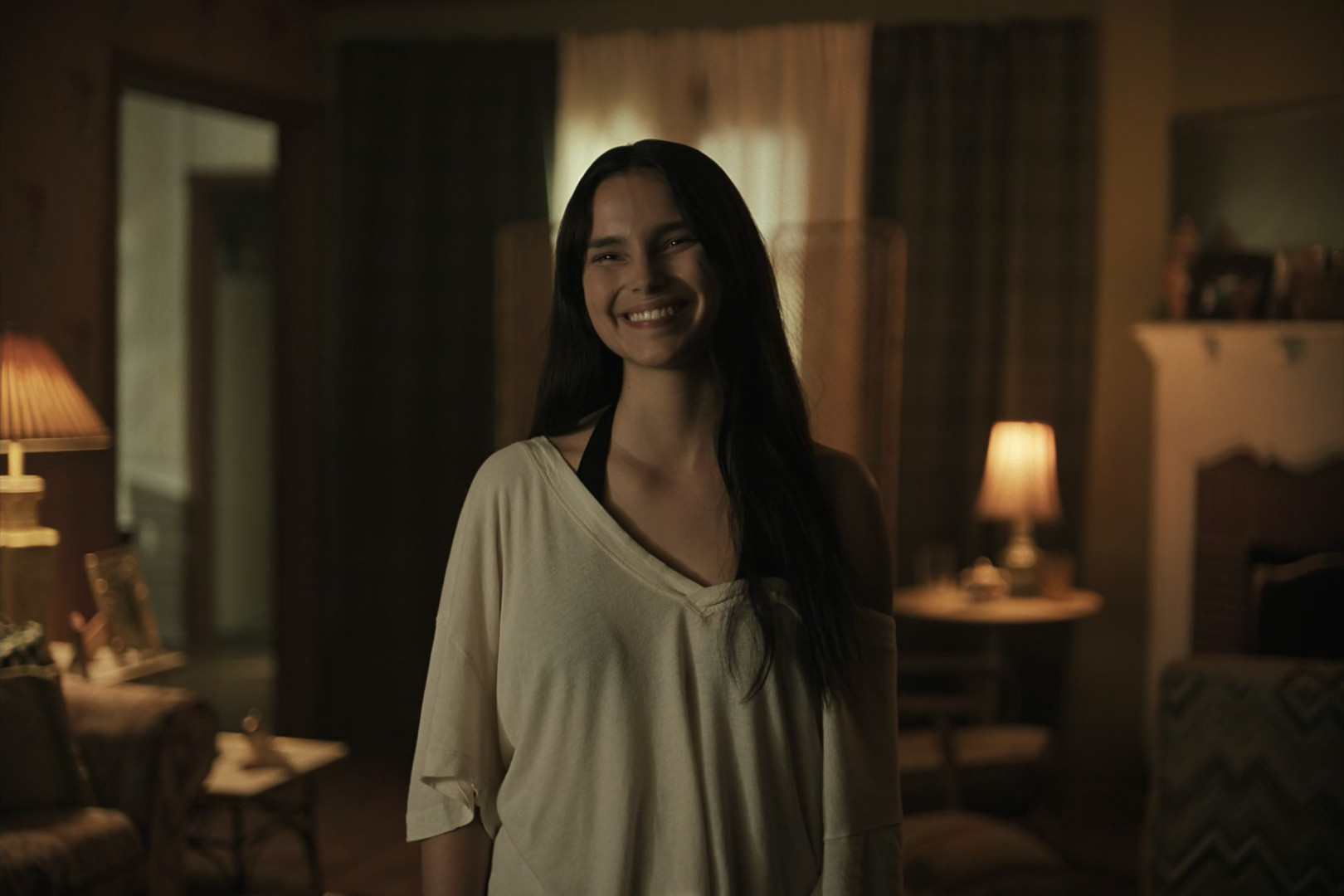
I finally saw Obsession.
Months ago, it was a huge, huge hit. A gigantic shadow, raring on the wall. Hard to tell with shadows, though. Sometimes they’re cast by a moth, batting against a light.
Obsession is a 7/10 movie. In fact, it is 7/10, The Movie: the most 7/10 movie ever made. It is seven and then a dot and then as many zeroes as we can calibrate.
It packs a whallop. It’s scary and tense and charming. But it will be interesting to see the legacy it ages into—already, few people seem to talk about it. Maybe there’s not much to say.
The plot is minimal—a “be careful what you wish for!” story very similar to many Goosebumps books, and Are You Afraid of the Dark, and The Monkey’s Paw. (The director claims to have been inspired by The Simpsons’ Treehouse of Horror II. An interesting fact about the future is that culture is now in the hands of people whose main exposure to iconic stories is in the form of parodies of those stories—I suspect we’ve hit a crossover point where people are more familiar withShrek than the fairytales it’s laughing at.)
It’s hard to describe Obsession’s plot without spoiling it. It’s hard to watch the first ten minutes of Obsession without spoiling it. In a first-ever occurrence, it’s hard to imagine the events the Obsessions’s plot might involve without spoiling it.
The writing and directing are serviceable. Inde Navarette carries the movie quite hard. Her face seems to be wired up with additional muscles that the rest of the population does not have.
Why Has It Made Eleven Trillion Dollars?
The horror genre has spawned many a sleeper hit, but they’re usually not inexplicable sleeper hits. There’s typically an obvious reason why a given popular horror movie is popular. This is not true for Obsession.
It is not formally innovative like The Blair Witch Project, not the beneficiary of a hot new distribution medium like The Evil Dead, wasn’t helped by a moral panic like Cannibal Holocaust and The Last House on the Left, and will probably will not be remembered as a major example of a film movement like Suspiria. It is distinctive in its unremarkability. So why has it become so popular?
A Backlash Against Prestige Horror?
“Prestige horror” refers to the recent surge of horror movies that have (relatively) high budgets, famous actors, cold blue/gray/sepia color-grading, and a lack of fun. Prestige horror desires respectability. It despises and repudiates any connection to “low culture” things like pulp, grindhouse, VHS rentals, porn, or Youtube (except to condescend to them, and show it’s above such tawdry fare). Prestige horror has tense, almost angry aspirations toward being serious art or social commentary.
Quoting from Will Sloan’s review of Helloween Kills:
In recent years (since approximately the release of Get Out), the idea that horror movies can be used to smuggle serious sociopolitical ideas has reached a new level of popularity. As a result, the new Halloween movie climaxes with Jamie Lee Curtis delivering a monologue about how Michael Myers represents the fear that divides society and turns people against each other. That’s right, folks. Michael Myers is partisanship. Michael Myers is horseshoe theory. Michael Myers is Donald Trump and Jeremy Corbyn and the Berniebros and the Capitol rioters. Putting aside how stupid it is, her monologue says a lot of things that are better left unstated, because the thing about metaphors is that they’re supposed to be metaphors. If a character in a Halloween movie starts saying that Michael Myers is a symbol of the fear that turns society against itself, the proper response from another character would be, “Actually, no – he’s a masked man who’s quite literally on a killing spree right now.”
Aside from this, I personally find it a bummer—almost like artistic gentrification—when Hollywood moves in on scrappy, low-budget genres. To me, this “uptown” approach often loses the rampaging energy that makes the genre appealing to begin with. Great horror films generally feel like a pitbull raging at the end of a leash—a force so malign that even the director seems barely in control of the snapping teeth and bulging muscle.
Perhaps others are sick of prestige horror too.
Obsession feels like an anti-prestige horror film. Its budget is small, its actors are or were unfamous, and its aspirations are quite humble. It doesn’t want to change your life. It wants to entertain you for a little while and then let you go. It’s the opposite of Inde Navarette’s character.
But there are other recent trends that Obsession avoids, to its credit.
It’s slow-paced. It’s not an unhinged gorefest or an alienating exposition of “style”. It’s not the You can watch it without thinking about its artistic forerunners, because it basically doesn’t have any.
It feels the way watching a movie did when you were a child, and had little connection to culture. When you were an island, in other words.
But just as a Sentinelese islander who finds a coke bottle is now in contact with an international global brand, Obsession does gesture at some interesting ideas.
Unconditional Love is Evil
If someone says they love you unconditionally, there might be hope. They could be lying. Or maybe you misheard them.
Love with no conditions is evil and abject and monstrous. And it’s also meaningless. Nobody is worthy of that love, and nobody should want it.
Most people who value it have not internalized just how.
You are not thinking about what unconditional implies: love without any conditions at all.
The unconditional lover doesn’t care about you. They assign you no personal subjectivity. They don’t particularly love you for any reason.
Their love is an alien force that has no connection to anything in the real world.
Imagine a person whose adoration is so unchanging that they wouldn’t care if you punched them in the face. Or murdered their pet dog. Or tattooed the entire text of Mein Kampf on your face in really small print and didn’t shake your head even once to show the tattooist you disagreed with it.
An unconditional lover would discover that you have a pile of murdered people in your basement…and they wouldn’t care at all.
Would that love mean anything? As the recipient, would you value it?
It goes further: imagine devotion so total that they wouldn’t even care if you died. Their love is not for you, it’s for the pile of atoms you consist of, and they’d be just as happy to love your dead and rotting corpse (and, presumably, the dirt under your body that soaks in your residue) as your living self. Hell, they might even murder you. Why the hell not? If their love could be impacted by trivial distractions like “alive” or “dead”, it wouldn’t be unconditional.
Obsession is clearly aware of these ideas.
To an unconditional lover, there is no difference between a living, purring cat and a bag of stinking, matted fur, its blind eye sockets boiling with worms.
He reacts with revulsion. He might have loved the cat.
He doesn’t matter to her. His wishes do not matter. He could punch her in the face and she’d still love him.
Whatever lives in “Frikki’s” demon-doll face, it is not love.
Conditionality gives love its power. It’s not a foregone necessity for two lovers to stay together: they can leave at any time and are choosing not to.
Is The Protagonist A Rapist?
First, the facts.
The protagonist purchases a supernatural toy called a “One Wish Willow”. He makes a wish on it, forcing a woman (Nicky Freeman) to love him.
But this is not his original plan. He intends the One Wish Willow as a gift for Nicky. Curry Barker’s original screenplay contains this graf.
“Bear grabs one. “THE ONE WISH WILLOW. SPARK THE MIDDLE AND BREAK IT IN HALF!” He flips it over. “You only get one wish, so make it count!” Bear smiles; Nicky’s gonna love this.”
After an awkward interaction with Nicky (she gives him an extremely obvious go-signal, he fumbles it), he’s left stewing in his car, alone. Frustrated by his inaction, he snaps the One Wish Willow in half and makes his own (“half serious”, according to the screenplay) wish.
I wish Nicky Freeman loved me more than anyone in the fucking world.
I don’t think this makes him a rapist.
Because he did not actually think the One Wish Willow would work.
The world of Obsession is not a fantasy world where wishes come true. It is (apparently) an unmagical one like ours. Bear surely knows that if One Wish Willows granted wishes, they would not be allowed to sell them in stores. They would be tightly controlled by the government, or something.
“But then why did he make the wish?”
Because he was blowing off steam. Because he was angry and in pain and needed an emotional release valve.
The One Wish Willow was not a dastardly plot to control Nikki Freeman’s mind. He just wanted to feel like he was in control for a few seconds.
A child who stamps their feet and yells “I WISH MOM AND DAD WOULD DISAPPEAR” does not want mom and dad to disappear. Even if, for a few seconds, he thinks he does. It’s emotionally satisfying—if hollow—to enact a fantasy where you have power.
Nikki kisses him. How does he react?
“What the FUCK WAS THAT?!”
…He’s surprised! Shocked! Confused! Because he didn’t expect his wish would work!
Basically, Bear is in the same situation as a man who gets fired by his boss. He storms out and mutters “I hope an anvil falls on your head, you jerk…” An overly helpful alien overhears him. SPLAT.
Would we say “the man killed his boss”? Yes, in a sense, he did. But emotionally, we do not regard him as guilty of murder.
In the same spirit, I do not regard Bear as a rapist.
Nostalgia For A World Unremembered
This movie portrays the past.
Yes, technically all films portray the past: even a livestream of a gamer saying the dreaded N word (meaning “narraag̉iitchuk”, Iñupiat Inuit for “has abdominal cramps”, which as we all know, white people have no right to use, ever) offers a window into the world of a few seconds ago.
But more seriously, Obsession depicts the unending cultural past that pop culture seems to be stuck in.
The Simpsons is a perfect example. This is Homer’s car.
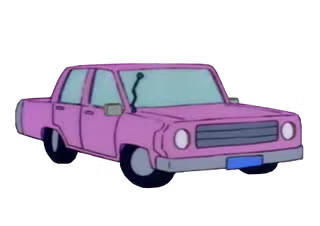
Cars do not look like this anymore. This “three-box” sedan look has gone out of fashion: everyone drives a SUV or a hatchback now. Cars no longer need a big radio antenna. You can listen to the radio via Bluetooth on your phone if you want (which you probably don’t.) Homer’s car is a Plymouth, a brand that hasn’t existed since 2001.
Notably, the Simpsons is still nominally set in the present day is (mobile phones and so forth exist, as does Lady Gaga). But its stylistic trappings are stuck in the past of 1990 or so. Homer’s car will look like this for eternity.
Obsession is the same. Despite a few half-assed modern signifiers (a Reddit lookalike, a ChatGPT lookalike, “I don’t wanna get some Karen to…”) everything in it is an artifact from the past.
- Everything looks retro. The bar is old-fashioned. Bear’s car has roll-down windows. There’s a lunchbox with Polaroid photos inside.
- the characters work together in…a musical instrument store? That feels like a 90s setting. Today, such stores are mostly dying or dead. Would such a tiny location drum up enough foot traffic to employ a rather large staff of young people with company shirts and so on? People don’t really form bands or play physical instruments. They make music on laptops. Or on Suno.
- The plot device of young people going out to “grab drinks”, and being passionate about trivia night…while not wrong, it does seem out of step with most of the young people I know. Interests have fragmented down a thousand weird, polarizing rabbit holes, away from public places like sports bars. Bear would be the mod for a Europa Universalis V fan wiki. Nikki would have a femcave where she goons to fujoshi brainrot.
- The regard One Wish Willows are held in (they don’t work…except maaaaybe they do? Woooo!) feels very “90s”: reminiscent of the days when nobody had internet access and thousands of weird urban legends about the hook handed man could spread by word of mouth.
It’s an interesting choice how everything is a thing that exists as a pop culture concept, but not necessary as a thing in real life anymore.
It’s also interesting how the director was born in 1999, meaning he has likely no firsthand memory of the things he’s referencing. It’s all just stuff he saw on TV/movies/Youtube. (Backrooms is an even more extreme example: “liminal horror” and the 90s VHS aesthetic as presented by a 21 year old who was born four months after the creation of Youtube.) Can you feel nostalgia for someone else’s memory? Someone else’s world?