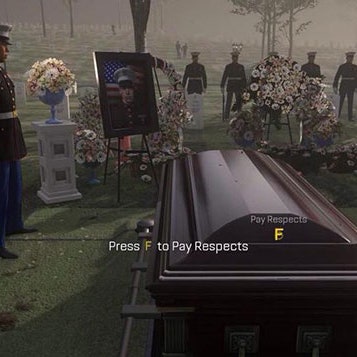
I don’t know. But the most inexplicable trend is the game that doesn’t want you to play it.
You are led by the nose down a path, having scripted experiences. Every choice has been made for you in advance. Stray from the path and you’re corralled back in by invisible walls or flashing “RETURN TO THE BATTLEFIELD” messages. Cutscenes are immensely long: you spend half the game with your inputs disabled.
Any “interactivity” is inconsequential: you can choose from two paths in the road, but both lead to the same destination. You can choose from two options in an NPC dialog tree, but the conversation ends the same way every time.
…Doesn’t this defeat the whole purpose of a videogame? Being able to explore and interact and express agency? Games lose a lot when they’re reduced to booklike narratives where the player’s “actions” are just fancy ways of turning the page.
This is not a “games were better in my day!” rant. The worst offenders in this category are actually classic games, particularly the adventure games of the 80s and 90s.
Remember adventure games? Like The Secret of Monkey Island and Leisure Suit Larry? Remember how, around 1995-1996, everyone suddenly stopped playing them?
“The death of adventure games” was a popular journalistic brief in the late 90s. Writers filed many a column inch about why adventure titles weren’t selling, and why the old guard of developers (Sierra/LucasArts/Trilobyte) were either shifting focus or filing for bankruptcy.
Always, an outside factor is blamed for killing the genre. Adventure gamers love Lost Cause myths where their beautiful, pure genre were ruined by Myst and Doom and Nintendo and arcades. Nobody wants to admit that the rot started within.
Here’s the truth: most adventure games (aside from a short list of classics) were actually total shit, full of illogical puzzles, mazes, pixel hunts, fetch quests, and arbitrary deaths. Here’s the average puzzle in a text adventure:
You are hungry! You find a HAM SANDWICH and a
TURKEY SANDWICH. What do you do?

>EAT HAM SANDWICH.

You are dead! It was a POISON HAM SANDWICH! Should have gone with the turkey, dumbfuck! Load save Y/N?
That’s not a strawman. Half the games Infocom ever made were exactly like that.
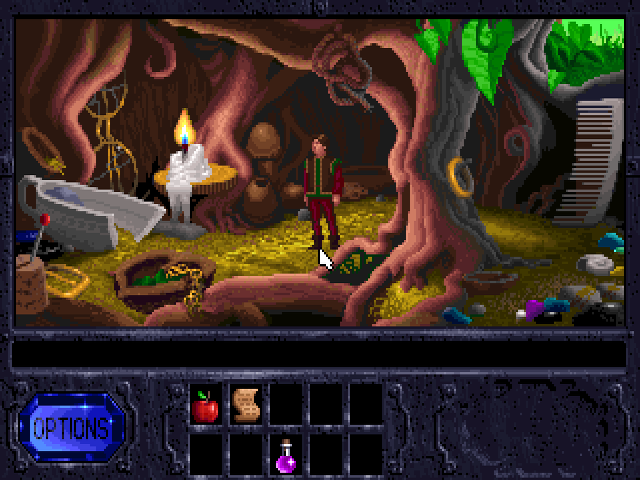
Just because I love you, here’s a real example from Westwood’s critically-acclaimed The Legend of Kyrandia, which sold quarter of a million copies in 1996.
Imagine this:
You are standing outside a house, looking down into a lake. You see a pair of eyes in the water. When you approach the water’s edge to get a better look, a huge monster rises from the water, snatches you with its tongue, and reels you into its mouth. Crunch.
Terrible. A whole Full Sail game design course could be taught about how utterly bad this puzzle is, in every conceivable way.
There’s no warning of danger, no possibility of escape, and the outcome for the player is death. There’s no skill involved: you just have to know not to follow the eyes. And since you can’t anticipate the next death trap (which there are a lot of), you end up creeping around Kyrandia like a scared mouse, hoping you don’t step on any Instant Death Pixels(tm).
The Legend of Kyrandia actively penalizes you for playing it. Exploring? Taking risks? That’s not in the plan. Stick to the main path, friendo, and do what the game wants you to do.
This design approach is great from the developer’s point of view. You spend less time designing art assets and playtesting puzzles. Your games ship sooner, and have fewer bugs. Open-world games with a lot of options quickly turn into a garden of forking paths. But in the long run, you get a constrained experience.
It’s interesting that the big genre shifts of the past few years have included open-world exploration games like Minecraft, and battle royales like Fortnite and Apex Legends. These are games where every experience is different. It’s not a surprise, in hindsight. Players, by definition, want to play. They don’t want to be conscripted characters in someone else’s story, and that’s exactly what many major games are.
I’ve long felt that the “are videogames art?” debate elides the obvious point that the “art” of videogames is usually just cinema, at best. Playing a Triple-A game is largely indistinguishable from watching a movie. The strongest claim games can make to being an art form are titles like Cosmology of Kyoto and Rez…
Forums are an unkillable zombie from the old internet, on the edge of complete irrelevance for ten years and counting. Predict the demise of forums and they predict the demise of you; we might never be free from BBCode, and signature lines, and people raping the page’s margins with 20-megapixel photos directly off their cameras.
Webmasters hate forums. They require constant maintenance, weaken your site’s security, and break your heart. They’re notoriously unprofitable: users load and refresh countless pages (wasting bandwidth), but this isn’t considered traffic by Google and won’t help your search engine rankings. Additionally, science has yet to find one example of a forum user clicking a banner ad.
There’s no way to win with forums. A dead forum is an embarrassment to your site, like throwing a birthday party and having nobody come. A successful forum is even worse – an accretion of egomaniacs and Little Emperors, cults and factions and politics, with moderators shamelessly playing favorites. Eventually a gang of jaded, old-school users will buck the rules, get mass-banned, start their OWN forum without any FASCIST JACKBOOTED MODERATORS, and do everything in their power to burn your original forum to the ground.
Many forum users (and owners) manifestly hate the place. They can’t leave. They’re prisoners. They’ve shaped the forum, and it’s shaped them in return. They’ve turned into lifers, and they have no idea how to survive outside the Vbulletin bars, even when the forum has turned toxic.
Which brings me to the latest Thing(tm) to hit the science fiction publishing world: an expose by Jason Sanford of violent rhetoric in the forum known Baen’s Bar.
Baen Books is a science fiction publishing house founded in 1983 by publisher and editor Jim Baen, a man with a talent for developing franchises (and individual authors) into profitable properties. He was also technologically well ahead of the curve: Baen was publishing electronically five years before Stephen King wrote Riding the Bullet. Although not explicitly political, the house is generally seen as a bastion for “old school” Heinlein-style adventure SF, which has a more conservative readership than the fandom as a whole.
It also has (or had) a forum. I’ve never read or posted on it, nor did most of the other people holding opinions on the scandal. Straight away you can tell the dialog’s going to be an open running sewer, with people forming judgments based on out of context quotes and screencaptures, and analogizing the drama to GamerGate or Tiananmen Square or some shit. David Chapman’s essay on Geeks, MOPs, and Sociopaths may be relevant. While you should be aware of outsiders exploiting the controversy (and your ignorance) for their own gain, some facts can be ascertained.
[…] just under 1,100 users have made more than 100 comments on the Bar since December 2011 […] And only 8,000 users have made a single comment since December 2011.
This is interesting from a network theory perspective. Online communities typically follow Zipf’s law (Muchnik et al, 2013), with the top 20% of users contributing 80% of posts. Baen’s Bar appears to a skewed ratio of casuals to super-users, indicating a forum that engenders a lot of loyalty.
Baen’s Bar was a small forum, but an unusually “sticky” one. This is a marketer’s dream. You’ve got a warm-network brand! People who will never leave! But it also has a dark side: when users cross a line, it’s hard to rein them in.
After all, they’re your friends.
As far as I can tell, Baen’s Bar suffered the fate of every forum. It aged, and became a parody of itself. As the forum became more and more Baenish, with everyone who wasn’t a true believer slowly falling away, they lost track of how weird they looked to the outside world. Which was fine…until someone screencaptured their worst excesses and broadcasted it to the outside world.
Recent events have brought this to a head. In 2021, Trump got mad that he lost an election, and told people to march to Capitol Hill, whereupon they broke into congressional offices, and bumbled around smashing things. I won’t express an opinion except “it was funny”. Our elected leaders are too big for their britches, and it’d do them good to clean a homeless man’s shit off their desk every morning. You might disagree with the protestors’ methods, but at least they took a stand.
However, some people (pro and against) think it was more than an amusing and freakish event, and represents an act of cultural revanchism of some kind. Baen’s Bar became venue to some heated talk, and some members said things that could be interpreted as calls to violence. Then, suddenly, it all came spilling out. Baen’s insular forum culture was revealed.
I don’t like the exposé very much. It’s sloppy with facts (“5 people were killed”), misrepresents posts to claim that they’re racist (“all the angry and non angry white males should stop going to work for a month or so” is clearly referring to a NY Time piece describing white males as Trump’s army, and it’s hard to see how the second quote is racist), and generally elevates molehills into mountains. And the most important part of analyzing these screencaps – the context – is absent.
For example, a Baen’s Bar user from India was nicknamed “The Swarthy Menace” on the forum by author Tom Kratman
Was this a racial insult? A joke between friends?
“The militia – again, a _well_armed_ militia – is necessary to present a threat in being to the powers that be such that, should they use extra-, pseudo-, and quasi-legal means to try to suppress the party, the price presented will be far too high.”
This quote (again by Kratman) is too weaselly and unspecific to mean anything. Of course a militia should be capable of resisting tyranny. Otherwise it’s not a militia, it’s a gun club. Who’s threatened by this?
I concede, however, that there are quotes that sound scary. Talk of blowing up buildings, and such.
But part of assessing a threat is understanding the venue. Is Baen known for being used as a staging ground for terrorists? Or is it full exaggerated shit-talk and LARPing? “Does it matter?” Of course it matters, dumbass. Terrorists blow up buildings. Shit-talkers don’t blow up buildings. How could it not matter?
I wish people wouldn’t pretend there’s a difference between real threats and fake ones. On Reddit, it’s very easy to fall down a rabbit hole on that site and end up in a comment thread full of radical leftists/tankies/anarchists posting what most people would regard as murder fantasies. I should have saved some posts when /r/leftwithsharpedge was still on the site, it had some real gems. There’s still threads like this, with the title “[GUILLOTINE SHARPENING NOISES]”, and comments like:
Mao: Not the hero we deserve, but the hero we need.
Guillotine? How about just a bat with nails for this one?
rope is cheap and widely available. lampposts and trees are plentiful.
I disagree. I want a spectacle, let’s get them thrown into volcanoes.
All we need a truck and some strong rope.
Landlords aren’t people.
Are these comments a credit to the people making them? No. Are they credible threats? Probably not. They’re people letting off steam, in a venue where everyone’s trying to out-edge each other. Would Reddit be justified in removing them? Yes. Is it a human rights crisis that they haven’t? No.
This +3800 thread on /r/socialism advocates an armed revolution, but mysteriously hasn’t attracted widespread media attention, condemnation, calls for Reddit’s CEO to get disinvited from SXSW, etc. This isn’t a forgotten thread I’ve picked out of some tiny subreddit. +3800 upvotes means it was pretty close to appearing on the front page of the site.
But nobody cared. And they were right not to. These words were not serious. That’s the main issue under consideration: are these “threats” on Baen’s Bar any more substantial or interesting than symbolic posturing, like a Twitter leftist with a guillotine avatar saying “eat the rich”? I don’t think they are.
So the expose has problems, and avenues of counterattack. But the reaction from the forum’s defenders has largely been to shoot themselves in the foot.
Baen’s publisher Toni Weisskopf had a hard row to hoe. If she deletes the mentioned posts and bans the offenders, her users will perceive this as a craven surrender to a bully’s demands. But if she ignores the expose, it will be spun as a further endorsement of violence.
She tried to have it both ways, temporarily closing the forum pending an investigation while refusing to condemn the violent threats. “We take these allegations seriously, and consequently have put the Bar on hiatus while we investigate. But we will not commit censorship of lawful speech.” She might have hoped that the scandal would blow over in a week, and she could reopen the Bar without doing anything. This approach blew up in her face, and caused her to lose her Guest of Honor spot at the 2021 Worldcon.
As I’ve said, you can’t win with forums. In chess, zugzwang is when you’re forced to make a bad move, because there’s no other way. Jason Sanford put her in zugzwang on February 15. There was no way she could have responded without suffering reputational damage, either from the SF community at large or from her own fans.
The smart thing to do, of course, would have been to never allow posts like that on Baen’s Bar to begin with.
But moderation is tricky, particularly with regards to powerful, respected users who are also personal friends. Forums founded on an ethos of “everything goes!” are generally moderated as little as possible, and this establishes precedent that’s hard to break. Like a roof with a hole in it, “everything goes” only seems fine until it starts raining. Moderation is almost always necessary, regardless of your friends’ feelings.
I’ve seen some attempted defenses of Baen’s Bar, and they’re not impressive.
Eric Flint provides an inspired masterclass in missing the point and arguing about the wrong things. Nobody cares whether Sanford is unfairly characterizing Baen’s Bar as conservative. Nobody cares whether Baen’s Bar is conservative to begin with. The forum could be the online wing of the Neo-Maoist Coalition. The point is that it contains threats of violence.
Nor is it a good idea to dismiss threats just because they’re logistically difficult to carry out, as Flint does. This is like arguing “the plaintiff falsely claims I beat my child with a lead pipe, but actually my child-beating pipe is made of aluminium” – this is the worst ground possible to stake an argument on. Also, the discussion is about Baen’s Bar, the forum, not Baen Books, the publisher. Saying that Baen Books publishes socialist/left wing authors is neither here nor there.
Larry Correia’s response is buzzword-loaded but writes checks it can’t cash. “[…] complaints were filed with the various internet companies Baen uses for services to pressure them into kicking us off the internet.” Is this true? I don’t know. Is it proof of a co-ordinated conspiracy? Simpler explanations are at hand. “I’m not going to talk about the moronic loser or go through all the nonsense in his ridiculous hit piece.” That’s a shame. Why even write the post then? David Weber’s defense on Facebook (“there is no way in hell that the Barflies, as they are affectionately known, are advocating for political violence”) rings hollow in light of the quotes Sanford posted. They need to be specifically addressed. You can’t just pretend they’re not there.
One last note: I’m not a conspiratorial person. But my twin from another dimension is, and he just said “this is how you kill Baen’s Bar”.
Forums don’t always die on their own. Sometimes they’re poisoned by an outside source. Old newsgroupers still talk about Eternal September, when AOL began offering free Usenet access to its subscribers, causing an influx of annoying n00bs that overwhelmed existing newsgroup culture. In 2009, xkcd described how author Stephanie Meyer could nuke 4chan from the internet by mentioning it in her next Twilight book.
And now, the word on Baen’s Bar is that it’s full of right wing lunatics.
It’d be interesting to see Baen’s Bar post-expose. Barring a new moderation strategy, I don’t see it ever getting better. New registrants will be culture warriors and people with a grievance, they’ll drive moderates out, the rhetoric will become more extreme, and eventually they’ll get a person who isn’t a LARPer. Curtains for the forum.
Baen’s Bar might not even be worth bringing back. Even if it wasn’t the far-right rat trap Sanford describes, it will likely become one now.
[Q. Why do forums still exist, given the existence of splendid social media sites like Parler and Voat and Pewtube?
A. Because of gravitational forces. Forums are like planets, you can lightly skim the outer atmosphere and escape, but once you actually land on one it’s very difficult to leave. You make friends, build a “reputation” (a useless one), participate in shared events and collective history (“remember when us brave Tails-Slash-Fanfic.org forumers stood against the Sonic-Anal-Freaks.net invasion of 2003?”), and soon you’re kind of held there by inertia. And if this is how a user feels, think of how much more compelling it must be to be a forum owner.]
1. The Beatles fandom is surprisingly forgiving toward its historic villains.
Yoko Ono was rehabilitated years ago. It’s difficult to believe that anyone ever resented Linda Eastman. Alexis Mardas is remembered as a lovable kook.
Allen Klein is a more difficult case: his current status is “slightly shady chap who nonetheless made lots of necessary decisions and helped save the Beatles from ruin.”
I wonder who will post the first unironic “You know, we’re really a bit hard on that Mark David Chapman bloke…”
2. Who broke up the Beatles?
The Beatles formed in 1960 and lasted until 1970, when they severed relations under a metaphorical cloud and possibly also a literal cloud (Paul was known to quote partake endquote). Any chance of a reunion ended in 1980 with John’s death.
But that’s only ten years of breakup. It pales into insignificance when you consider the years prior to 1970 in which the Beatles were broken up, because they hadn’t formed yet.
There’s a strong argument that they were more broken up in 1900 than in 1979. In 1979, they could’ve theoretically gotten in a room and played together. But in the year 1900 the Beatles were broken up so hard they hadn’t even been born. In 1700s their instruments didn’t exist. In 10,000 BC music didn’t exist. 1.4 x 10^10 years ago the carbon composing their bodies didn’t exist.
The further back you go, the more broken up the Beatles become. Ironically, the Beatles weren’t broken up at the beginning of the universe, when all matter was overlayed in a single point. The Beatles existed in that point, as did all of their music and all of their fans and the bullets killed one of them and the cancer that killed a second. But then the point released its energy, and the tragic Beatles-less aeons began.
To answer the question: God himself broke up the Beatles. He caused the fourteen billion years of creation and ensured that the Fab Four only existed in ten of them.
3. What’s the greatest Beatles album?
It’s unthinkable in 2021 to say Sgt. Pepper’s Lonely Hearts Club Band. Maybe you actually like that one the best, but it’d be like picking Ziggy Stardust as the best Bowie album or Dark Side of the Moon as the best Pink Floyd album. You’d look like an milquetoast, risk-averse idiot, following the herd. The point of these “what’s your fav?” questions is to display the sophistication of your tastes.
Abbey Road or Revolver or Rubber Soul? Those are still too popular and well-loved. The WhiteAlbum? Let it Be? Then there’s the opposite problem: you’re obviously trolling, trying to get a reaction. One of the first five albums? And announce that you’re a lobotomy patient who only listens to pop songs and doesn’t appreciate psychedelic 9/8 sitar anthems about monkeys fucking etc?
So what’s left? We’re running out of albums. I’ve given this important matter several seconds of thought and reached a conclusion: the greatest Beatles album is The Rutles (1978) by The Rutles.