While walking in a desert, in the river of shade flowing between two dunes, you find a shape in the sand: a long stroke, capped at both ends by a much shorter stroke. What is it? Hard to say. It could be many things.
Then you find a second shape, a circle with a short, right-leaning stroke bisecting the lower right edge. It’s obviously the letter Q. Remarkably, you now recognise the first shape: the letter I. One shape is meaningless: two causes meaning to flood into your head.
The Harry Potter books were like that. Written by a single mother drawing a £70 a week welfare cheque, they weren’t an overnight success. You probably only heard of them after Book 3 came out, by which point it was impossible to not have heard of them.
Even after it became a global phenomenon, Harry Potter confused a lot of people, particularly your parents, teacher, and youth pastor. What sort of book lurked between the covers? The premise was easily understandable – boy discovers that he’s a wizard – but were they children’s books? Young adult adventures? Fantasy stories? Gateway drugs into black magick and the occult? Did you file Harry Potter next to Roald Dahl, The Saddle Club, or Aleister Crowley?
The first book’s marketing reveals this confusion. Would children buy books written by a woman? Better initialise her name, just to be safe (Harry Potter fans used to lord over the rubes by saying “Joanne Kathleen” as loudly as possible). Her American publisher thought that Philosopher’s Stone was dry and static, and released it as Harry Potter and the Sorceror’s Stone. They probably expected a turkey: the book was of near-unpublishable length (kids don’t read books that are 300 pages long) and it was also too British (American children won’t understand arcane Limeyland terminology like “ice lolly”, et cetera).
By Book 4, Harry Potter made a lot more sense. It was a heroic coming-of-age epic with elements of the fantastical. Being a new Harry Potter fan at this point was like tuning in to a song partway through the chorus – you tried to enjoy the moment while hastily backfilling your knowledge about the first three books. But for most of us, it was entertaining backfilling. Virtually everyone who reads the Harry Potter books all the way enjoys them greatly.
But to break butterflies under the wheel…what’s good about them, exactly?
JK Rowling has weaknesses as a writer: virtually every “he/she said” has an adverb clinging to it like a parasitic tick (“she said sharply”, “he said heavily,” “Harry said desperately”). When she describes something she provides cliche: eyes like dark tunnels, legs as thick as tree trunks. Her books (including this one) are often plotted around some piece of secret information that, once revealed, isn’t as interesting or important as its place in the story would suggest. Her worldbuilding is fun but unserious – nobody in a world of magic would need to wear glasses, for example, nor would they use flaming torches for light.
But she has strengths, too.
She has Evelyn Waugh’s ability to make anything funny or interesting: even if a character is sitting alone in a room, we get a wry observation about the room. Some passages are hilarious: I enjoyed rediscovering all my favorite lines in a recent re-reading. “Scars can come in handy. I have one myself above my left knee that is a perfect map of the London Underground.”
She also possesses Waugh’s talent for effortlessly establishing character. Sometimes it takes her a single sentence – “Mr. Dursley hummed as he picked out his most boring tie for work” – while sometimes she takes a little longer, like a boxer wearing down an opponent. The headmaster Dumbledore is a good case. When we first meet him, he seems like God, all-knowing, all-powerful, and all-benevolent. But in later books (and even a little in this one), his benignity is tempered with slight dishonesty. He is a man who might tell a lie, if he decides the truth is not in your best interests.
Much of Philosopher’s Stone takes place in a classroom, which enables JK Rowling to kill two birds with one stone (we get exposition and worldbuilding from a teacher, while whispered conversations among students advance the plot). The classroom scenes are the workhorses of the Harry Potter books, a delight to read, and it’s always a shame when one ends. Harry’s first encounter with Severus Snape, the sinister Master of Potions, is a masterclass in character dynamics: we clearly see his resentment of Harry, his desire to publicly humiliate him, and a shuttered past that Harry can’t possibly know about but has to bear the brunt of anyway.
“We clearly see” applies to most things in Harry Potter, because JK Rowling writes some of the clearest prose I’ve ever seen. Despite the convoluted plots, you always know what’s happening in Harry Potter. Granted, it might be “something mysterious” or “something Harry doesn’t understand”, but we always, always, always understand the action described on the page. George Orwell compared prose to glass: stained glass windows are pretty, but you can’t see through them. Good writing is like transparent glass, providing a clear window into the action. JK Rowling’s prose is 99% transmittance 9H tempered glass.
The first book is the roughest, and tonally the most unique. There’s more whimsy than the later ones, more surreality, and less adherence to logic (certain elements, like ghosts and paintings that talk to you, would hang uneasily in dramatic stories were death is supposed to be final). You can see all the roads the Harry Potter books could have gone down, from Dahl to Amis to Milne. Perhaps JK Rowling herself was still uncertain about what Harry Potter was, but it was very clearly something.
Have you ever read a book or watched a movie that was edited by a machine?
I don’t mean “edited by a human using a machine”. I mean the technology itself decided which parts to excise, which parts to keep, which parts to change and how.
I once backed up an old hard drive which had begun to demagnetize. The photos are still viewable, but many are corrupt. Lines of pixels rip my face to pieces. Family photos are half-submerged in a fluorescent vomit sea.
The music files are worse. Many mp3s cannot be opened. The handful I can still play are filled with crackles, pops, squalls, and static. Sometimes I get halfway through, and then VLC Media Player crashes.
It’s a reminder of just how much is possible in the universe, and how little of it makes sense to the human mind. A couple of random edits on my hard drive transformed the familiar into the alien. We have used machines to reshape the world and make it comfortable…but what happens at the margins, when machines obey chaos and entropy instead of us? Will we survive, with our fragility? Will we want to?
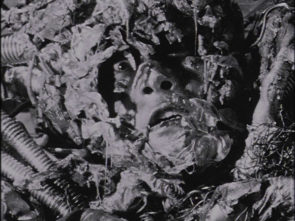
Machines don’t just alter pictures, they also alter bodies. Car crashes sever limbs, blunt-force trauma breaks bones, bullets spin red helices through flesh. Tetsuo – The Iron Man is an intense Japanese experimental film, directed by Shinya Tsukamoto, about a man whose body seems to be turning into metal. It is often called “cyberpunk”, but that evokes images of neon-lit bars and chrome-hipped razorgirls. Instead, it’s more about the fragile, brief period where humans still rule and machines still don’t…yet.
Tetsuo is overtaken by a sense of fatalistic doom. The man’s fate is hopeless. He’s transforming, turning to metal like a junkyard Midas, and so’s the world around him. Tokyo used to have buildings made of cypress. Now, skyscrapers stand everywhere like tombstones. There’s no going back.
Even the human scenes have a lingering impression of the mechanical. The protagonist receives a phone call that consists of him and a woman saying “Hello?” meaninglessly at each other, like two modems failing to connect. As he does so, he awkwardly “reads” a newspaper by holding it an inch from his face, like a robot over-literally following instructions on how humans read. These are dramatizations of the 21st century, where we are so entwined with our tools that they hardly feel like tools. Soon, the tail might be wagging the dog.
Like David Lynch’s Eraserhead (probably a big influence), it’s shot in black and white, filling the frame with a chiaroscuro of palpitating metal. The editing is kinetic and violent, ratcheting from cut to cut. The soundtrack sounds like a set of Ginsu blades spinning inside a tumble dryer. There’s liberal use of stop-motion animation, which gives the special effects shots an epileptic jerkiness.
Tsukamoto directed two films before and two films after – all variations on the same theme – but Tetsuo: The Iron Man seems to have stuck around the longest. Its filming was a bad experience for him, marked by many production difficulties and most of his crew walking out. Maybe he wants to forget he made it. I won’t forget seeing it. You do not watch this film. It rams itself through your head with the force of a diamond-tipped drill, flinging corkscrews of brain matter out of the exit wound. The ultimate machine edit.
“Commencing countdown, engines on (five, four, three)
Check ignition and may God’s love be with you (two, one, liftoff)”
There are no American flags on the moon.
The crew of Apollo 11 placed six on the lunar soil. They were symbols, invested with meaning. But they were also cheap flags bought at Sears. After fifty years, harsh ultraviolet rays have bleached them entirely white. All their vexillological meaning is gone, erased by the sun.
David Bowie was like those flags. He seemed to transcend humanity, but he didn’t, he was made of flesh, and in 2016 he died. Four years later, the phrase Dead David Bowie still seems fundamentally and grammatically wrong, like a paradox. He cannot be dead.
Blackstar entered the world two days before Bowie left it. He would have suffered through its recordings, but this can’t be heard in his vocal performances, which are powerful and strong, or his arrangements, which are transcendentally detailed and elaborate, performed by Donny McCaslin’s jazz band.
The most noticeable thing is the musical approach, which is different to anything he tried before. Station to Station might seem like an obvious comparison. There’s a long song at the beginning, and some pop songs at the end. But musically it represents a clean severance with the past. He’s gone longer than the title track, and more literary than “Sue (or in a Season of Crime), and catchier than “I Can’t Give Anything Away”, but this particular fusion of elements feels unique, both within his catalog and outside it.
Blackstar has no nearly rock influences: when electric guitars are heard, they exist as pure tones – a vaccuum cleaner or AC unit could have served the same function. I only place hear distorted guitars is on “Lazarus”, where dirty chords smoulder like hot coals on grass that’s slightly too damp to catch fire.
Instead, Blackstar is an album of jazz, electronica, pop, and perhaps three or four genres that only exist in New York. This ambitious approach is seen most clearly on the nearly 10 minute long “Blackstar”, which is propelled by shuffling snare beats and strings, and sounds both final and uneasy, like a monument built on a crumbling cliff. “‘Tis a Pity She Was a Whore” has a deranged energy not unlike the Manic Street Preachers, although without as many layers of guitars. But there’s an element of quasi-improvisational looseness that’s missing from past Bowie classics like Low, which are the result of perfectionism. “Whore” and some of the others sound recorded quickly (I have no idea whether this is actually the case), as though there was a spontaneous energy that Bowie wanted or needed to capture.
The album trails off in quality a little towards the end, and at times Bowie seems a distant presence among the instrumentation. But the great songs truly are great, both for their music and what they portend. Despite his passing, Bowie was a blessed man: he got to write his own legacy. Few encomiums have Blackstar‘s directness and connection to the source.
Earlier, I described the sun as hateful for destroying the flags. But is it really? The flags got there because men put them there. Men who traveled by a rocket powered by compacted algae. Algae that fed upon photosynthesis provided by…the sun. Everything exists as transformation of the sun’s energy. You can’t curse the sun for erasing the past, because it also creates the present. Bowie understood this. He knew that someday he’d be a long dead icon, his humanness erased and forgotten as new days come and new legends get to walk in the light. This was fine. All he could do was try to have the final word.
The Elton John song “Candle in the Wind”, which (after a dead princess and a meretricious rewrite) became the biggest selling single in history, purports to be a memorial of Marilyn Monroe. I always found it disingenuous and creepy. Norma Jeane Mortenson inhabited roles created for her by men all her life, and now here were two more men, asserting their right to write the definitive story of who she really was. Maybe Elton John and Bernie Taupin meant well, but the song makes my skin crawl. Shouldn’t Marilyn Monroe herself be the one writing this song?
Blackstar is exactly that: a self-describing legend who doesn’t need interpretation or reification. Not that people like me don’t try, but we do so at our peril. Bowie has told us exactly who he is here: and if it’s a confusing picture, maybe that was the truth all along. Musically, Blackstar is good and debatably great. But as a final album, it virtually couldn’t have been better. He may have wanted to write more songs, but at least he got to write the last one.