The band[1]Sascha and Loble aside was nearly in their fifties when they wrote *Seven Sinners*. Fifty’s quite an age to be playing in a band called “Helloween”. That thought would probably occur to you during band fights and label disputes and twenty-hour layovers to Tokyo. “I am a fifty year old in Helloween.”
It could be worse—the German power metal scene has no shortage of embarrassing band names. You could be in Edguy. You could be in Gloryful. You could be in Pink Cream 69 (a certain Helloween alumnus actually was.) You could be in Brainstorm. Most direly, you could be in Custard. Encyclopedia Metallum advises that “Chris Klapper is the only original member still in Custard.”*Thank God, the others got away. I mean, obviously my thoughts and prayers are with Chris Klapper and I don’t mean to trivialize his suffering, but at least there’s not five or six people tied to those particular railway tracks, you know?
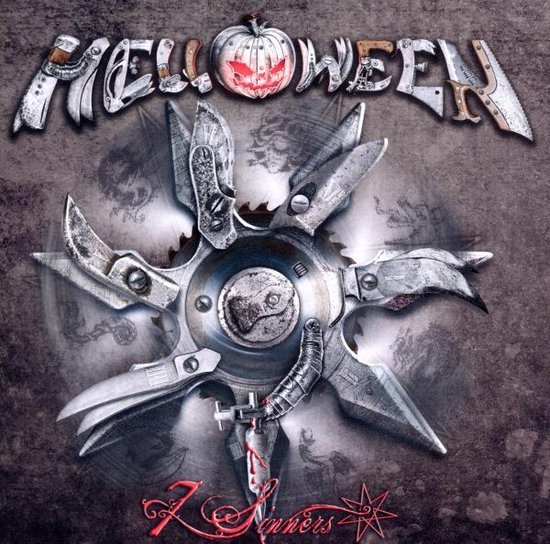
Helloween further standardize their modernistic sound on Seven Sinners. There’s only about two or three experiments. It’s the first Helloween ever to open with a slow track, the doomy “Where the Sinners Go”. “Raise the Noise” has a Jethro Tull flute solo. The closing track is quite unique, and unlike anything they’ve attempted yet. Otherwise, it’s a very strict remanation of their sound.
The album is also notably heavy: probably their most brutal yet. The only competition is The Dark Ride, which has some darker songs (particularly “Escalation 666”) but also a lot of light power metal. This album is consistently dark. There’s no comedy or silly business: the lyrics are about drug abuse, schizophrenia, and so on. Even the piano-led ballad, Deris’s “The Smile of the Sun” is piercingly bittersweet: the fragrant juice from a crushed flower.
I do find it less charming than *The Dark Ride*. It needs more texture and more light to balance the shade. It’s action-packed and heavy but fairly one-dimensional. Many songs just do not work that well, and a lot of this weaker material is tracklisted at the start. (And some of its greatest songs aren’t on the album at all!)
“Where the Sinners Go”, “Are You Metal?”, and “Who Is Mr. Madman?” are just not compelling song. Sorry. The first is slow and draggy. The others are fast but have weak hooks (“Who is Mr. Madman?” reuses the melody of “Perfect Gentlemen”, and has a spoken word intro by Bill Byford of Saxon. As always, “remember when?” is the dullest form of conversation). “World of Fantasy” is another dud. Just the blandest power metal I’ve ever heard. It sounds like a *Rabbit Don’t Come Easy* song: lots of flash and noise with emptiness at its core.
Weikath’s “Raise the Noise” and Deris’s “Long Live The King” redeem the album for me. Both tracks are ferocious and catchy riff monsters with great choruses—Bauerfeind’s relentless guitar-focused mix makes them as muscular as steroid-pumped gorillas. Deris’s vocals are in top form as well.
“The Smile of the Sun” is another excellent song, then we’re back in fillertown. Sascha’s “My Sacrifice” and Deris’s “Not Yet Today”/”Far in the Future” end the album in good order.
“Far in the Future” is just insane, the song “Who Is Mr Madman?” wishes it was. A seven minute quiet/loud game with guillotine-suspended-by-a-thread tense sections punctuated by explosive steeplechase thrash sections. There’s an energetic Jimi Hendrix-evocative riff section in the middle that evokes *Chameleon* (of all things to evoke!), along with Gamma Ray. A great song.
The bonus tracks for Japan are surprisingly incredible! This has the best bonus material of any Helloween track yet. “I’m Free” and “Aiming High” in particular are blazingly fast and memorable power metal albums. They honestly could have bumped one or two lesser album tracks, like “World of Fantasy” and “If A Mountain Could Talk”, for one or both of them.
The album is a regress from the one before it, but it’s nowhere near actively bad. I cannot get offended by *Seven Sinners* when there are actual tragedies in the world, like innocent humans playing in a band called Custard. I just wish Helloween had changed their sound by adding things instead of removing them. But it’s dark and nasty and heavy enough: sometimes Halloween candy has razorblades in it.
A gross-out sitcom by Whitney Cummings and Michael Patrick King. It contains bawdy jokes and women showing their ankles. This show does not honor Christ.
I had COVID, and needed something dumb to distract me while I was dying. 2 Broke Girl fulfilled the assignment. Not the “distract me” assignment. The dying. The show rapidly accelerated my disease, hurtling me at Mach 5 speed into my grave. Thanks to 2 Broke Girls, I am no more on this world.
Here’s what you need to know about the afterlife: that smug grinning twerp with the book deal wasn’t lying—heaven is for real. The bad news: only half of us gets to go there. I don’t mean “one person out of every two”. I mean half of your body, split down the middle. The other half goes to hell. My right arm is playing a harp, and my left arm is burning in a lake of fire. My upper body has little white wings and a halo, and my lower body has assless leather chaps and a #TWERK4SATAN tramp stamp. This is not what I signed up for, and I would recommend not dying, no matter how cool your friends make it sound. I will talk about 2 Broke Girls.
It is (obviously) a show about Nazi death camps.
Conceptually, 2 Broke Girls is an upstairs-downstairs sitcom about two waitresses from different social classes who start a cupcake business on the mean streets of Williamsburg.
2 Broke Girls shares DNA with Cheers and Laverne and Shirley in the same way your lips share DNA with your asshole. It is profane and gross. People eat meals without saying grace. Unmarried people hug each other! Frontally! And no, they don’t leave room in the middle for Jesus. It’s disgusting what they put on TV these days.
The show is a postmodern reaction to other sitcoms. For example, most sitcoms do not ever talk about money. The cast of Friends live in implausibly huge brownstone apartments: how they can possibly afford to rent them is never discussed in any detail. The Simpsons are vaguely middle class: within those boundaries, they are as rich or as poor as tonight’s episode needs them to be. 2 Broke Girls subverts this: the show’s cast is caught in an unrelenting battle for tiny scraps of money: indeed, money (along with sex) is the show’s primary subject matter.
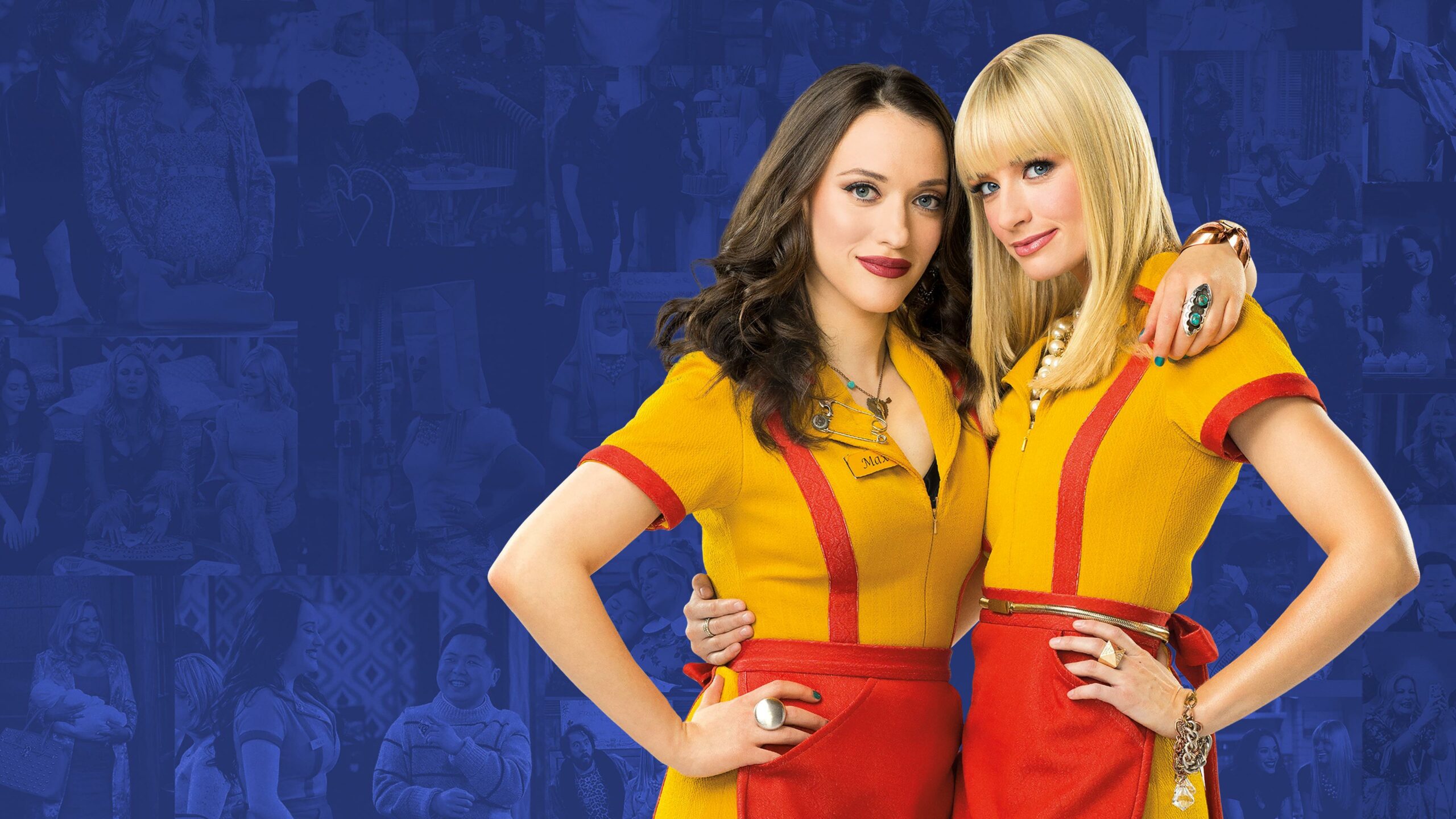
The show is carried by Kat Dennings, whose character is named Max Black and not Min Black. Her large breasts are an invaluable source of comedy and some episodes would become literal Tiktoks if you edited out references to them. It’s like a joke credit card: whenever the writers are out of ideas (which happens more often than you’d hope), those breasts are just sitting there, ready to bail them out.
But Kat Dennings is more than just a female Atlas, holding the world aloft on her tits. She’s charming and likeable actress with psychogogic screen presence. I wish she was the star of those suck-ass Thor movies. Yes, I know she’s comic relief, and yes, I know you can’t build the entire plane out of black box material because it would be too heavy to fly, but still…I’d rather watch her than Natalie “Boring” Portman, who is attractive but has all the zing and pizzazz of dry salad leaves with no dressing.
Kat Dennings is not a real person. She is a stage name for Katherine Litwack. Either she didn’t like her name, or was told it was an obstacle to getting callbacks.
Natalie “So Boring” Portman is also not a real person. She is a stage name for Natalie “Really Boring” Hershlag. Either she didn’t like her name, or was told it was an obstacle to getting callbacks. Also, she’s boring.
I read a genuinely horrifying short story by Harlan Ellison when I was younger. It was called “Boulevard of Broken Dreams”, and can be read here, assuming the guy hasn’t secured his Amazon S3 bucket by the time you click the link.
The demitasse cup of thick, sludgy espresso stopped midway between the saucer and Patrick Fenton’s slightly parted lips. His arm froze and he felt cold, as if beads of fever-sweat covered his forehead. He stared past his luncheon companions, across the tiny French restaurant, through the front window that faced onto East Fifty-sixth Street, eyes widened, as the old man strode by outside.
“Jesus Christ!” he said, almost whispering in wonder.
“What’s the matter?” Damon said, looking worried.
[…]
Fenton sipped water. He took a long pause, then said, “I was a clerk at the Nuremberg trials in forty-six. You know. There was an officer, an *Oberstleutnant* Johann Hagen. He was in charge of the mass grave digging detail at Bergen-Belsen. He did things to women and small boys with a pickax. He was hung in June of 1946. I was there. I saw him hang.”
To spoil the story: Fenton is haunted by ghosts of Nazi war criminals. Men who died long ago have returned, shrouded in a purple glow, prowling the streets of a city that is suddenly—oddly—empty and dark. He thought the clouds in the sky were full of rain. But now they are ashen black that reminds him of charcoal.
We learn that “Fenton” is a Jew…
He saw them all, one by one, as they walked past, strolling in both directions, free as the air, saying nothing, hands empty, wearing good shoes.
He tried to grab one of them, Wichmann, as he came by. But the tall, dark-haired Nazi shrugged him off, smiled at the yellow armband Fenton wore, smiled at the six-pointed star on the armband, and shoved past, walking free.
…But his behavior around the Nazis is strange and not what you’d expect. He displays guilt, shame, and defensiveness. He behaves like he’s theone who’s done a wrong thing.
“Changed at Ellis Island!” Fenton screamed at Wichmann’s retreating back. “I had nothing to do with it!”
The story ends with the Nazis’ purple glow settling on him.
What do you make of this story? I’ll tell you my theory: it’s about Jewish participation in the erosion of their own identity.
“Changed at Ellis Island!”—he’s referring to his name. Before Ellis Island, his family was presumably Feinberg, or Feitelson, or Finkelstein. But now it’s Fenton: a name that is not just goyische but grandly, blandly, crashingly goyische. “Fenton” is to names what Natalie “Star Bores” Portman is to actressing.
Even though the name change was (likely) performed by his father or grandfather, Fenton bears the guilt of erasing his Jewishness for the possibility of an easier life. “The Personal is Political”, the feminist slogan goes. By altering his name, Fenton has participated in a personal Holocaust.
Fenton is no Nazi, no brother to these death-skulled reapers of his people. But under this impossible ashen sky, he seems to realize he’s not totally unlike them, either. Hitler, Ribbentrop, Goebbels are dead, but the “decision” (in Fenton’s mind, and perhaps Harlan Ellison’s) is one they would have approved of.
One Jew less.
This is a provocative reading that probably crosses the edge into “offensive” (which is why I suspect it’s exactly the meaning Ellison intended). Is Fenton’s crisis intellectually compelling? Not to me. A name is just a name: heritage goes deeper than that, surely. And even if it didn’t—if Anglicizing your name meant throwing away your Jewishness, root and branch—what of it? Must Fenton serve as the unwilling ambassador for his tribe until the end of time? It’s a free country. Why can’t he not be a Jew, if that’s what he wants?
And while I hate to bring up logic in such a striking story…the Nazis defined racial purity by blood. If the story’s point is “Fenton has spiritually Holocausted himself”, the architects of the actual Holocaust would not have agreed. The Nazis repudiated the idea that a Jew could ever stop being one, let alone by changing their name. They specifically hated efforts to assimilate—hated Litwacks and Hershlags becoming Denningses and Portmans[1]Portman can be an Ashkenazic surname—it’s Anglicized from German Portmann, but it is also an old English name meaning “burgher”. Less centrally Jewish than Hershlag.. To the extent that that Nazi Germany tolerated Jews, they wanted them to be as visibly, distinctly Jewish as possible.
But the story seems to repel logic, because guilt repels logic. One of the story’s best touches is the transformations that carve out the city like a Halloween pumpkin. Day becomes night in the span of a few minutes. It empties of people while filling with Nazi ghosts. Fenton’s friends apparently cannot see the Nazis. The friends, too, vanish from Fenton’s world at the end, as though they weren’t ever truly there, either. It’s a subjective world with no essence or center, just our beliefs. Even though these Nazi monsters are dead, Fenton feels he has continued their work. The gears of the Holocaust machine creak and turn long after the engine is shut off. And now they creak and turn in him.
Another reading might be the inescapability of the Nazi blood libel: the way it almost might be self-fulfilling. I am reminded of Ari Spiegelman’s Maus. His father was a complex figure—fretful, quibbling, clannish, miserly. Spiegelman understood the terrible circumstances that had made his father. But he was also *horrified* by his father: the man seemed almost like a Nazi caricature of a Jew! There’s some of that in Ellison’s story, too. Fenton’s name change proves he is a literal rootless cosmopolitan, pretending to be something he’s not, like a Plasmodium falciparum travelling disguised between red blood cells. This is the Nazi caricatures of what a Jew is. Fenton feels trapped by these long-dead men: feels their skulls staring at him. He cannot escape being defined by the language and ideation of Nazis. They just have to smile on the street, and a yellow star appears on his shoulder.
Again, it might be illogical for Fenton to feel this way. But logic seems to have fled the city: it is a place corroded by guilt, where basic reality cannot find purchase. A hollow place, with Fenton’s feeble excuse—“I had nothing to do with it!”—the hollowest thing in it. Might as well be “*I was just following orders!*“.
Anyway, 2 Broke Girls—
(What am I doing? Well, on one level it’s a Sam Kriss type thing where he uses banal media as a jumping off point into a more interesting discussion: the sow’s ear becoming a silk purse, etc. Mostly I’m trying to confuse the reader. Tricking them into committing on one level, then the floor gives way and they’re in the middle of something else. “What am I reading? This person is insane.” Insane people are captivating. You can yell at them or stare at them. The thing you can’t do is ignore them.
I think writers should learn from John Coltrane, who would start off with a familiar tune like “My Favorite Things” and “Chim Chim Cheree” then leap into neo-tonal space, tearing down the walls of jazz and then music itself, letting a great wall of light crash in, stunning you, disorienting you, terrifying you with the universe’s awful strangeness. Will you die out here? Die in the awful cold? Don’t worry: Coltrane smiles, whips out a quick 2nd inversion F major V7-I, and suddenly you’re back in “My Favorite Things” again.
Why am I tiresomely explaining the joke to you now? Because I am beginning to suspect it doesn’t work. The modern reader doesn’t “commit”. There’s no frame you can shake or shock them out of. Their auditory canal is a quivering bowel excision with a perpetual enema of noise flushing through it—AI-generated ASMR in one ear, Huntrix JOI (10 hour mix) in the other—with only about four of twenty words registering in the gurgling slop chute of their brain, eventually congealing into some grotesque parody. One that bears as much resemblance to your argument as a heap of gore-splattered fur in a food-blender does to a small tortoiseshell kitten. “So you’re saying Natalie “Turboboring” Portman supports the Holocaust? Burn in hell.” First, I’ve said I already am burning in hell (My lower half is, anyway). Also, have you seen the news lately? Tons of kids with septum piercings and purple hair are already saying that for me, so don’t worry.)
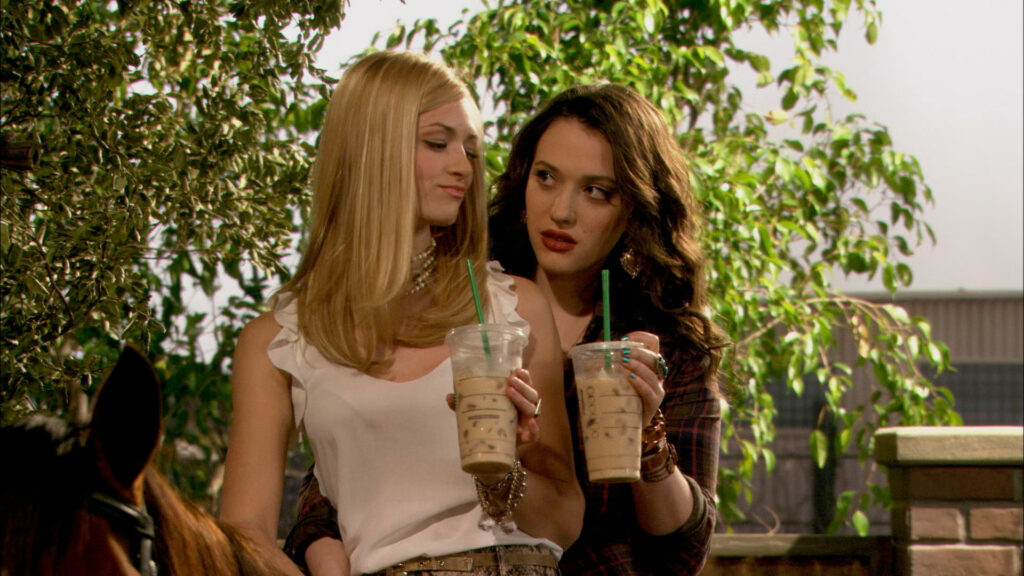
I liked the cast—Kat Dennings and Beth Behrs have fab chemistry as Max and Caroline. (Behrs is 5ft 5, but looks like a giraffe next to Kat Dennings, who is shorter.)
The jokes are surprisingly funny, albeit in a “A writer pulling out the first bingo ball from their head” type of way.
Han: Hipsters like karaoke.
Max: Replace the word “like” with the word “Hitler” and you’ve got the three worst things in history.
Hipsters and karaoke were very soft targets in 2011. (As was Hitler, I guess.) Most of the gags are “okay” more than “hilarious”, but the writing bombards you with so many of them that even this low hit rate works.
The show manipulates your emotions in a way that’s fun, because it’s done audaciously and without any shame. The sudden whiplashes from laugh-tracked comedy to smaltz are found in every sitcom. 2 Broke Girls doesn’t care that it’s obvious. I liked that.
It has a lot of, well, dated humor. 2011 seems very recent in my memory. But the style of writing feels many years older, like what you’d get from mid-2000s Sarah Silverman or pre-Ozempic Lisa Lampanelli or even a raunchy boner comedy from the 90s like American Pie.
And there’s race humor. Lots of it. Nearly every character is just 3 or 4 somewhat unflattering stereotypes about their respective ethnicity. We get broad one-note portrayal of Orthodox Jews and the Amish. There’s an old jaded black guy called Earl: he’s nice, but everything he says is about how he’s seen some shit, has done cocaine with James Brown, and so on.
Han Lee (Max and Caroline’s boss, played by Matthew Moy) is a particular problem. This character is unimaginable today: a sexless emasculated ABC who talks in fresh-off-the-boat broken English. If you’re hoping for a reunion or revival of the show, the Han character is lurking in the shadows holding a baseball bat.
Worst of all, Caroline is a cruel parody of the most oppressed group in history: rich people. She is blonde, materialistic, obsessed with shoes, her daddy is in jail for running a Ponzi scheme (or something), etc. Frankly, it’s disgusting that this character was put on TV. Caroline is no better than Stepin Fetchit or Fu Manchu: a hateful stereotype that was wrong then and is wrong now. Shame on all involved.
Something I’ve often wondered about…well, you know what a Patient Zero is. What’s the opposite of Patient Zero? The last thing to have a disease?
For example, songs once referred to themselves as “records” but they no longer do. The reference doesn’t make sense as nobody buys records. So, what was the last major hit to talk about a “record”? There must have been one. The last one I know of is 2008’s “Just Dance” by Lady Gaga
>What’s going on on the floor? / I love this record baby but I can’t see straight anymore
Likewise, when was the last time a major TV show could be carelessly “problematic” in the way *2 Broke Girls* is, without becoming a *Million Dollar Extreme* type affair?
Honestly…was *this* it? Was *2 Broke Girls* the last public hurrah? The violinists saying slurs as the ship goes down, as it were?
Culture can go through abrupt shifts 1967-1969 was a turning point. 1991 was another. You look at pop culture on either side of those breakpoints, and it’s like looking at two different worlds.
One of those shifts occurred around the time *2 Broke Girls* was made. A pervasive sense began that Your Words Matter. Shows and movies would no longer throw around “fag” and “retard”. It was very sudden when it happened. 2 Broke Girls does feel like a progressive rock album in the age of punk rock: it was already past its time, even when it was new.
This is not a rant about the woke mind virus or whatever. I don’t really care that much. I’m just interested in the dynamics of how these things occur. What I do care about is the fact that the show starts to suck fairly quickly.
A character is introduced in season 1: Zofia “Sophie” Kaczyński, played by Jennifer Coolidge. If 5’2 Kat Dennings makes 5’5 Beth Behrs look tall, she makes 5’10 Coolidge look like a Biblical giant.
At first, Sophie’s a fine addition to the cast. A human thundercloud: an irresistable, terrifying, inexplicable presence with an unclear and slightly sinister background (she might be the madame of prostitutes). She is socially oblivious, cannot be reasoned with, brays instead of talks, and clearly can only be a powerful ally or a life-ruining enemy. The viewer wants to discover which way the cards fall.
Then she hooks up with Oleg, and devolves into a one-joke character (oblivious foreigner!). This is textbook Flanderization, where an initially complex character devolves into a grating one-note parody of themselves. Named after Ned Flanders, who transformed over The Simpsons’ life. Starting as Homer’s annoyingly perfect neighbor (who happens to go to church), he becomes a raving, sociopathic religious fundamentalist.
I guess the studio has it in their heads that Sophie is a “fan favorite”—whenever she enters the scene, the laugh track roars with Ivy Mike intensity. But I can’t stand her. She is one contemptible note banged out again and again, is in far too much of the show, and I soon began skipping over her scenes. It’s always the same shit. “She and Oleg are gross and hairy Europeans and have gross and hairy European sex. Thanks, got it.”
Sophie’s character Dr Kevorkians the show, but it was already in failing health: by season 3 it’s tottering around with a listening horn and a bottle of smelling salts. I noticed I was not laughing much at all. At anything.
It gets to be kind of a slog. I don’t even think the writing gets much worse. It’s just…there’s only so many jokes you can wring from this setup, eventually every joke has been made, and finally even the comedic credit card of Kat Dennings’ boobs starts declining.
Average season 6 episode of 2 Broke Girls: Caroline sees something gross. “Eww! It smells like puke on top of poop on top of more puke!” Max quips “That’s what they called my vagina in seventh grade!” Sophie walks in and shrieks incomprehensibly to fill up time. Repeat.
Another problem is that the central dynamic (Caroline is a fish out of water, reliant on Max to survive) increasingly falls apart as the show runs on. After 130 episodes, Caroline should have plenty of salt on her skin, and increasingly she doesn’t have much to do. She’s just…another version of Max.
“Outlasting your central conceit” is a classic network TV malady. Adam Cadre describes this in his discussion of The Wonder Years, which launched with a brilliant concept: a twelve year old boy in 1968, coming of age in a country that’s coming of age. Both nation and boy are allowed to become mirrors of each other.
But *The Wonder Years* became a hit and just kept getting renewed for season after season (it ran for the same number of seasons as *2 Broke Girls*), with Kevin growing older and older. Eventually it’s not “a twelve year old growing up in the Summer of Love” but “A sixteen year old in the final year of the Nixon administration”, which doesn’t have the same monomythic clarity.
The episodic nature of The Wonder Years forced Kevin to learn basic lessons about niceness and fairness over and over again. The large number of episodes (plus Kevin’s advancing age) changes how we receive these basic life lessons. Eventually, he’s no longer a naive young kid, but a teenaged idiot.
2 Broke Girls has fewer stakes on the table than The Wonder Years, but S5.E11, “And the Booth Babes”, shows it falling prey to the same problem.
The “plot”: Max and Caroline become “booth babes” at a gaming convention. A few predictable gags are trotted out: the girls don’t want to hang out with gross nerds, the convention is sponsored by Virgin Airlines, etc. Fine. But Max (accidentally) ends up cosplaying as videogame character Murderbitch, who cuts off heads and drinks beer. The writers go absolutely nowhere with this, but it’s cute, I suppose. But there’s just…nothing for Caroline to do. So she ends up wearing a yak costume and being Murderbitch’s sidekick. Don’t worry, there’s plenty of screeching from Sophie. The writers just seem desperately unsure of what *2 Broke Girls* even *is* at this point.
On May 12, 2017, the answer became “cancelled”. Not cancelled in the “gendertwunks with blue hair and septum piercings yell at you” way that Natalie “Incredibly Boring” Portman endured (thoughts and prayers, etc). Cancelled in the “not on TV way”.
Perhaps the show had simply run its course. Or perhaps the cultural forces it had lashed itself to the mast against had finally won (throughout the show’s run, the Han character just provoked nonstop discomfort, if not anger.)
Despite the aching loss of *2 Broke Girls* we feel in our bones, the world moves on. Beth Behrs moved on from being deceptively tall to being a voice-actor for cartoons, Kat Dennings moved on from carrying a sitcom to carrying Natalie “There’s No Way I Move During Sex, Like, At All” Portman in *Thor*, and Harlan Ellison’s story has continued to prove eerily prophetic. Except these days we’re lucky if the undead Nazis aren’t IN THE WHITEHOUSE, am I right? (Clap if you agree. Notice how I didn’t call Trump or Biden a Nazi but gave you enough rope so *you* could do that. They call it “playing both sides”, toots.)
“The nightmare that will never go away.”—Harlan Ellison, Boulevard of Broken Dreams
Portman can be an Ashkenazic surname—it’s Anglicized from German Portmann, but it is also an old English name meaning “burgher”. Less centrally Jewish than Hershlag.
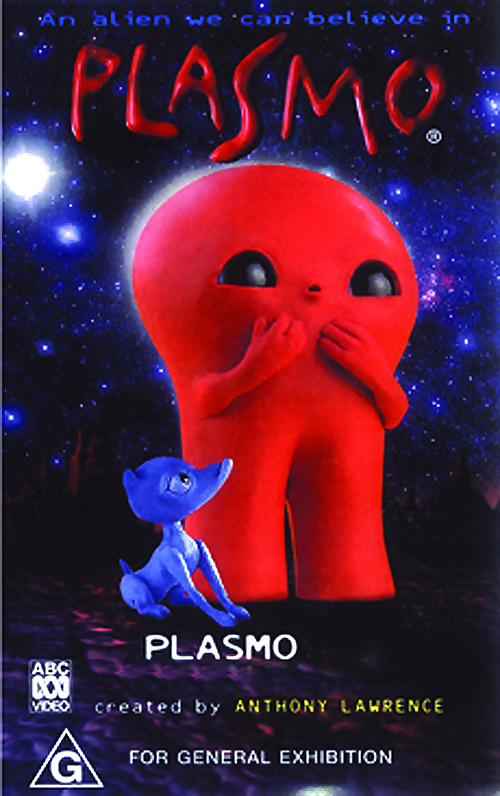
A pink clay alien stumps his lonely way across a desert. He has legs the way a T-rex has arms and a penguin has wings: not very successfully. He’s trying to get into space by piling up garbage in a large heap.
Plasmo is both naive and wise. Like the Sufi mystic in an Arabian folk tale, he is a clever fool. The cup that is both empty and full. He lacks life experience but is brimming with insight. A normal person cannot reach space by climbing a teetering pile of trash, but perhaps Plasmo can.
The character is the work of Australian animator Anthony Lawrence, who brought this special alien to the airwaves twice. In 1988, as a 26-minutes short film called Happy Hatchday to Plasmo. Then in 1997, as a 5-minute thirteen-episode TV series called Plasmo. This second adaptation played frequently on ABC, and was syndicated and dubbed for foreign markets.
The show was not a massive hit—if Taylor Swift plays Olympic Park Stadium on the same night Plasmo reruns are on TV, she surely wins the battle for Australian hearts and minds. I sense millions of PlasmoHeads protesting in the comments “b…but…what if her tickets are really expensive? What if her current boyfriend is really racist? What if it’s cold and rainy and…” no, friends, we must face the facts: Taylor Swift is more popular than Plasmo. Be brave and accept the truth in its monstrous cruelty, as Plasmo would.
But it did alright, considering. A decent percentage of Gen X Australia has grown up with a pink clay monster in the back of their head along with “how’s the serenity?” and old AFL footie jingles, and that’s not nothing. Plasmo’s species is (I think) a “polybop”, and many teens identify as poly now. So the character was a trendsetter in that respect.
Both Plasmo versions are an interesting yardstick to judge the other one by.
The 1988 film is grimy, wonderful space trash. Stylistically it’s Gumby meets Star Wars, with intergalactic bounty hunters, oceans of sand and ice, and grungy urban sewers. The two comic relief characters—Coredor and Brucho—are both great, even if their designs aren’t fully there yet. They’re voiced by musician-and-actor Phillip Houghton with a voice like mucus-coated gravel. Lucas’s “used future” aesthetic proves a real workhorse on sets created out of scraps and rags (the used present, one might say), because it creates a reality amenable to technical errors. In the 4k upscales on Lawrence’s Youtube, you can clearly see that the ice on Pynco is styrofoam, for example. But this strangely makes it seem even cooler than when I first watched it in standard definition, because I can better appreciate the labor that went into creating it. [1]I wrote that this scene was likely a reference to the moon-skating in Wallace and Gromit’s Big Day Out…but then I checked, and Happy Hatchday to Plasmo was on the air one year earlier! Someone … Continue reading
The 1997 Plasmo is a lot better on a technical level. The effects are more elaborate, and the designs more intentional. In 1988 Coredor was a fleshtone Gumby with an eyepatch. In 1997 he’s a talking pair of labia lips atop a swaying monitor lizard neck. He looks wonderful! The polybops are cuter too, with big expressive eyes kept weepy and moist via liberal brushings of peanut oil.
Yet it loses some of the dirt and grit that makes the original a blast (gone, too, is the subversive, edge-of-acceptable humor, like birds defecating in mid-air and Brucho wanting to go to the disco to meet “intellectually stimulating chicks”. I like that sort of thing more than ABC’s Standards and Practices did, I guess). It’s like a steam-cleaned version of the Plasmo concept.
But the 1997 show has a stronger plot. Gotta give it that. Plasmo finds a spaceship, uses it to get off the planet, crash-lands on another planet—Monjotroldeclipdoc, which has a hole punched through its middle by a long-ago comet). The show then settles into an “issue of the week” formula for seven or eight episodes: Plasmo tries to fix his ship while helping various people with problems like a blocked drain and a ghost-haunted library. Then the great comet unexpectedly returns to Monjotroldeclipdoc’s skies, doomsday looms, and Plasmo and his friends must make a choice.
Plasmo is a thoughtful show, not afraid to confront young viewers with tough ideas.
There’s the variant of Prisoner’s Dilemma found in “Nice to be Nice” (if Coredor knocks over Plasmo’s glass of milk, should he retaliate?). And the invocation of cosmic fractality (and the Avataṃsaka Sūtra) in “Plasmo in Deep Space” (which has a sharp and horrifying screenplay). There’s allusions to Ringworld and Citizen Kane (As a child, I would have missed the latter even if I’d been aware of Citizen Kane—the ROSEBUD on the sled is hard to see in 720×480).
Even the fact that “Monjotroldeclipdoc” is pronounced with an alveolar click on the final c (notated something like Monjotroldeclipdɒǃ, I think)…how often do you hear African click consonants on a kids’ show? When I was small I didn’t get all that, of course, but the show felt noticeably…deep compared to the programs before and after. There’s a lot of “they didn’t have to make the effort but I’m glad they did.”
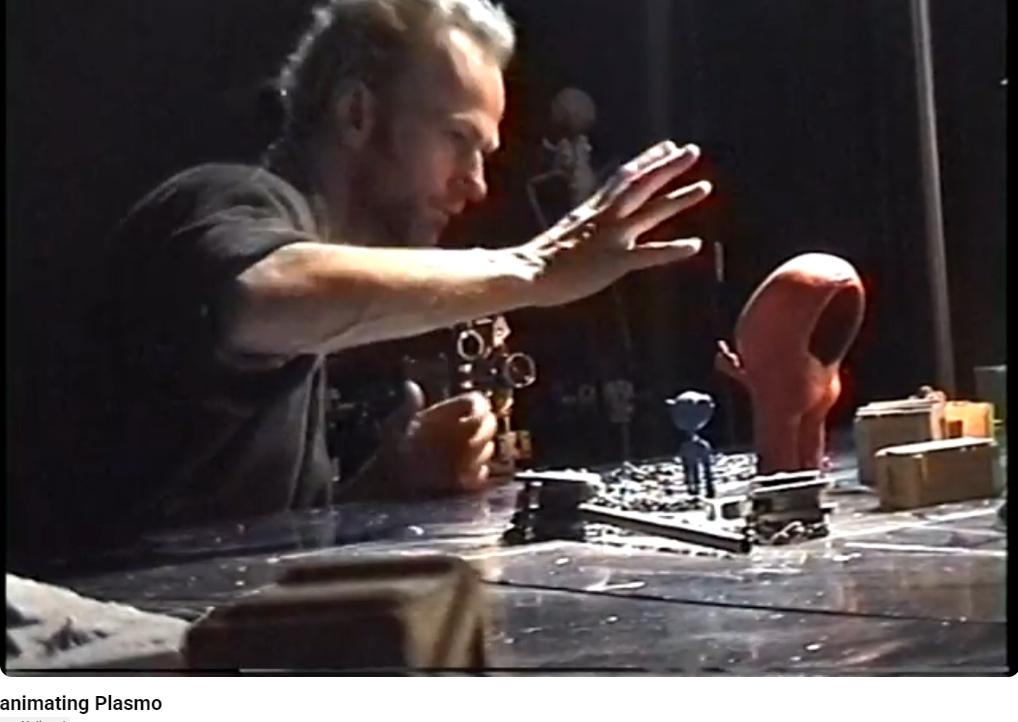
Production-wise, Plasmo was an audacious mixture of basically every animation technique available at the time. It had claymation, stop-motion puppets, some cel animation (for effects like lightning bolts) and CGI, most of it integrated quite well. (The CGI has aged the worst, obviously.)
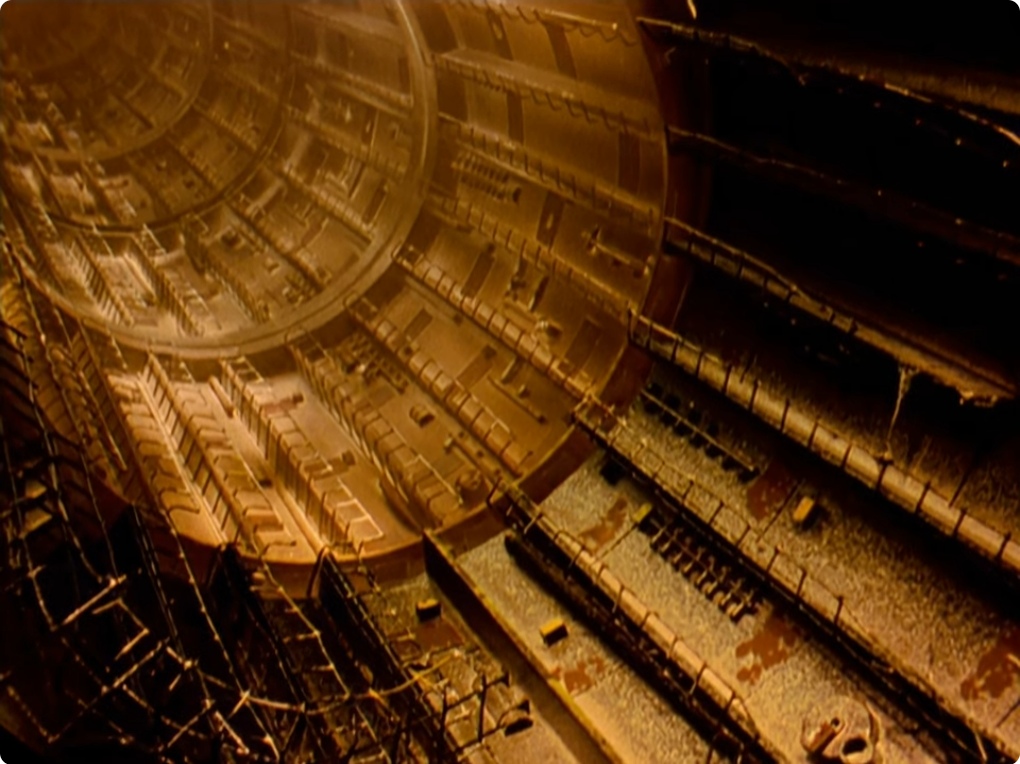
Lawrence’s team achieved remarkable stuff on a small budget. He once maintained a website where he discussed some of the effects—like using a pair of mirrors to create the haunting interior of the ship where Plasmo was hatched.
Is it strange that this is why I respond to Plasmo with sadness as much as nostalgia? 1997 was near the end of the line for this kind of Will Vinton/Ray Harryhausen stop-motion whateveryoucallit. If it had been made even three years later, likely every part of it would have been computer-animated.
For better or for worse? Animating all this stuff by hand sounds like misery. Lawrence says the 1988 film took two years to animate and hospitalized him at one point.
But I think restrictions—the denial of shortcuts—can affect art in interesting ways that are not always negative. The crucible of labor can force choices that are ultimately correct ones—pruning away excess, tightening up dead spots in the script, working out conceptually what the point of the show or character even is. It is possible to film and write nothing. It is not possible to animate nothing. This is what attracts me to animation as a viewer: the medium fights bloat and excess by its nature.
And it’s a shame when old techniques are no longer used. The end result is that they cannot be used, even if you want to use them.
When animator Don Bluth worked for Disney in the 1970s, he was struck by the fact that much about the studio’s 30s/40s hot streak had already been forgotten. It wasn’t just the spirit of those old movies that was missing, even basic techniques were falling through the sands of time.
The Nine Old Men were going gray. Walt himself had been dead for half a decade. Nobody was preserving the hard-won knowledge and craft of the studio’s RKO years. He would ask questions like “how did you do the rippling water in Snow White and the Seven Dwarves?” and be astonished that nobody could tell him. In some cases, even the technique’s inventors had forgotten!
Ever since the failure of Sleeping Beauty, Disney had been fighting a war against budget overruns. Animators were urged to cut costs, to reuse footage, to do more with less. The result was that old knowledge and techniques atrophied because there wasn’t the money to apply them. What doesn’t get used gets forgotten: and soon you’re doing less with less. Bluth had arrived in a dying place: its animators the caretakers of an ancient language they could no longer read. Almost like Plasmo himself, trying to reach the sky with old scraps of the past.
What would it take to create Plasmo today? Or in another thirty years? Would it even be possible? Could puppetmakers of Nick Hilligoss’s skill be found? Would tools like surface gauges and plasticine still be readily available? I don’t know how many of the techniques required are even still taught at film school. How long before this character is simply impossible to bring back, except as a horrible CGI/AI shell of itself? It might be like that often-mocked meme about building a cathedral in the modern age. “We can’t. We don’t know how to do it.”
To address more important topics, Plasmo’s model looks like this from behind. Which is really disturbing.
I wrote that this scene was likely a reference to the moon-skating in Wallace and Gromit’s Big Day Out…but then I checked, and Happy Hatchday to Plasmo was on the air one year earlier! Someone owes Lawrence a cheque!