Norwegian Wood is a slow book with only a little story, but I did not want it to be faster and I did not want there to be more. Someone once said that being a writer is like being a paleontologist digging up a dinosaur skeleton – and praying you don’t break anything as you transfer it from idea to paper. This book constitutes perfect paleontology. Few books are as precise and well realised.
However, parts of the Norwegian Wood skeleton are still underground. Even at the end there questions unanswered, and reasons and whyfors unexplained. Murakami must have decided that they were better off as secrets in the earth. What’s left is an understated but moving story of a young man courting a young woman in 1960s Japan. It’s a fiction book, but one feels justified in thinking that Murakami is transcribing some of his own experiences – he was a college student in Tokyo through this period.
Norwegian Wood has lots of exciting and dramatic and funny moments, all of them written in Murakami’s trademark understated style. Some writers leap and cavort for your attention. Murakami assumes he already has it. Some parts of the book feel real enough to make you uncomfortable. At his best moments, Murakami connects with the reader and makes him feel like he’s actually experiencing a love story, not just reading one.
The characters seem simultaneously realistic and exaggerated, from the disturbed Naoko to the charismatic Nagasawa to the friendly but unknowable Kizuki, whose death is the catalyst for most of the events in the book. They come across as types, but also as people. Main character Toru Watanabe is rudderless and confused, as many young people are, but he’s not uncaring. In fact, he cares too much. Away at college, away from his troubled girlfriend, he starts to feel attraction for another girl. This love triangle forces to make a choice, but that choice merely deepens problems and adds more responsibility to this young man. But that’s the way of things. Choices multiply into more choices, until eventually you’re middle aged and wondering what happened.
Norwegian Wood is a love story, but Murakami sublets narrative space to lots of other ideas. He gets in some shots at student activists, who want to overthrow the system until they graduate and need the system to supply them with a job. He gives Toru a funny roommate who is so likeable that I was saddened when he disappeared from the story. Music is often a prominent feature of this writer’s books, and you could put together a pretty comprehensive 60s compilation album from songs mentioned in Norwegian Wood.
Ultimately, you could view Norwegian story as a symbolic tale of a man facing two paths…and two girls. One is his past, the other his future. The ending is cruel for everyone involved, especially the reader, as he is cut out of one crucial piece of information about what happens to Toru.
But again, that follows from life. We can roll the dice and make decisions…and never know whether we chose correctly or not. I like Norwegian Wood a lot, maybe because it feels like I’m reading about myself.
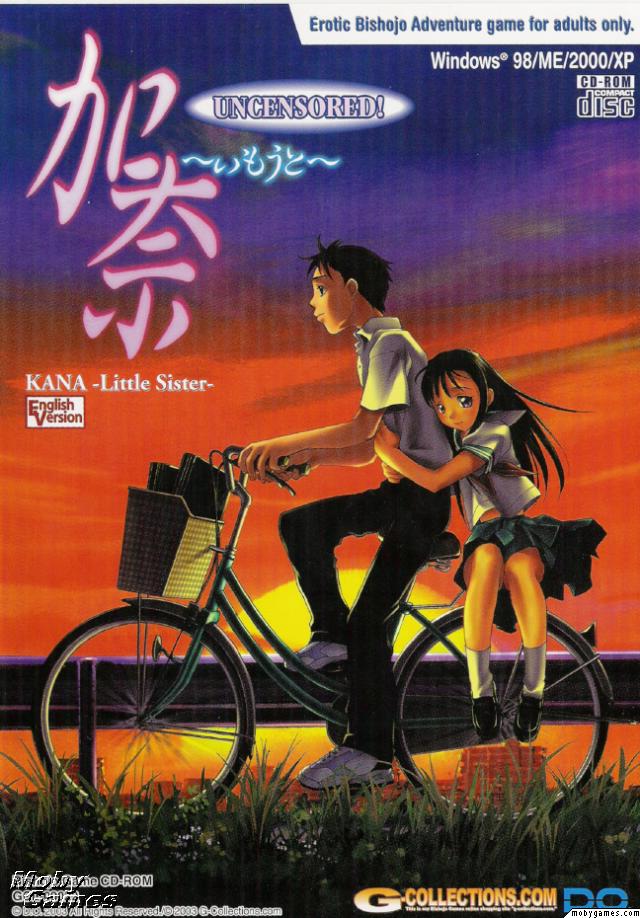 They talk about being a big fish in a small pond. Kana Little Sister is a whale imprisoned in a raindrop. In 1999, the hentai/eroge industry (“Do You Like Horny Bunnies”, “Battle Raper”, etc) released this very sad and emotional game, which is unlike any other h-title I’ve played or heard about. It has sexual content, but it could be deleted off the disc without affecting the experience. Kana exists to exposit one of gaming’s most tragic love stories, and tissues will now absorb other bodily fluids.
The game is about the coming of age of siblings Taka and Kana. Kana suffers from chronic renal failure. The expectation is that she will die at some point. Taka is initially resentful of Kana, but their relationship soon changes into friendship and then sexual intimacy. The game explores a lot of deep themes, like forbidden love and acceptance of death. I enjoyed the story, as well as Taka and Kana’s relationship, which is given beautiful frisson by the fact that it will not last.
The word “game” keeps coming up but Kana deserves it no more than the word “hentai”. This is the least interactive “game” I’ve ever seen, you just click dialogue options and get railroaded to one of six endings. Even though you play it less than you “play” an ink and paper RL Stine “Give Yourself Goosebumps” book, the minimalistic gameplay actually works to keep your attention on the story.
The art is nice. The music is repetitive and distracting. There’s no voice acting. The whole thing takes about five hours to complete. Kana’s an embodiment of function over form. It has little to offer if you want production values, it relies on content to woo the player. But honestly, I still have reservations about the whole “player” thing. Know what you’re getting into with this one: it’s not a game, it’s a vaguely interactive novel. And that might be a problem. Kana has one of the most emotionally affecting stories ever seen in a videogame, but if you judge “Kana” as a book…well, there’s a bit more competition there, no?
Kana is not great literature. It draws an emotional reaction in the same way a soap opera does. Sometimes the story’s twists and turns feel organic and natural. Sometimes they come across as phony and manipulative. And that’s a shame. Kana is too great to be a hentai game…but not good enough to cut it as a book. It’s stuck somewhere between worlds. Someone looking for porn won’t find it here, and it probably won’t win over highbrow lit fans. I’m reminded of a chrysalis. One one end a caterpillar, on the other end a butterfly…and in between there’s this really odd thing that doesn’t seem to belong.
Kana Little Sister is an interesting game, and certainly worth checking out. It will probably draw a “that’s it?” reaction from many players. It’s short, it’s crude, and it’s barely interactive. But when the story gets going, you will forget about all of that. In the tale of Taka and Kana there’s something very rare in a game storyline: inspiration.
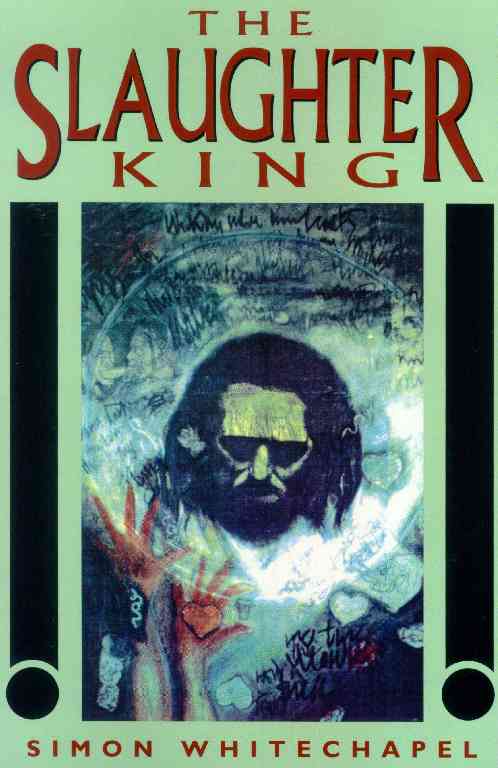 A deathwalker prowls the night paths, killing and disappearing like a nightmare with sharp teeth. The Slaughter King is a murderer in the legal sense, but that word seems wrong. “Murder” means the killing of man by man. The Slaughter King does not seem to be human, and after he’s finished with his victims, neither do they.
A London policewoman is following The King’s body trail. Unless progress is made soon, the Met will remove her from the case. The killer seems to have links to the Neopagan community, radical feminists, and even the industrial music subculture. Alannis Kirk hopes she can weave these threads into a rope strong enough to hang him. Along the way, she falls in love with a young woman called Sansiega, who possesses insider knowledge on The King. Or, she seems to fall in love. A big part of the book is Alannis’s own motivations, and – when down on the wire – how much better she is than the man she’s stalking.
This is Simon Whitechapel’s first book, and his only attempt at writing a novel (to my knowledge). One one hand it is an archetypal small press novel, featuring unfettered chaos and misanthropy etc, but on the other hand it might be the most “normal” book by this author. There’s not really any of the existential surreality that The Eyes hints at and Gweel declaims like a manifesto. Although nobody would mistake this for a mainstream thriller, your brain can definitely make sense of The Slaughter King.
The story isn’t such of a much. Its twists and turns are illogical and the ending isn’t very satisfying. What The Slaughter King successfully doubles down on is its dark and compelling atmosphere. It’s violent, but more than that, there’s a real sense of inbound doom. The King is bad, but as revelations come to light about his true motivations, he seems like more like a pawn of a corrupt and rotting institution. Ben H Winters wrote a book called The Last Policeman, about a policeman trying to solve a murder when he knows the apocalypse will come in six months. That sums up The Slaughter King to me. Whether The King escapes or goes free doesn’t seem to matter, as the world trying to catch him is fragile and ridiculous — a card tower made of 52 jokers — and destined for imminent collapse.
The book is grisly in that superdescriptive way that makes you feel like you’re reading a medical textbook. The first blow was carefully calculated to maim but not kill, to be massively painful, but not so massive as to pass shortly into numbness: a slash delivered through the flesh of the upper right thigh, ploughing apart the dermis and epidermis, the waxy yellow subcutaneous fat and the deep fascia as it sliced through the rich red fibre bundles of the superficial muscles, the tensor fasciae latae, the rectus femoris, the iliacus, the psoas major, the pectineus and adductus longus, the gracilis, cutting the wet tubery of the veins and arteries, the descending lateral circumflex, the oxygen balas’d arteria profunda fermoris, the vena saphena longa, almost grazing the femoral surface at its deepest point. The Slaughter King has lots of lesbian sex, too. These sequences are lavishly described and endlessly creative, but there are a great many of them and they seem of small thrust to the plot. After the second or third I found myself speed-reading through them.
The Slaughter King is a flawed but definitely interesting book. If there were Simon Whitechapel trees on every streetcorner with copies of The Slaughter King hanging off every branch, I’d have no trouble recommending it, but finding an out of print book from twenty years ago might not be worth the trouble for some people.