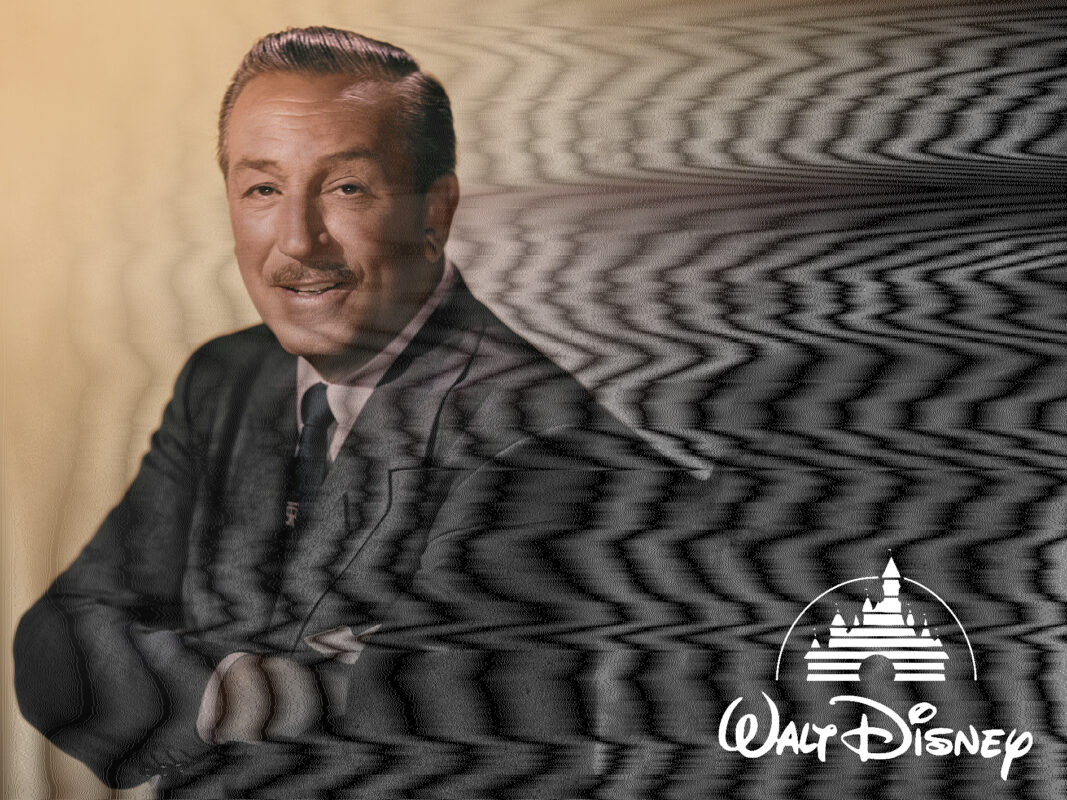
A friend, discussing Disney’s 1949 film The Adventures of Ichabod and Mr. Toad, had this to say about one Walter Elias Disney.
Disney’s historical impact is complicated. On the one hand Walt Disney was a bad man in one thousand ways (although I think as the face of media’s Evil Empire he gets strange flack for crimes he’s not guilty of. Family Guy deserves a huge chunk of blame here) who left the entertainment industry and probably the entire world a worse place than he found it. On the other hand without him we never really would’ve had cartoons in the way that we have them now. Sorry but no Looney Tunes. Anime would be something unrecognizable. No Rocky and Bullwinkle. No Simpsons. I know this seems melodramatic but his impact on animation was meteoric. Tex Avery would still have been born and would probably have made some masterpieces but he got his start with Disney and sharpened his sensibility against The Disney Tone. I think without Disney, theatrical cartoons would’ve crested with the Fleischers in the early 30s and gradually died out after the Hays Code. We’d still be making cartoons but you’re kidding yourself if you think Ub “Flip The Frog” Iwerks was sparking culture in the same way. I’m not sure which reality I’d prefer -the one with or without Walt Disney- and luckily I don’t get to choose. You don’t want a guy like me making those calls.
When pressed for details about why Disney was bad, he cited the usual stuff—busting up strikes, and naming names to the HUAC, and that sort of thing.
“Walt Disney was bad” is a valid perspective. My perspective is that Disney was not a bad man, just a flawed one with a demon on his shoulders that he probably couldn’t see. A fear of losing control of his art ran through all he did, and his paranoia manifested in ugly ways. Ways that he likely regretted in his better moments.
He seems like a fictional character, so the temptation is to let your brain lazily flood-fill an existing fictional character on top of what you don’t know. He’s Willy Wonka[1]When I Googled “Willy Wonka”, it returned Johnny Depp ahead of Gene Wilder, and I attempted suicide because of this. I leaped out of a window. It was only a first floor window, plus I … Continue reading, Mr Burns, Michael Jackson (good), Michael Jackson (pejorative), the Pointy-Haired Boss…picketh your poison.
My (sympathetic) reading comes from Michael Barrier’s excellent biography The Animated Man: A Life of Walt Disney (University of California Press, 2007). It gave me a fuller picture of Disney as a man. Enough that many puzzle pieces fall into place: not just about Walt, but about the culture he created (and we now live in, for better or for worse).
His early working life was the same damned thing happening on repeat. He’d build something from scratch (a company, a partnership, a creative franchise), and then have it stolen or destroyed senselessly in seemingly a moment. Sometimes he was wrecked upon the vicissitudes of luck. Other times he was outmaneuvered by flinty businesspeople like Pat Powers and Charles Mintz. He usually had very little warning before the ground fell out from under him. After a distribution deal with Universal fell through in 1928, he realized he’d lost the rights to his studio’s benchmark character—Oswald the Lucky Rabbit. He was forced to create a new one—Mickey Mouse—on the train home from New York.
This sort of “You made this? I made this” deal was the lot in life of many 1920s and 1930s cartoonists. See, for example, Otto Messmer losing Felix the Cat—a character who he is extremely likely the creator of—to Pat Sullivan. [2]Pat Sullivan has a real “sorry for party rocking” Wikipedia page, by the way. Eight headings, two of which are “Rape Conviction” and “Racism”—and text sprinkled … Continue reading Then (surely now) animators treated their work with a light touch. Whatever their role in creating a famous character, it was seldom “theirs” in a legal sense, and had to be disposable. But with the success of Snow White, Disney thought he’d escaped that trap. He’d built something that would last.
In the 1940s, problems massed against the studio. The war destroyed the European market for cartoons. Costs of producing films continued to rise as techniques became more elaborate and its workforce expanded—which also meant management (and Walt) became separate from the worker bees, creating a stratified business where the various “layers” (ink and paint, storyboard, directing, management) drifted apart and had little idea of what was happening above them or under them. In this situation, a business can end up at war with itself. (Read Zvi’s “Moral Mazes”).
With the studio in millions of dollars of debt, and contemplating drastic layoffs to meet bank loans, Disney’s paranoia fell on the rank and file. He heard stories of workers unionizing (on company time), and saw it as the next verse in the same old song and dance. Dark powers were assembling to destroy him, but now the stakes weren’t “a business partner”, or “a handful of animators”, or “a character”, but “a company with 1200 employees that was making the most technically elaborate works of animation ever made”. He probably thought “Not today, Satan.” He’d finally found a hill he was ready to die on.
(And we should not be too naive about the labor movement. A lot of people involved were literal criminals and thugs, like Willie Bioff, enforcer for the International Alliance of Theatrical Stage Employees. [3]Bioff has another hall of famer Wikipedia page, which ends in “Bioff walked out of his home and slid behind the wheel of his truck. A moment later, an explosion rocked the neighborhood. Parts … Continue reading )
I also learned more about Disney’s father: a cold and difficult man who demanded unquestioning obedience from his children. If Walt or his brother were tardy in obeying some instruction, they’d get “whupped” with whatever Elias Disney had to hand: a hammer, or the flat of a saw. From the age of nine, Walt was put to work on a newspaper route in Kansas City by his father (who refused to pay him). Walt’s own account of his childhood is so woeful it verges on comedy, like Monty Python’s Four Yorkshiremen sketch.
“We had a newspaper route . . . delivering papers in a residence area every morning and evening of the year, rain, shine, or snow. We got up at 4:30 a.m., worked until the school bell rang and did the same thing again from four o’clock in the afternoon until supper time. Often I dozed at my desk, and my report card told the story.” Forty years afterward, he still dreamed that he had missed customers on his route. “I remember those icy cold days of crawling up these icy steps” to put the newspaper inside a storm door, he said in 1956. Elias insisted that the papers not be thrown on porches or in yards, but carried to the front door. “I was so darn cold I’d slip, and I could cry, so I cried.”
Ya tell that to kids now and they won’t believe you.
It stood out to me that Elias (like many farmers) was a union man—a member of the American Society of Equity, and firmly under the sway of Eugene V. Debs. Walt learned to draw by copying comics from Appeal to Reason, a socialist magazine that his father subscribed to. Maybe Walt had lingering bad associations about the kind of man who joins a union because of the kind of man his dad was. It’s possible. So are many other things.
So that’s the positive gloss on Disney’s activities: a justly-paranoid man trying to protect his art. I am not saying this was the truth, or that he reacted correctly.
But what was Disney’s “art”? And how much of it was “his”?
Walt’s position in media is complicated. So is his position in my head. He is a fundamentally a confusing individual, and Michael Barrier’s biography doesn’t shed much light on it. I kept thinking of nostalgebraeist’s the void—a character that just doesn’t make sense or have internal coherency yet still claims that it exists. Disney feels like that too.
Was he charming and avuncular, or a quiet introvert? Was he a Pollyannaish idealist, or a flinty realist? Did his workers love him, or did they not? It seems you can make any interpretation of Disney work by selecting some facts and ignoring others. And to be sure, an entire life offers ample opportunities for apparent contradictions to emerge.
One striking irony is that Disney was a perfectionist who himself was not capable of perfection. Films like Bambi have some of the best technical animaton ever attempted, and they were done without computers or digital ink and paint or anything like that.
But Disney himself was an animator of utmost mediocrity. His own work can be seen in Alice’s Day at Sea. It’s creative in its blending of live action, stop motion, and 2D animation, but the animation is shoddy even for 1924. (To be fair to Walt, these were cranked out at Stakhanovite pace for pitiful sums of money, and I’m sure he didn’t regard this as fine work.[4]Apparently the live action footage of public places was shot illegally—Laugh-O-Gram couldn’t afford permits—and they’d run if they saw a policeman watching! That said, where is his fine work?)
By the 1930s, Disney realized that he was better stepping away from the coalface of the animation industry. His skills had long been eclipsed by others. He became a marshaller of the creative talents of others. (He said of himself: “I’m the little honeybee who goes flying around sprinkling pollen here and there to keep everything going.”)
Was he a good overseer of others’ work? I think so. To an extent. Certainly, most of the Disney artists (even the great ones) who left the company accomplished little of note without him. They had their weaknesses and limitations, too. Overall, Disney had excellent taste for where the industry was going, and where it could conceivably go. He saw possibilities. He felt that animation had to grow larger and larger, expanding its vocabulary, assimilating other forms of media. I think Fantasia, for example, is wonderful.
But at the same time, his instincts clearly failed him many times. Isn’t there obviously a fair amount of bad stuff in classic Disney films? Even the ones that are rightly regarded as classics?
They’re very kitsch. John Kricfalusi had a cruel but funny dig about the average Disney screenplay: it contains 10 minutes of plot and 60 minutes of flowers singing and birds wiping dishes with their butts. Anyone who, like Ralph Bakshi, thinks animation has to mean something ([the idea of] “grown men sitting in cubicles drawing butterflies floating over a field of flowers, while American planes are dropping bombs in Vietnam and kids are marching in the streets, is ludicrous”) will have capital P Problems and a capital D Drama with Disney. Modern aesthetes demand art that comforts the disturbed and disturbs the comfortable. Disney’s films seem to comfort the comfortable and disturb the disturbed.
Or perhaps you agree with CS Lewis, who felt that the mark of true maturity is that one is old enough to read fairytales again.
I’ll admit there’s a streak of broad sentimental schmaltz in Disney that I have to put myself in a weird or altered mood to sit through. I don’t even hate it. I just don’t understand it. It makes no sense to me. Whatever effect Walt is trying to achieve in the singing birds of Snow White (say) doesn’t really translate to me. I’d go further, and say that certain scenes—like the idealized lissome youths presented in Fantasia’s “The Pastoral Symphony”—are outright uncomfortable to watch and unpleasant in their connotations.
The strong parts of Disney films are always the dramatic, nasty stuff. Which says something about me, I’m sure. Probably that I’m smart and sophisticated, unlike you rubes. Consider Chernobog’s hands. Those awful, flame-wreathed, nigrified hands of soot. Have you ever seen such hands? Do his hands wait for you in your dreams? They do mine. Those hands.
So I don’t understand Disney. Not in the sense that Barrier failed in his duty to accurately portray a man—I think my confusion is the portrait. Disney was a man of mirrors. Gaze too hard and you tumble into a labyrinth of references and cliches and finally you stare back at yourself.
That intensity, never visible to viewers of Disney’s television show, showed itself in his behavior when he was in the park. “He would never walk past a piece of litter,” said Michael Broggie, a ride operator in the early 1960s. “He would reach down and grab it, and everyone was expected to do that.”
I do that too! When I see garbage, I pick it up. Assuming it’s not disgusting and putrid.
There’s also some evidence in Barrier’s book that Disney presented a facade to the world. He made himself look stupid. That’s sinister to me. Men who try to look smarter than they really are a dime a dozen and harmless. Men who try to look stupider than they really are can be quite dangerous. It’s better for a mountain to become a molehill than a molehill a mountain.
While the public thinks of Disney as playing with trains and exchanging pleasantries with juvenile alumni of the now-defunct Mickey Mouse Club, he actually is one of the most widely read, most widely traveled, most articulate men in Hollywood. I became acutely aware of this when I spoke with him recently at lunch in the private dining room of his… studio. While he devoured a dietetic meal of lean hamburger and sliced tomatoes he spouted rustic witticisms with the aplomb of a modern-day Bob Burns. But every once in a while his eyes would narrow, the rural twang would disappear from his voice and he’d discuss financial projections for 1962, the modern art of Picasso and Diego Rivera, and Freudian psychiatry. In a few moments, however, he’d catch himself ” and revert to homespun stories.
While we’re contemplating morbidity (we weren’t, but just pretend)…what does it mean for Disney to die?
A common Disney trope is the death of a parent used as a symbol for maturity. Bambi’s mother is the ur-case. But the parent, of course, is not truly dead. Something of them remains in the child who must continue on without them, before dying in turn. Our bodies are pathways for ancient seething forces too great—and terrible—for bodies to contain.
References
| ↑1 | When I Googled “Willy Wonka”, it returned Johnny Depp ahead of Gene Wilder, and I attempted suicide because of this. I leaped out of a window. It was only a first floor window, plus I removed the glass to avoid a nasty cut, and put a mattress out to cushion my fall, and this led to a suicide attempt that was painless but ultimately unsuccessful. I won every battle and lost the war. |
|---|---|
| ↑2 | Pat Sullivan has a real “sorry for party rocking” Wikipedia page, by the way. Eight headings, two of which are “Rape Conviction” and “Racism”—and text sprinkled with gems like “According to artist George Cannata, Sulivan [sic] would often fire employees in a drunken haze, not remembering the next day, when they would return to work as if nothing had happened.” Whatever his faults, Disney was a distinctly unbad man in the grand scheme of things. |
| ↑3 | Bioff has another hall of famer Wikipedia page, which ends in “Bioff walked out of his home and slid behind the wheel of his truck. A moment later, an explosion rocked the neighborhood. Parts of Bioff and his truck were strewn all over the driveway. Police found the remains of a dynamite bomb wired to the starter. The killers were never found.“ |
| ↑4 | Apparently the live action footage of public places was shot illegally—Laugh-O-Gram couldn’t afford permits—and they’d run if they saw a policeman watching! |
No Comments »
Comments are moderated and may take up to 24 hours to appear.
No comments yet.