From his snowbound manse in Portland, Maine, Stephen King has unleashed his most horrifying work yet. A terrifying look at man’s inner heart, a raw and beating extrusion of pure horror.
I refer, of course, to his Twitter account, which is just the drizzling shits.
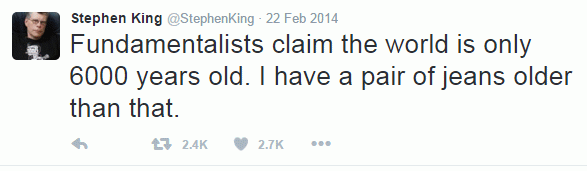
Imagine a hacky 1930s vaudeville comic with buck teeth, a spinning bow-tie, and a lapel flower that squirts water. Imagine “topical” humor that was growing only slightly musty in the early years of the Bush presidency. Imagine forwards from your grandma that are forwards from her grandma. Welcome to the Stephen King twitter feed.

The handful of pity retweets/favs renew one’s faith in humanity. Some people are taking a stand against this abomination. But there’s no time to relax, the assault has only just begun. 
His jokes are best read with a trombone player supply the “waah waah waah” at each punch line.

What the fuck is this happy horseshit? I want to take the Twitter social media platform to a rape crisis center of some kind, whispering reassurances in its ear. “Everything will be OK. You’re being very brave right now. Just remember…it’s not your fault.”

Just annoying.

Shut up.

I had a small Mogutu-style breakdown when I saw this. How’s this funny or clever? He just took a famous quote and changed it so it’s about Twitter. Yeah, and Gandhi would be like “be the RT you wish to see in the world.” Scary funny!
But there’s more! Are you a fan of low-effort dumbfuck political pandering? Especially of the left-wing variety? Stevie’s got you covered, my friend.
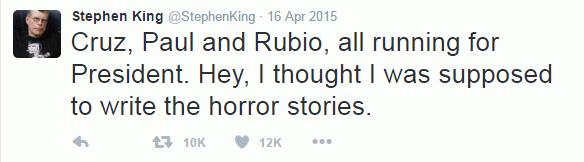
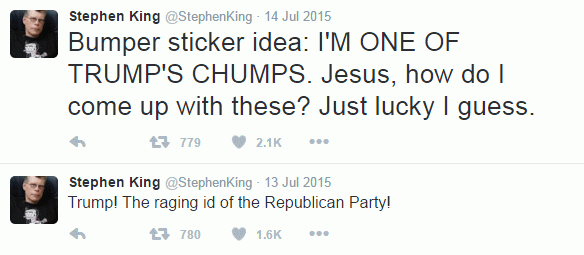
Somewhere, there is a politburo meeting in secret. They are compiling evidence, and building a case. Their thesis is nothing more than this: Twitter must be destroyed.
Obviously, if they rise to power they’ll close Twitter, bulldoze the corporate headquarters, imprison everyone involve, and grind the hard drives into a fine metal powder. But what will happen to the people who use Twitter? They’re the real problem. Final solution: lobotomies all around. They’ll insert a sharp metal rod under your eyelid, gently (or not) insert it past the sphenoid structure, and sever your frontal brain lobe. Not too far, though, or it might be fatal, and we still need people to drive lorries and empty rubbish bins and things. I’m not saying I support this plan. All I’m saying is that it’s real, it’s happening, and right now @StephenKing’s tweets are in the prosecution’s brief.
Is it too much to ask for some entertaining cornball, such as “The man in black created a Twitter account, and the gunslinger followed”?
 “You know, it was always a big thing in my life when I was a kid, because I thought Muppets were cool. Now, I’m not talking about the ones that had their own show, I’m talking the Sesame Street ones. I was one of the people that felt that Kermit was a sell-out when he started his own show. I was never really into it. Fozzie Bear is just a wannabe Grover. I always thought there should have been war between the East Coast and West Coast Muppets. That’s just me.” – Joss Whedon
“Some people heard Johnny Rotten’s cry of “get pissed… destroy!” and took this as a call to set up left-wing youth community theatre projects. I set out to get pissed and destroy”
– Ashley Pomeroy
“That tiger didn’t go crazy. That tiger went tiger.”
– Chris Rock
“A professor is one who talks in someone else’s sleep.”
– WH Auden
“Talent hits a target no one else can hit; genius hits a target no one else can see.”
-Arthur Schopenhauer
“Fingers scratching blackboards makes cowards of the brave” – Ronnie James Dio
“When you’re taught to love everyone, to love your enemies, then what value does that place on love?”
– Marilyn Manson
“My favorite joke of his occurred when George was telling me about the joys of grandfatherhood. “If I could have figured out how to have grandchildren without having children first, I would have done so.” Later on, I knew just what he meant – high relatedness, no work. Or as Melvin Newton (Huey’s brother) once put it, “You can serve them ice cream for breakfast, what do you care?”
– Robert Trivers
“I hate when a director says to me ‘Here’s how I envision this scene’…excuse me? It’s right here in the script – I ‘envisioned’ it FOR you. Do what I wrote. If you want to ‘envision’, you should become a writer. Where the fuck were you when the page was blank?”
– Harlan Ellison
“Never underestimate the determination of a kid who is time-rich and cash-poor.”
– Corey Doctorow
 Jaguar Warriors (Aztecs). You can tell jaguars from leopards because jaguars have a distinctive spot-within-a-spot. You can tell jaguar warriors from other UUs because they blow. Jags are one-joke anti-infantry units that have a handful of uses: if your town is being overrun with eagle warriors and literally nothing else, make a few jags, they will get the situation under control. Otherwise, the story of your jaguar warrior binge ends with them dying, horribly, to almost everything. 3/10
Longbowmen (Britons). Archers with huge range. They kill units underneath castles, snipe siege onagers, and do your taxes. Very useful UU dragged down by something that’s not their fault: Britons just aren’t all that good in Imperial. 7/10
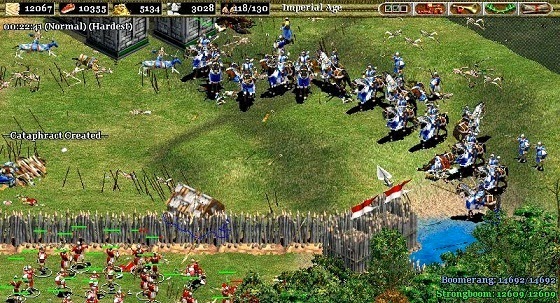
Cataphracts (Byzantines). The shallow interpretation that they are specialised anti-infantry cavalry. The deeper interpretation is that they are a UU without any hard counters. They kill pikes, they kill camels, they aren’t horribly uncompetitive against anything in the game. Unfortunately, they have lots of “soft counters”. Unit for unit they lose to paladins, and even sometimes cavaliers. Slightly low HP and pierce armor make them vulnerable Byzantines don’t get the blast furnace upgrade, which is a shame. 6/10
Woad Raiders (Celts). Infantry with the speed of cavalry. They’re fast, and dish out lots of damage, and critically they have no vulnerability to pikes. Get them into the enemy’s lumberjacks and watch him suffer. Should be used more than they are. 6/10
Chu Ko Nu (Chinese). Perhaps the most dominant UU in castle. Gather them into a large group and you’ve basically got a Starcraft-style death ball that can shrug off anything (knights, skirms, lcav) except mangonels. In Imperial their low HP and range start to tell against them. The way they attack is complicated. The first arrow does full damage (affected by upgrades), and subsequent arrows in the volley do 3 damage, regardless of upgrades. In practice, this makes CKN highly effective at destroying things with high pierce damage (like buildings and siege rams), since they’re getting many more shots in. 7/10
Throwing Axemen (Franks). Here’s a little trick – if you make lots of throwing axemen, you soon get a “You have been defeated!” message. Try it! 1/10
Huskarls (Goths). Anti-archer tanks that laugh in the face of arrows. Unlike other UUs, you can flood them from raxes. With the various Gothic bonuses that stack on to them, they’re perhaps the most bonused UU in the game. One of the backbones of the Gothic army. 7/10
Tarkans (Huns). Shitty UU, perhaps the second most shitty after the throwing axeman. Dedicated building killers that die to everything and aren’t even very good at killing buildings. They have one use: if you’ve got a castle out in the open somewhere, getting attacked by a single unguarded siege ram (this sometimes happens in death match), pop out a tarkan and kill it. Otherwise, make them in zero or negative quantities. 2/10
Samurai (Japanese). Good, but you have to understand them. Micro them intensively. Keep their attacks focused on low-HP units (they attack very rapidly and can kill or neutralise lots of weak enemies) and away from high-HP units. Don’t send them on a suicidal Iwo Jima charge against longbowmen or cataphracts on the basis that “they counter UUs, dude!” They are created very quickly. You both can and should mass them. They aren’t a “make a few here and there” UU. Lots of caveats but a decent unit all around. 6/10
War Wagons (Koreans). Lots of HP. They’re not exactly damage-dealing dynamos, but they fall nicely under the category of “support unit”. The idea is that while your enemy is trying to fight these overfed things, your siege onagers/bombard towers are raining heck on him. They even go well when paired with halberdiers. 6/10
Turtle Ships (Koreans). Near-worthless jokes that continue to baffle me with how bad they are. What’s the point of a slow ship that gets outranged by galleons? The enemy can just keep retreating out of range and kite these things to death. Yeah, they can nuke enemy docks, but if you’re in a position where the other guy is letting you pound his docks, you’ve basically won the game anyway. 2/10
Plumed Archers (Mayans). Fast, insanely tough archers that rule so much in Imperial. One of the two main tentpoles of Mayan army. Make them as soon as you can and never stop. 9/10
Mangudai (Mongols). Perhaps the best UU in the game. Cavalry-mounted machine guns that unleash a rapid stream of arrows into the nearest enemy soldier, the soldier standing behind him, his dog, his mother, his favorite out-of-work 80s sitcom star, and so on. Get a bunch of them into the enemy’s trade cart line and he’ll have lost 30 before he even realises they’re there. Nothing brings sudden, unexpected death like mangudai. 10/10
War Elephant (Persians). 620HP behemoths that defeat every other unit in the game with hundreds of HP remaining. Due to their massive cost (not so much gold as food), these are usually reserved for big team games with a Persian in the pocket, but when they appear, your opponent NEEDS to immediately have a counter. They cannot be ignored. They lay waste to everything in their path. Certain units counter them cost-effectively, but none counter them pop-effectively. If you can mass 80 elephants, your opponent probably won’t have the 320 halberdiers needed to stop them. Converting them sometimes works. Heavy scorpions with a meat shield works better. Either way, there is no elephant-sized pooper scooper to clean up these turds. 9/10
Mamelukes (Saracens). Any type of cavalry instantly becomes obsolete when these scimitar-hurling lunatics punch in for work. Slightly easier to counter than mangudai (tip: make skirmishers), but no less terrifying, these are a critical element of the late-game Saracen army. They shit on most units, and since they do hack damage they can rapidly take out buildings and siege equipment. These things are expensive, but they do an incredible amount of work. 9/10
Conquistadors (Spanish). Another great UU. Most effective in castle but stays competitive in Imperial. Like the cataphract they have few weak spots, and with their massive attack and fast speed they work well at basically anything you put them to. Very often the guy racking up ridiculous k/d ratios has conquistadors to thank. 9/10.
Missionaries (Spanish). Fast monks with less range. To be honest, I never see these used. Maybe they’re good, and we don’t know. Remember how it took years of everyone ignoring Aztecs and Mayans before people learned to DRUSH using them? For now, the jury’s still out. ?/10
Teutonic knights (Teutons). War elephants with three less attack, FIVE HUNDRED AND TWENTY FEWER HP, more armor, and no weakness to halberdiers. Pretty useless. Kind of the turtle ships of the land. They’d potentially hold a Goth player at bay for about three minutes until he gets some archery ranges built. 3/10
Jannisaries (Turks). I take back what I said about Chu Ko Nus, THESE are the best castle-age UU. For a while a winning strategy was to sling your Turkish team-mate to castle, let him pump jannies, then laugh your way to the victory screen together. 17 attack is really hard to beat in castle. They probably come off a bit better in Imperial too, when all is said and done. Note that hand cannoneers get 17 damage but +10 vs infantry, while elite jannies get +22 with no bonus to anything. A cunning Turkish player will switch from one to the other depending on what opposition he’s facing. 8/10
Berserks (Vikings). Crappy infantry that heals itself. What’s the point? As soon as they start fighting, they usually die. They never get a chance to heal themselves. I put them in the “tarkan” category. Use them if your castle is getting attacked and you have no other units nearby. 4/10
Longboats (Vikings). Unspectacular performance against galleons. Pretty good at sitting on the shore and shooting into the enemy’s town, but as with turtle ships, if you ever get to do that, you’ve basically won the game anyway. Late-game naval combat is one of the things ES made wrong. It’s just a game of who can mass the most galleons. All of these other naval units are just awkward fifth wheels, if you’ll pardon my Geneva convention violation against metaphors.
(No, I haven’t played any of the non-ES add-ons of the game)