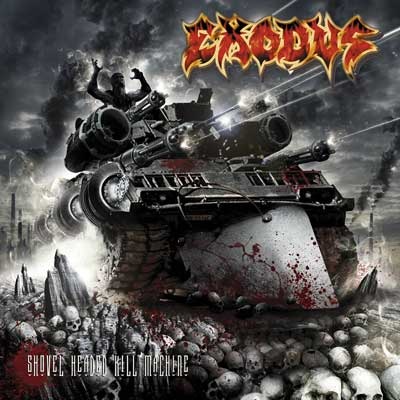
 When people say “time has passed”, they actually mean “events have happened in the time that has passed”. The number of years doesn’t matter, just the changes the years have wrought. Thrash metallers Exodus released Force of Habit in 1992 and then did not put out another studio album for twelve years, but 2004’s Tempo of the Damned found them playing the same style with nearly the same lineup. Yet just one year later, Exodus had fallen apart and had reformed with radically different members, and a modern, quite different style.
Rick Hunolt is out, Heathen’s Lee Altus is in. Tom Hunting is out, frequent Slayer fill-in drummer Paul Bostaph is in. Most worryingly, Steve Souza is gone again, probably forever this time, and in his place is one of metal’s less convincing frontmen: Rob Dukes.
To be honest, this guy’s vocals take a lot of getting used to. Possibly an infinite amount of getting used to. Souza had a nice Mustaine-like snarl. Dukes’s voice is a haggard bark, like a cranky old person and a chihuaha rolled into one. He’s VERY limited vocally, just be thankful he doesn’t try any clean singing (go straight to The Atrocity Exhibition: Exhibit A for that…eww.)
Fortunately, the band’s wunderkind guitarslinger Gary Holt is still in evidence, and he puts out his usual barrage of hard-edged thrash riffs. The upgraded Exodus war machine unleashes brutal song after brutal song…although they often don’t have the consistency one would like.
“Raze” is a certified winner. It’s not a song, it’s a slash at your neck hard enough to decapitate the three people behind you.. “Now Thy Death Day Come” and “Going Going Gone” are more songs in the same vein, featuring brutal riffs and a heedless forward charge worthy of a Tennyson poem. “Deathamphetamine” is a little more varied…in quality, and in tempo. It has lots of great moments, just not enough to carry it across its 8:31 running time. Exodus seems to have caught Metallica’s disease of finishing a song and then continuing for 2 or 3 minutes.
“Shudder to Think” and “Altered Boy” are heavy midtempo tracks. Their primary strength is Sneap’s dense production style. “.44 Magnum Opus” has a great title, and great lyrics. “A motherfucking Van Gogh with a gun”…Exodus lyrics are always best when they’re tongue in cheek, and it’s a shame that they become all faggy and serious on their next release. The title track is quite short and not very focused musically. The band didn’t seem to put much thought into writing it. Turnabout’s fair play, I didn’t put much thought into listening to it. “Karma’s Messenger” has some harmonised riffs, giving it a slight Arch Enemy character. The Japanese release has two bonus tracks, a Sex Pistols cover and “Purge the World”, wherein lies more thrashing.
“Shovel” is brutal and heavy…but it’s very different from past Exodus releases. It has a different feel and flavour from the classic albums, and although the riffs are still great, some of that classic Exodus swagger seems to have disappeared. The band sounds quite mechanical and lifeless these days, the odds of them writing another song like “Toxic Waltz” are slim. Bonded By Blood and Shovel Headed Kill Machine are like the T-800 Terminator and the T-X, respectively. Kristanna Loken might be harder and meaner, but people will always feel more attachment to the fleshy, bleedable Arnold Schwarzenegger.