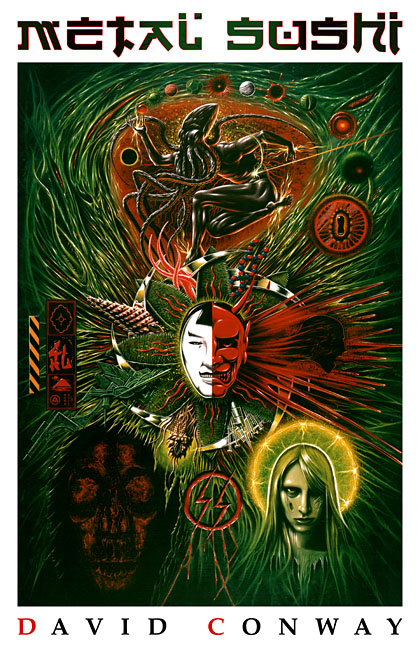
 Starry Wisdom had a story called “Black Static”, by David Conway. It wasn’t the best story in the collection, but it was the defining story – the one that kind of spoke for the others. Then I read Starry Wisdom‘s sequel and “Manta Red” went one better – it was the defining story of the volume and the best one.
Metal Sushi contains both these tales, and four others. Conway’s work could be described as the bang-from-behind bastard children of surrealist literature and those ultra violent 90s anime where the human body is a bag containing about twenty gallons of pressurized blood. He throws a lot at you – lots of themes, lots of ideas, and lots of dense, adjective-stuffed prose.
The first story is “Eloise”, which is like an Oscar Wilde or Edgar Allan Poe story performed in modern dress – very dark and romantic. “Black Static” is more chaotic and challenging, and extracting meaning from it feels more like deciphering tea-leaves than the normal reading of a story. “Manta Red” (the greatest story in this volume, too) is the interstice between the two.
This collection gathers all of Conway’s strengths as a writer, but it gathers all of his weaknesses, too. Metal Sushi suffers from “too much”, particularly “too much writing.” Certain parts sound like the kind of thing they make fun of in the Bulwer-Lytton contest. “His failing metabolism slid further along the steep, declining gradients of encroaching mortality”…he grew old, in other words.
But it also suffers from “not enough.” Despite the purple prose, Metal Sushi feels cold, with not enough energy or passion. It lays out thousands of ideas, but often to little effect. At times it reads like an author writing sentences around interesting words he found in a thesaurus (“A numinous parallax whose focal apex is rooted deep in the reptilian matrix of avatistic consciousness”) – and Michael Gira and James Havoc play that game much better.
But to be honest, I knew what I was getting into. “Black Static” and “Manta Red” were very memorable, but then one has to ask what they were memorable for. David Conway’s writing is a fragmentation bomb of words, blasting you with sensations and ideas, but at the same time blasting other ideas ineffectively away from you. It’s not focused. This is the kind of book that tries to do everything at once, and cram Lovecraft and Akira and Burroughs and Blade Runner into one book. Does it work? Not always. In fact, not even often.
At first, I thought the title was nonsense. Now I see that I was wrong – this book is exactly like metal sushi. Different. Not much nutritional value. Likely to give you tetanus. But eating (or reading) it will be an experience you’ll remember for a while, and I think that was the author’s main intention.
 In one of his books Neil Strauss says something about male psychology. You can take literally any task in the world, give it grades, rankings, and scores, and men will become obsessed with it. What’s the point of martial arts? To learn how to defend yourself? Probably. Most of the guys at your local McDojo are there to attain a higher belt level.
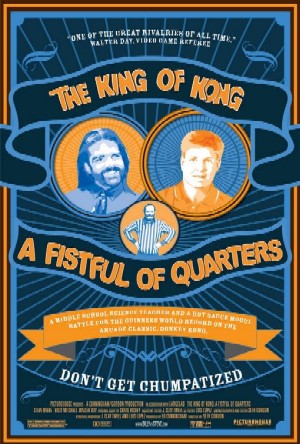
Donkey Kong is an arcade game released in 1981. It runs on a 3MHz CPU, a 224×256 resolution, and the game mostly involves dodging barrels thrown by a gorilla. But because there’s a world record at stake, grown men play it obsessively.
This documentary covers the war to set the top score in Donkey Kong. For many years, the highest score was held by a hot sauce entrepreneur called Billy Mitchell. Then, in 2007, an unemployed schlub called Steve Wiebe set a new record, causing a scandal in the community.
I mistrust King of Kong as a documentary. Its events seems too perfect, too movie-like, too different to real life. But it’s interesting. Lots of battling egos. I liked the way it captures the exhaustion of extended gaming marathons, with the players’ brains grinding themselves to mush. It’s not barrels or fireballs that kill the players at this level, it’s their own fatiguing mental circuits.
Wheels spin within wheels. How do you verify a high score in a videogame? Is a videotape enough, or do you need to perform it live at a “meet”? Is it possible that Steve Wiebe is playing on a “fixed” board that makes it easier to score? Is he being shafted by Twin Galaxies, the organisation that verifies videogame scores?
This movie could cause a psychoanalyst to start climbing the walls. Billy Mitchell in particular seems to have missed his true calling as a cult leader. He’s creepy, charismatic. He doesn’t speak, he asserts. Steve Wiebe seems much more down to earth, but his obsession with the game is only slightly less odd. There’s other memorable characters, like Walter Day, the incongruous head of Twin Galaxies, and Brian Kuh, a weird yes-man in Billy Mitchell’s corner. He doesn’t seem like a guy who has ever spoken to a girl, although he might not be a virgin if you take my meaning.
Probably the most bizarre person in this movie is Roy Schilt, “Captain Awesome”, who talks about his world record in Missile Command like it’s the Pulitzer Prize, and wonders why he hasn’t appeared on any TV shows yet.
And it does seem like a peculiarly male obsession. What’s one of the most popular games among women? The Sims, which has no goals, no scores, no competition. You win when you decide you’ve won. But men seem to need an element of contest in their games. Put them in suburban homes, put them in suits, give them haircuts (a poor one, in Billy’s case), and it doesn’t matter. Only the dead have seen the end of war.
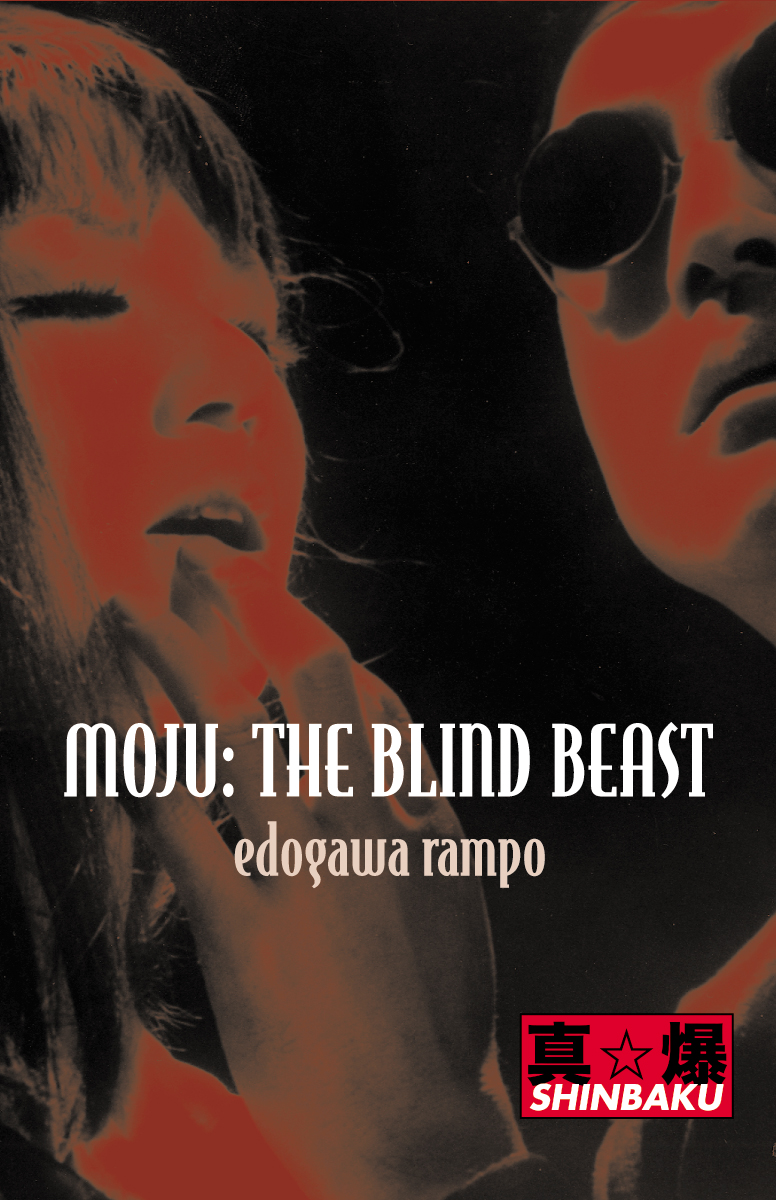
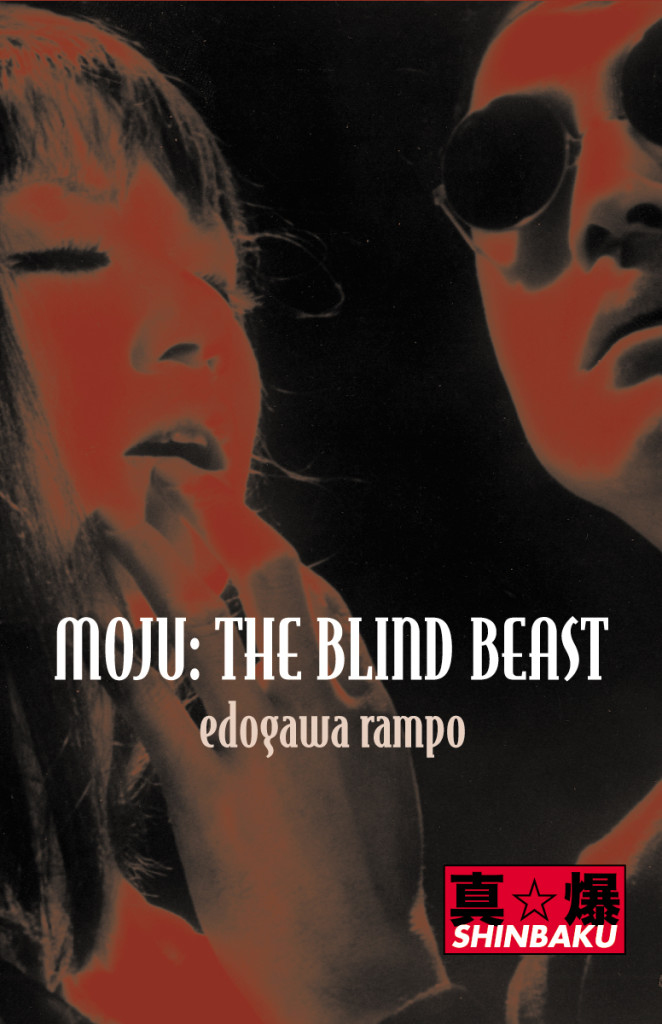 In 1925 Edogawa Rampo wrote one of Japan’s creepiest horror stories. “The Human Chair” was the literary equivalent of pleasantries from the mouth of an leering pervert – the events were tame, even funny at the end, but its subtext of sickness and depravity made it hard to forget.
Moju: The Blind Beast recreates the same atmosphere, but now that subtext is matched with violent and gruesome events more in line with the Hollywood slasher movies it predates by forty years. It has moments of humour, as well as amusing Japanese political incorrectness (Hawaiians are described as “barbarous”, Westerners in general are “disgusting”), but the main impression The Blind Beast leaves is one of destruction and carnage, blood spraying the walls like an artistic fresco.
Singer Mizuki Ranko is being stalked by an blind man of artistic bent who is obsessed with touching the curves and contours of her body. Soon, she finds herself imprisoned in his underground maze, which has walls fitted out with rubber breasts and noses and legs. The man has an obsession with touching things, and craves the stimulus he cannot get from his eyes. He has chosen Ranko to fulfill his desires, and she still might not be enough.
I liked “The Human Chair” more, mostly because it’s more compact and focused, but The Blind Beast is an entertaining read and touches upon many similar themes. Rampo obviously wants to be more sexually explicit, but for whatever reason (fears of censorship or his own prudishness) he tends to imply or insinuate sex rather than outright state it. The effect is rather brilliant, and probably more disturbing for the fact that it isn’t explicit. I’m reminded of how Hollywood’s Golden Age occurred during the period when it laboured under the infamous Production Code.
The book has things to say about art – again, through allegory and inference. The book ends with the blind man conducting an art exhibit, showing a sculpture made from the pieces of various murder victims. A not-so-nice feature, but artists are often not-so-nice people.
The truth is, if The Blind Beast‘s artist goes to hell for his crimes, he might have to wait in line. John Lennon liked to tune up on his wife. So did Elvis Presley. William S Burroughs shot his wife in a drunken game. Allen Ginsberg is a member of NAMBLA. All these guys were members of the vaunted 50s/60s counterculture, back when people thought that art would be the force that saves us from the evil capitalists and what not. A nice idea, but maybe Rampo was right.
Maybe artists, deep down, are the worst people of all.