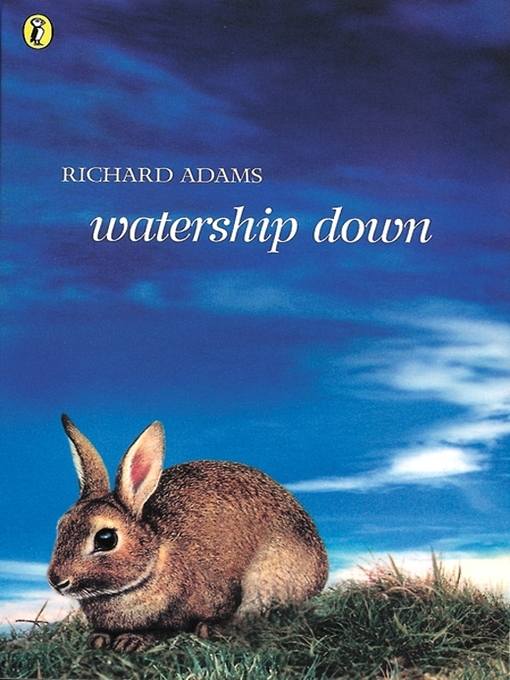
 This book humbles you, and makes you realise how powerful stories can be. It’s about rabbits.
It’s been said that carnivores evolved binocular vision – both eyes pointing forward – because it’s better for hunting, while herbivores have eyes on the sides of their heads to maximise their field of vision (there are exceptions, pandas have binocular vision, for example). Combine sideways eyes with disproportionate ears and fast legs and you have a rabbit, a creature with a thousand enemies. To be a rabbit is to live in fear. Your very design is a statement of your vulnerability.
It must be stressful to be a rabbit. Constant danger. Constant alertness. Attacks might come from any quadrant and any direction – the sky, or the ground below. Your weapons are inadequate. Your only defence is vigilance. Fortunately, the fictional rabbits in this story have another defence: a precognitive runt called Fiver who one day has a vision of destruction falling on their warren.
Attempts to persuade the chief rabbit fail, and a handful of believers abandon the warren. What follows is an adventure in southern England, and then an attempt to start a new warren next to the aggressive and warlike Efrafans.
Adams makes us feel the terror and smallness of a rabbit’s existence. Human things like trains and bulldozers seem as monstrous as Greek titans. Cats seem as cruel to us as they do to the numerous small creatures in the story. There’s a scene where the heroes are helping some rabbits escape from a hutch and it feels like they’re storming Fort Knox. Reading Watership down is like watching an IMAX movie, every blade of grass magnified a hundred times on the screen.
The numerous scenes of lightness and comedy (such as the stories of the mythological rabbit El-ahrairah) are perfectly inserted into the story, and relieve the tension without breaking it. Characterisation is another strong point. Every real life rabbit has seemed boring indeed next to these ones. Nearly every real life human, too.
Some authors cheat and make their animals into humans (as in Pride of Baghdad). Other authors are conservative and leave their animals fully animal, which sounds laudable but is often boring in practice (I think Tarka the Otter was like that, but it’s been years since I’ve read it).
Richard Adams achieves a balance. The rabbits are anthropomorphalised enough so that we relate to them and understand their motives, but they are still animal enough to thrill the reader with their strangeness.
Despite their vulnerability, rabbits have proven to be astonishingly successful. A thousand enemies haven’t stopped them from devastating my country’s ecosystem. This book is equally successful, and far less harmful. It’s an amazing story that exalts the small, and makes holes dug in the ground seem like palaces.
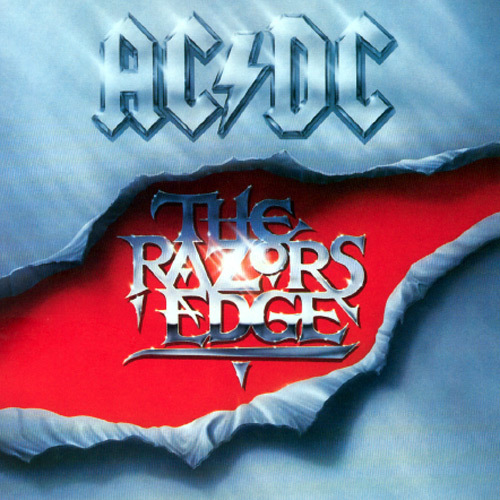 After releasing a few albums so featureless that I suffer from narcolepsy thinking about them, AC/DC stopped messing around.
The greatest four-song streak in accadacca history starts with “Thunderstruck”, featuring a iconic main riff and a great vocal performance out of Brian. “Fire Your Guns” is fast boogieing rock with lots of attitude – when it wants to, this band is better at being Aerosmith than the actual Aerosmith. “Moneytalks” is fun, catchy, and irresistable. “The Razors Edge” is another patented AC/Creepy song…maybe their second best AC/Creepy song, after “Hell’s Bells.”
After these four songs end, the album goes into fillerland, but even the filler sounds energetic, switched-on, and inspired. Listen to “Rock Your Heart Out”, with its nimble, ninja-like slashes of guitar and bass weaving through Chris Slade’s percussion. “If You Dare” is built around a catchy hook-and-release formula. “Are You Ready” is a drawling, sprawling song that sounds like a bar’s last call encapsulated in music. “Shot of Love” has a hard, mid-tempo grind. On every track, the band sounds muscular, vital, and alive.
What happened? Slade is definitely a factor. His drumming is much busier and more interesting than Phil “Wants To Be A Metronome” Rudd. I gather he didn’t work out personality-wise, but he’s probably the best drummer AC/DC has worked with. Normally Angus and Mal’s riffs are what I pay attention to when I listen to this band. On The Razors Edge I listen to the drumming, too.
The production is also a bit different to past records. The muddy, reverb-saturated din of Fly on the Wall et al has been traded out for the crisp production style that AC/DC has used ever since. The title is appropriate, as this record has a sound sharp enough to shave with. This is the first AC/DC album to not be immediately dated by its production style.
But mostly, it’s the songs. They are good, and nothing else is required – the new drummer and revamped sound are just paint. I don’t know what happened, but the band seems revitalised and renewed.
AC/DC realises that never changing your music can be a bug, but it can also be a feature. While other bands are getting in on prog rock or grunge or nu metal, AC/DC just keeps doing what they do, oblivious to trends. On this album though, they made some subtle shifts, and all of them were for the best.
This lineup fell apart, and AC/DC began another gradual slide into boredom. But this was an exciting album, not just on its own merits, but because of what it portends for the future. The old power lives on. AC/DC might seem hooked up to life support these days, but only a fool pronounces them dead.
The missing apostrophe bugs me, though.
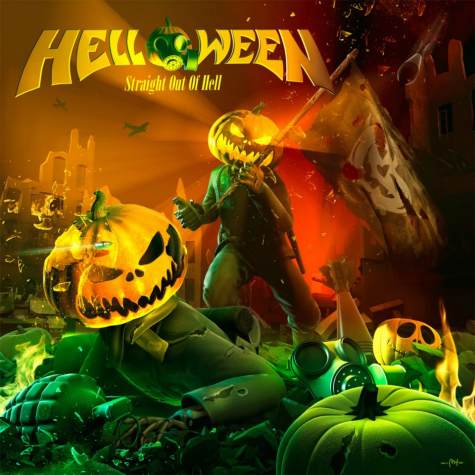 What happened to this band, and what are the chances of it unhappening?
Helloween’s latest album has some good songs. Not too many – you won’t need to graft additional digits on to your hands to count them – but they’re there. Yet it doesn’t matter. The magic is gone. What happened to the good old days, when the songwriting was careless and free? Helloween is now an overcalculated parody of itself.
To recap, Helloween’s Keeper of the Seven Keys 1 and 2 established them as a band of huge promise in the late 80s. Speed metal was already desiccating into something dry and unappealing – Helloween sounded fun, colourful, and catchy. They soon moved away from metal and started aping The Beatles, which went over as well as you’d expect.
The band reshuffled its lineup and had a nice little renaissance in the mid 90s, with Roland Grapow on lead guitar and Uli Kusch on drums. Then that lineup collapsed at its high point (The Dark Ride), and the band decided to call it a day. Or so my crack fantasies go. In reality, here we are with yet another not-so-essential power metal album.
It has better production than the last few albums, but that highlights what a meatless meal this is. Most of the songs are simply not good. And even when they are good, they’re an obvious, safe kind of good. Opening track “Nabataea” is one from the latter category, containing a rote progression of effects-laden intro –> Iron Maiden melodies –> Megadeth thrash riff –> etc. Very predictable. You can almost hear the band ticking things off a list.
That song was written by the guy behind the microphone. If you want to talk about The Beatles, Andi Deris is this band’s Paul McCartney. He’s written some of their most powerful and interesting songs (“Before the War”, “The Shade in the Shadow”, “Time”), but also some of their most commercial and irritating (“As Long as I Fall”, “Mrs God”). On this album, he is an outright liability. He contributes five songs, and three of them are hogwash. Firing Deris would not save this band but it would be huge step in the right direction.
The album’s best moments are penned by Michael Weikath. The scorching mini-epic “Burning Sun” and the catchy and nostalgic “Years” are very good songs, I keep coming back to them even after I’ve forgotten what’s on the rest of this disc. In the Keeper era, Weikath was the band’s weak link. Now he embodies everything that’s still good about this band.
Grosskopf still has his highly active basslines, and Sascha Gerstner makes a fairly good lead guitarist (Roland cannot be substituted for.) I don’t know why I dislike Daniel Löble’s drumming. Maybe it’s the overloud cymbals, maybe it’s his fill-heavy style that tries to make the music all about him. Competent musicianship all around.
But competent musicianship doesn’t mean competent music. Straight out of Hell is boring and crappy. Didn’t they realise that nobody wants to hear “We Will Rock You” by Queen ever again, and that rewriting it into a 2 minute joke song called “Wanna Be God” is gilding a venereal lily? Didn’t they realise that three of these songs (“Far Beyond the Stars”, “Make Fire Catch the Fly”, and “Church Breaks Down”) have the exact same chorus? Didn’t they realise they should have broken up years ago?