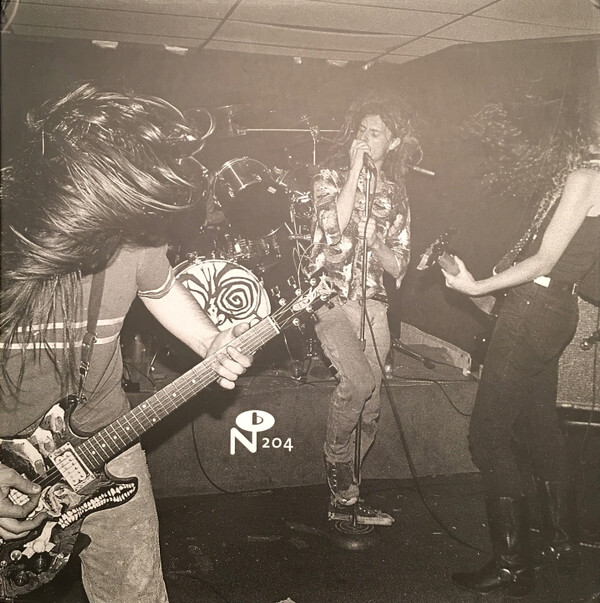
White Zombie lived Charles Beaumont’s quote about showbiz.
“…like climbing to the top of a mountain of manure to pluck one perfect rose– only to discover that you’ve lost your sense of smell.”
They slaved for a decade to the obdurate disregard of the record business. Too art school for CBGB’s and too tasteless for East Village, they floated between punk rock, psychedelic noise rock, and heavy metal, depending on which guitarist was in or out. They were always broke, sometimes homeless, and occasionally starving. Their singer changed his name three times. It sounds like the kind of arduous vision-quest where if you knew what was ahead you’d never take the first step.
In 1992 they got their break and became one of the defining metal acts of the decade. It was too late. The band was already kind of over. Behind the scenes they’d burned out, couldn’t get along anymore, and the bassist and singer had broken up. Shortly after White Zombie exploded in a good way they exploded again, this time in a bad way. Instead of reaping the rewards of their toil, it all just ended. Their career as a headline metal act seems compressed and short: a band that came from nowhere only to vanished into the deep abysm of history. Most fans did not know about the ten-year iceberg beneath the water, but that’s the part of the iceberg that wrecks the ship.
For years, White Zombie’s early releases were obscure rarities. (Hidden on purpose, one might suspect…) As a teenaged fan reading the band’s Wikipedia, I was struck by the contrast between the band’s first release (Gods on Voodoo Moon—no label, self-produced, sold 100 copies) and their last (Astro-Creep 2000—major label, produced by Terry Date, certified 2x Platinum). It’s hard to imagine Metallica’s first album (for example) languishing in such neglect. Once White Zombie began filling arenas, why did nobody put these early albums back into print? For that matter, what did they even sound like?
To answer the second question: “it depends but mostly like the sonic equivalent being projectile-vomited face-first into a slaughterhouse.”
To answer the first: “because Rob Zombie did not allow it”.
Rob is a complicated guy. I have said as much before. A blunt but honest read is that he’s both the party most responsible for the band’s breakup and the primary legal obstacle to its older work being available. I’d psychoanalyze him as someone who loves other peoples’ pasts (his art is colored by the aesthetic seepage of Russ Meyer and Sam Peckinpah and Universal horror films and…) but who feels mainly disregard, alienation, or hatred for his own past. He’s a visual artist in the most Baudrillardian sense, a manipulator of images, and he seems to dislike the idea of a permanent record that fundamentally cannot be changed.
Even as a kid, I noticed that Rob (when interviewed) was reluctant to remember or reminisce—he’d give short non-answers, always railroading the conversation back onto his current project. (Guaranteed interview-killer question: “will you bring White Zombie back?”). He was impervious to nostalgia. A typical Rob Zombie setlist used to be “80% or so of his last album, plus some token past hits here and there” (lately he’s broadened out a bit). And when he parts ways with a musician, he generally does so permanently (there are two major—and again, recent—exceptions). To him, the past is very much a foreign country, and he’s in no hurry to renew his visa. I recall an impromptu fan Q&A session held on his MySpace page. The first question was something like “why won’t you play any old White Zombie songs live”? He replied with something like “because nobody knows them and I’ve forgotten them and there’s no point so thank you” and then basically never spoke to anyone on Myspace again. Fair enough. He moves on. Maybe we should too.
But in 2008, the de-facto omerta against White Zombie’s early years ended. Rob (likely motivated by a crazed WZ fan holding a gun to his head) finally surrendered and re-released the WZ back catalogue as a five-disc box set called Let Sleeping Corpses Lie. The title said it all—the only box he thought White Zombie belonged in was a coffin. It was a disappointing, poorly-packaged release with no liner notes and no input from band members other than Rob, and various ex-Zombies lined up to publicly barrack it. … https://blabbermouth.net/news/former-white-zombie-guitarist-talks-band-s-split-let-sleeping-corpses-lie-box-set
Crawdaddy!: I understand you had no input in “Let Sleeping Corpses Lie”, the WHITE ZOMBIE box set, at all?
Yuenger: Not at all.
Crawdaddy!: How did you find out it was happening?
Yuenger: They sent me and [former bassist] Sean [Yseult] mockups, like, two days before the release date. There was such little thought put into it. None of the photos were credited — we were like, “Uh, you know you have to credit photos or people can sue you?” And they were like, “Oh.” There were no liner notes, which are essential for something like that. I mean, the band had such an interesting story, how could you not have liner notes? I hear about it all the time from fans. They’re happy that the super rare early records are on there, that’s cool for them to hear, but the packaging sucks. Sean’s got all kinds cool shit — photos and flyers and stuff that they could have put in there.
[…] Crawdaddy!: I’m detecting an acceptance in your tone. Are there no hard feelings on your end?
Yuenger: Oh, sure there are. [Uncomfortable laughter]
Jay Yuenger, via Crawdaddy
and
Rock N Roll Experience: I thought it was lame that you & J. had no involvement with the White Zombie box set.
Sean: Yeah, I sent them some VHS’s & J. and I were both getting stuff together and next thing you know we were sent some proofs of, “here it is, it’s done!” & there was all kinds of mistakes on it, lack of credit to photographers and friends and band members and I was trying to make corrections and they were like, “Oh, it’s already being printed.” (laughs) It was a little bit of a fuck you to me & J. which was kinda weird since we were 2/3rd’s of the band but anyways…(laughs)
Sean Yseult, Via Rock-N-Roll Experience
Rob Zombie hates the past. When he’s allowed to define it, he does so in the most shoddy, careless, self-serving way possible.
In 2010, Sean Yseult published I’m in the Band, a tour diary and photobook of her years with White Zombie. Then in 2016 Numero Group released It Came from N.Y.C, a much better boxed set (it contains liner notes, audio remastered by Jay Yuenger, and even a pile of unreleased tracks from the Tim Jeffs era!) which may be as close to definitive as we ever live to see.
Or hear, if you’re a weirdo who opens a $150 boxed sets to listen to the music. Early White Zombie releases are incredibly different to their later incarnation as industrial metal titans: I cannot stress this enough. This is music by the sewer, of the sewer, for the sewer.
Its most listenable moments are scruffy unproduced proto-Pixies punk rock. Its most challenging are the ear-splitting avulsions and contortions of Soul-Crusher—storms of Michael Gira-esque noise that I cannot listen to for more than a few seconds with the volume dial past three. It’s a corrosive, hateful sound but a compelling one, mucus-slick and burning in the ear. It reminds me of a time I was really sick, and I vomited some stomach acid up my nose.
These records were recorded with some expense spared. You can very much hear (spiritually, if not literally) Rob’s roommates pounding on the wall, yelling “shut that racket off!” You might want to join them. I can easily believe this band did not have record labels banging on their door waving checks. I can also easily believe they did not have a door to bang on. This confused and confusing thing, nominally a band if not always practically, was simply not a thing that could be marketed or sold. This site, with early press, captures the confusion they inspired. Journalist after journalist simply doesn’t “get” the band at all, and are forced onto dreaded “quoting the band’s titles/lyrics” territory.
JUST what is a “slug motion dinosaur”? Have you ever had a “cannibal collision American girl suckin’ your gut”? Do you find the phrase “some kind of portable radio melted into her screaming legs” horrifying or just a bit of a ribtickler?….Christ what a lyric sheet!
– Billy Lucas
FROM the Pussy Galore strain of piss-off wrought iron thrash and trash, White Zombie have all the right titles–“Ratmouth”, “Diamond Ass”, etc., the right name and…..well, “Soul Crusher” is just right.
– Greg Fasolino
When you’ve reduced scumcore nowave countercultural journalists (used to extracting comprehensible prose from Thurston Moore, Glenn Branca, and Lydia Lunch) to saying “these weirdos and their song titles!” it’s possible we’re looking at a rough sell.
White Zombie had identity issues from the start. They changed genres basically every time they changed guitarists, and they did this a lot. Paul “Ena” Kostabi in ’85. Tim Jeffs in ’86. Tom “5” Guay in ’87. John Ricci in ’88. Jay Noel Yuenger in ’89. All of these men had different styles, different abilities, and different limitations.
The style shift from 1985’s Gods of Voodoo Moon (“badly-produced but tuneful punk rock with wailing guitar solos”) to Pig Heaven/Slaughter the Grey (“5-7 minute long long psychedelic rock noodle-fests”) is noticeable. Then Tom Guay joins, leading to the sky-dissolving noise-acid of 1987’s Psycho-Head Blowout and Soul-Crusher. The progression (or disintegration) of the band’s music is fascinating, but there’s not much here for me. “Gun Crazy” has a crazy mathcore riff that sounds like Dillinger Escape Plan or whatever and “Ratmouth” kind of has a chorus. Otherwise, all these songs run together and the track lengths feel like suggestions. 1989’s Let Them Die Slowly is a thrash metal album, if a bit noisy and slow. It has a weird phased-out quality and an empty lifeless mix. “Disaster Blaster” is the closest to a WZ deep cut we get here. You can see the chorus riff re-appear (faintly) in later songs like “Black Sunshine” and “Blur the Technicolor.” It’s most notable for where it’s pointing: toward metal, toward comprehensibility.
Running through a decade-long tumble of chaos and flux are two steel supports: Sean Yseult’s bass (she varies in how loudly she’s mixed but her playing is always aggressive and forceful) and Rob Zombie’s psychedelic day-glo horror lyrics and art. Rob’s vocals are not on the list. His voice and vocal approach changes and matures with time. In the early days, he is as unrecognizable as the rest of the band—a harsh nasal presence who usually doesn’t gel with the music at all. The guitar work of Tom Five and John Ricci is wildly expressionistic, but Rob is consistently unable to find his way in. He sounds like a karaoke singer howling over a song he doesn’t quite know (which may well be the truth). He has a weird tic where he delivers lines as anapests, stressing and cutting short final syllables. Howling out sound like a windsock, then stomping it flat. You hear this in, eg, “Power Hungry”:
“Fu-TURE! a-LIVE! ro-BOT! ciTY!”
According to Sean Yseult, his scatted-and-spat-out vocal rhythms were largely made up by him at the mic during recording sessions (which tended to be one-take affairs). Only later would he discovers his thunderous from-the-chest roar—along with producers who have heard of multitracking to thicken out a singer.
Let Them Die Slowly is a big leap forward in this regard, even if it’s onto a fad (thrash metal) that was already starting to die. 80s Metallica proves an overshadowing influence—”Demonspeed” is kinda just “Jump in the Fire” mixed with “No Remorse”, and most of the others are equally obvious in their derivation. But Rob’s vocals are now very close to his modern style.
In 1989, Jay Yuenger joins, and the band releases its final EP (God of Thunder). They are nearly in their final form here. Neither “Love Razor” and “Disaster Blaster II” are fantastic songs, but they’re clearly White Zombie songs. The only element still missing is the electronic samples (inspired by the hip hop, a’la Public Enemy, which was then everywhere in the Five Boroughs).
Yuenger is pretty clearly “the” White Zombie guitarist. The massive groove-thrash riffs underpinning Astro-Creep 2000 are phenomenal, and are captured in one of the heaviest guitar tones ever on a record. But the work of his predecessors is strange and interesting, and I had overlooked their influence until now. You’d wonder if some of Yuenger’s “edgier” riffs, like the one just before the verse of “Electric Head pt.2” (Is it F#sus2/4? F#add9? Whatever…) were always just an attempt to recreate Tom Guay’s wild noise-rock jangle.
It Came From N.Y.C. is fascinating as a record of where a band comes from. Do I like it, though? Well, it doesn’t want to be likeable, so I suppose it would have failed if I had.
No, I don’t want to hear any of these songs again, but I understand the band a bit better from hearing them. This is a group striking a nihilistic “fuck everything” pose from the gutters of Manhattan, only to decide they wanted some of that everything, so they conformed just a little bit. It suited them. They became my favorite band for years and years—hooky, ingenious, clever, and supremely heavy. I do not regret for a moment that we lost another Sonic Youth or the next Metal Machine Music, because we got La Sexorcisto: Devil Music Volume One and Astro-Creep 2000 in trade (plus Rob’s solo music). Many experimental artists would be wise to follow the advice of “sell out as fast as possible”. Experimental art sucks, frankly.
This boxed set seems like it will be the end of White Zombie. The final stopping point. As Beavis and Butthead might comment “They were cool, and broke up before they stopped being cool.” What more can you hope for? Mourn not a dead zombie. That’s a common state for them to be in (perhaps even a fundamental one). Rather, rejoice and marvel at a zombie that was once alive…even if it was just for a fleeting moment, twenty years ago in the Lower East Side.
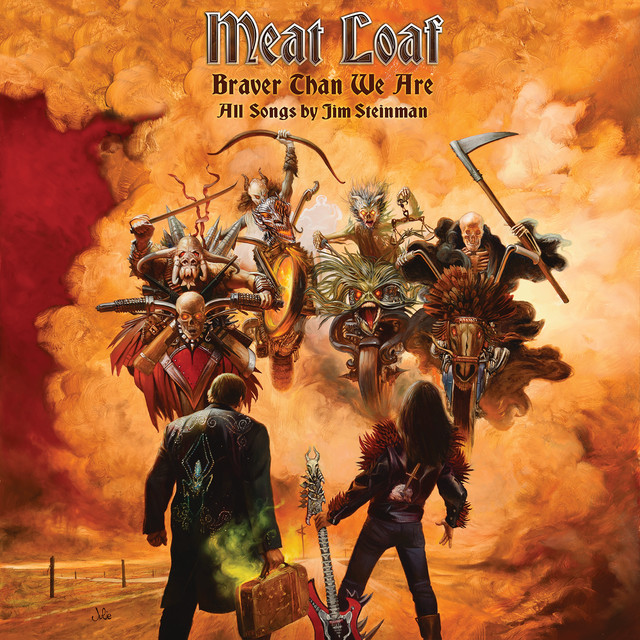
The final album by Michael “Meat Loaf” Aday and Jim “Jim Steinman” Steinman arrives bedecked in heraldry. It knows it has to matter. It pulls out all the stops. It brings back Ellen Foley and Karla DeVito. There’s “All Songs by Jim Steinman” glaring off the cover with point-making intensity, with “Desmond Child was taken out back and shot” in small print (wait, it’s not on yours? It’s on mine. Mostly because I added it in Sharpie.). Every work of art might turn out to be your last. Both men clearly sensed—maybe knew—that this was the end.
Even if you agree with producer Todd Rundgren’s view of Bat Out of Hell (Interview Q: “Do you ever put on the record and listen to it?” Todd: “Not much.”), it’s impossible to see the Julie Bell cover art—two figures vs the apocalypse; a giant with his slumped shoulders Atlas-huge and Atlas-weary, and a scrawny brave lion with his hair blowing behind him—without feeling a sting of sadness. What an incredible forty-year partnership these men shared.
And so it is with regret that I pronounce the Braver Than We Are a bin fire. If you love it, you’ll have to love it for both of us.
I knew he was sick. I still wasn’t prepared for how bad Meat Loaf sounds on this record. On Dead Ringer his voice was only worn-out and haggard, here he sounds like Mr Burns. Hearing him mutter and cough and bark through songs is demoralizing experience, turning his glorious last stand into a glorious last sit (amusing witticisms like that are the reason I am known as a “card” at parties), and sucking the panache from lyrics because you can hardly understand what he’s saying.
I am not exaggerating. This is awful. There’s a moment in “Souvenirs” (after “…cold cold night”) that’s just “Guhh-buhhh-gahhh” lip-flap that I couldn’t in a million years decipher without a lyrics sheet, plus a conspicuous cut in the audio where two salvage-job vocal tracks were spliced together. “Only When I Feel” has some of the most horrendous singing I have ever heard on a record (“End-less…payyyyyeen!”). I am just in awe of the fact that *this* was the best recording they could get out of Meat Loaf. *This.*
It doesn’t help that Foley and DeVito still sound fantastic and whenever there’s a duet they just flash-burn him to a skeleton like the Terminator 2 kid clutching the chainlink fence. On “Paradise By the Dashboard Light” Foley was a stronger presence than Meat, but that was a deliberate choice and made sense in a battle-of-the-sexes story where she had the upper hand. On “Going All The Way Is Just The Start” she steals the show from Meat in a way that isn’t planned. She’s singing against a decrepit singer whose vocal range is so limited it’s more like a vocal melee. Of course, it’s not hard to do that when you’re mixed twice as loud. It’s not every day you hear a record where the the backing vocalists are louder than the singer.
Jim Steinman described Meat Loaf’s vocals as “heroic”, which is a courteous way of saying “he’s trying as hard as he can”. But that brings me to a question that I assume I won’t like the answer to: what did Steinman do here, exactly?
Braver *doesn’t sound like a Steinman record*. The bombastic Phil Spector 2.0 loudness and opulence (the wall of sound gilded and plated in titanium) is absent, backup vocals aren’t layered the way Steinman would do it, and so on. Then you see the credits, where Steinman is credited as a “Creative consultant” and think “oh, right”.
Quoting a Jim Steinman message board post from “steven_stuart” (who seems to know what’s up).
It’s basically a Paul Crook production. These days it’s difficult for Jim to actually produce in a studio but he can still produce when he sends Rink [sound engineer Steven Rinkoff – ed] to the studio as his representative. But a while ago Jim said that Rink hasn’t been invited to get involved. It’s Paul Crooks show but Meat will keep mentioning Jim because it’s good for publicity. I am sure that Jim is commenting through emails though. I think Meat said that. But I think this album is going to be more of a Dead Ringer than another BOOH. Although I like Meat a lot, so I hope it works. Especially since it could be his very last album. Meat is one of the great icons of rock. He deserves respect.
The thing Steinman certainly did not do is write tons of new music. Every song on Braver is at least several years old, and much of it is far older. The earliest tracks date back nearly half a century, and were the first he ever wrote.
Song by song:
– “Who Needs The Young” was written in 1968, when Jim was a student at Amherst College. It was composed for *The Dream Engine* (1969) and became “In der Gruft” (“In The Crypt”) for 1997’s *Tanz Der Vampire*.
– “Going All The Way Is Just The Start” is a medley of “Draußen ist Freiheit” (“Outside Is Freedom”) / “Stärker als wir sind” (“Stronger Than We Are”) / “Das Gebet” (“Say A Prayer”) from various versions of *Dance of the Vampires/*Tanz Der Vampire*. Basically, the lead chorus melody (which originally comes from “Sail On Haym” in Steinman’s 1970s play *Little Friend from Front Street*) is “Draußen ist Freiheit”, the “*sometimes it’s the flesh…*” bit is “Stärker als wir sind”, and *”say a prayer…”* is “Das Gebet”. I am a bit uncertain about which segments date from which run of the play.
– “Speaking in Tongues” was (supposedly) written for the 2007 musical adaptation of the 1990 John Waters film Cry-Baby. Information about this is scarce. Jim Steinman claims the bridge was rewritten for this release.
– “Loving You’s a Dirty Job (but Somebody’s Gotta Do It)” is from 1985, and is found on Bonnie Tyler’s 1986 album *Secret Dreams and Forbidden Fire.*
– “Souvenirs” is from the 1973-1974 anti-war play *Souvenirs* (later retitled to *More Than You Deserve*.)
– “Only When I Feel” is apparently part of a larger composition that also spawned “If It Ain’t Broke, Break It”. I believe it was written in 2003, along with Jim Steinman’s other contributions to Suri Krishnamma’s film *Wuthering Heights*.
– “More” is (as all TRUE goths know) from My Chemical Romance’s 2006 album *The Black Parade*
– “Godz” is “The Song of Defencelessness” from Steinman’s 1972 student production of Brecht’s The Good Woman of Szechuan. It was later used in an unfinished conceptual rework of *The Dream Engine* called *Neverland*. “Godz” shares a title with a composition from the 1972 musical *Rhinegold*. This is a musically unrelated piece. It was also performed as “Great Boleros of Fire” (amazing title, also) on the *Bat Out of Hell* tour.
– “Skull Of Your Country” is “Come in the Night” from *The Dream Engine*, where it exists in the libretto as “Invocation and Formation of the Tribe” (and it was also famously reused in Bonnie Tyler’s “Total Eclipse of the Heart”).
– “Train of Love” is another The Dream Engine piece, apparently from an attempted 1970 production of the play.
So, that’s a lot of very old songs.
“What else is new?” you might ask. Steinman was always rock’s biggest recycler: his “use every part of the ox” approach extended to melodies, leitmotifs, themes, lyrics, and entire songs, which would appear over and over, in different formats and mediums, decade after decade. Steinman fans enjoy this little easter egg hunt, tracking the evolution of bits of music down through the years. It’s no different to how a painter would work—returning to the same themes over and over, emphasing and de-emphasing certain features, always seeking perfection, never quite getting there.
But the truth is, Steinman worked this way out of practical necessity. He wrote at the speed of molasses dripping down a tree trunk. There’s an extensive list of one-time clients—from Def Leppard to Bonnie Tyler—who ditched him just because they got sick of waiting for the Steinman lightning to strike. Even *Bat Out of Hell II* only has about four new songs.
And yes, it’s fun to notice the changing context of Steinman’s music. (A vivid example is “Who Needs the Young”, which was written by a young man and repurposed by an old one). Few rock composers allow you to see their work flux and mutate in front of the public eye like this. His music could feel almost like a continuous thing: ideas and motifs rippling and resurfacing like flotsam decades later. Anger at the smallmindedness of the Vietnam war turning into anger at smallmindedness in general, and a desire to create the biggest and loudest art possible. A desire to top Phil Spector and Richard Wagner at their own game. A desire to peel off the face of even the blandest, most milquetoast acts (Air Supply, Westlife) and find something braver than they were underneath. An admirable interest in performance as a unifying thread over human history, transcending stylistic trends. Few producers had his ambition, or his hit rate. Steinman was probably the best songwriter to have ever lived at writing in the style he did. When he came up with music, he typically hit it out of the park. But he simply was not productive enough for a mainstream music industry that demands 40-60 minutes of new material every few years, and had to bulk up his catalogue with old music. That’s reality.
It’s also reality that you will not find anything as excellent as “Bad For Good” and “Paradise by the Dashboard Light” and “Total Eclipse of the Heart” and “Ravishing” and “Faster Than the Speed of Night” and so on. Instead, you will find covers sung by a man with a very bad voice, plus various very old works from his college-era theater productions that don’t work on an alleged rock album. “Who Needs the Young” is not even a song, it’s a bizarre bit of tin-pan alley slapstick. Was it necessary for the world to hear this? On a Meat Loaf record? This doesn’t feel like Steinman recontextualizing his work for a new audience, new medium, or new interpreter. It feels like “Steinman raking through his trunk for old sheet music to mail to Paul Crook.”
I don’t believe Steinman changed anything much in these songs: most of the alterations would have been Paul Crook’s work. And they were clearly only “changed” to 1) be easier for Meat Loaf to sing and 2) smooth over stylistic deficiencies. For example, “Godz” now has its piano line replaced by a snarling guitar lead over a stroppy martial beat. That’s fun. I don’t hate it. But it’s clearly a producer trying to toughen up a ballad-heavy album with some token Jack Black “meh-tuhhlll” heaviness.
Even if we accept all this, I just don’t find these songs compelling examples of Jim’s craft. “Going All The Way Is Just The Start” is a good song that needed to be great. It occupies the slot that “I’d Do Anything for Love” did, and although energy does build at times, that goddamn crowdkiller of a chorus just hits the song like a shovel to the face, stopping its momentum dead. And I have never particularly loved “Loving You’s A Dirty Job”. In the late 80s Steinman started to lean into AOR blandness that didn’t suit him and overall hasn’t aged that well (“It’s All Coming Back to Me” is another egregious case). “More” has chugging guitar riffs thrown in. Great. It also loses the sparseness that made the original Sisters of Mercy song compelling.
Meat Loaf was always a parody (Todd Rundgren produced Bat out of Hell was because he was sick of hearing Bruce Springsteen on the radio and thought Jim Steinman was making fun of him) that became serious and heartfelt. Here, sadly, it collapses back to parody. Very, very sad to listen to.
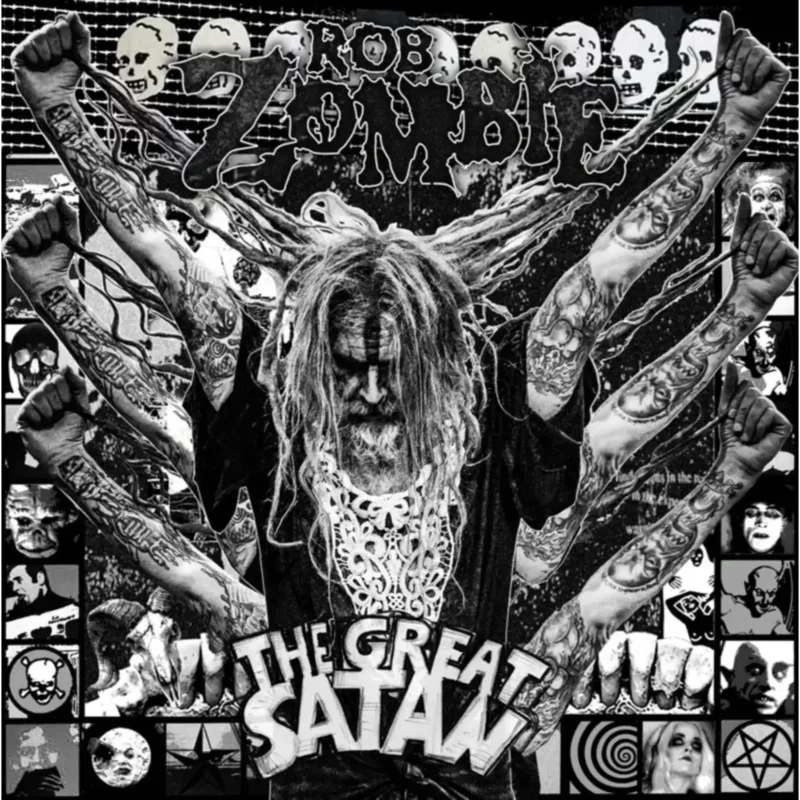
This album is exactly how you want it to be. If you (like me) find the John 5-era Rob Zombie albums a frustrating experience, with Rob’s signature creative vision mired among bland riffs and awkwardly-integrated “experiments”…well, terrible news on that front: John 5 is gone. He left the band to pursue his childhood dream of sitting on a tour bus with three middle-aged millionaires who hate each other, and we wish him the best. But this forced Rob to make a horrible decision…rehire his original guitarist, who co-wrote what many fans would regard as his best material and best solo albums. Oh no, anything but that!
Straight away, Mike Riggs (and returning bassist Blasko) just fix everything that was wrong with the last four or five Rob Zombie records. It’s brutal and direct and immediate and has more energy than a tokamak reactor. The Great Satan has three thoughts in its deranged caveman prefrontal cortex. 1) Keep it short 2) Keep it simple 3) Refer to steps 1 and/or 2 as appropriate. The album ends with its idea of a slow and meditative epic dirge. One that’s three minutes and thirty seconds in length.
This is not a return to the Hellbilly Deluxe sound. If you want tons of samples and loops and electronic textures, that’s not what he’s doing here. But if you want heaviness of the (shall we say) “metal” variety, you are feasting. The opening salvo of “FTW ’84” and “Tarantula” is almost overwhelming in its destructive firepower: staccato riffs are palm-muted out at machine-gun speed and backed with Ginger Fish’s double-bass drumming, something I’ve not heard on a Rob Zombie song in thirty years. . Dare I say it, “Tarantula” even has some slight melodeath influences—those harmonized pitch-bends Riggs plays after the first chorus could be on an At the Gates record. The album’s stripped-down and raw, but bristling with surprising influences. It takes cues from genres and styles that I never thought Rob would go near.
Oh, and there’s punk, too. The Misfits have always been more of an inspiration than a direct influence for RZ, but near the end of the album we get “The Black Scorpion”, an all-out tribute to “Green Hell” and “Skulls” and so on—fast, neck-wrecking moshing under a blaring farfisa organ. It’s really good! As is “Punks and Demons”, a nasty, lo-fi Venom-sounding track with an 80s Slayer riff over the chorus.
“(I’m a) Rock ‘N’ Roller” is a soul-deadened tribute to literally-deadened Bowie’s “Moonage Daydream”. (T-Rex, too. I’ve always suspected that Rob might be a secret Marc Bolan fan: he has the same psychedelic lyrical approach.) It has tense, thundercloud verses. What do ten thousand people sound like to ears ringing with tinnitus? Like nothing. The rockstar is in the masses, but not of the masses. Then the chorus arrives. Or falls on your neck like a guillotine. “That doesn’t sound like fun! Also, probably fatal!” Buddy, you’re in the Spookshow International. Having your head severed by a stainless steel blade is an inconvenience, yes, but not necessarily a fatal one. It’s pretty much the price of admission.
Then there’s the fourth track and possible album standout “Heathen Days”. Propulsive and addictive and fastfastfast, the track just attacks the listener like a demented skeleton and holds up with the best stuff Rob Zombie has ever put on a record. I like the under-the-verse riff, where Riggs picks natural harmonics on the 10th and 12th fret (or something like that). Like, that’s all the sonic diversity I want, you know? I don’t really need bluegrass and chicken-picking and lap-steel slide guitar on a Rob Zombie record. I’m a simple man: just give me a natural harmonic now and then.
The album does lose some energy in its middle stretch: “Sir Lord Acid Wolfman” and “The Devilman” feel like they could be John 5 studio leftovers. They are a bit slow and baggy for my tastes. The former is apparently a pirate character Rob came up with (the patriarch of a Manson family on the high seas). But the closing track “Unclean Animals” is wonderfully eerie. A psychedelic Iron Butterfly freakout that feels like being dead. You’re wandering down a long hallway, maybe some dark woods. You can’t tell whether you’re going to the good place or the bad one, but from the smell of sulfur hanging in the air, it ain’t looking great.
So do we have a bona-fide comeback on our hands? I guess. Rob Zombie has returned. The Great Satan slaps, and I am beyond happy with 80-90% of it. “Who Am I”, asks track 5. For Rob, the answer is self-referential: *this.* I struggle to imagine a Rob Zombie fan who dislikes this. If you are that person, I choose my next words with love and pity: I do not understand you. It might be time for the state to step in and make you comfortable. Music cannot bring you happiness. Perhaps medication will.