Except... | Music / Reviews | Coagulopath

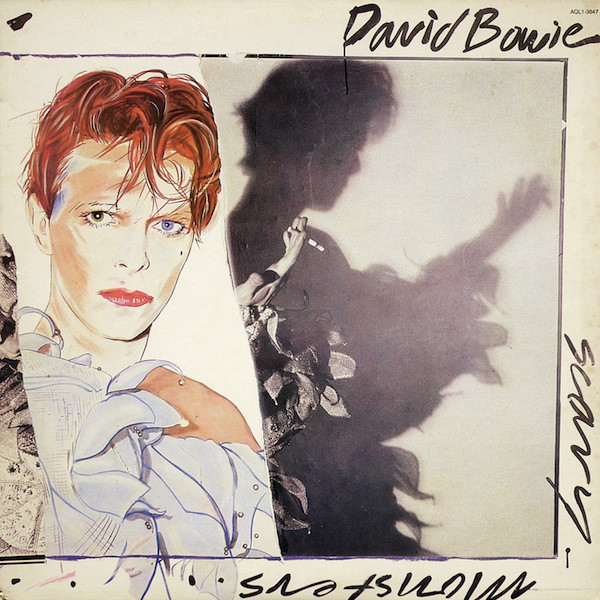
Scary Monsters and Super Creeps is Bowie’s Except Album, meaning it often appears along with the word “except”. “Bowie sucked in the 80s, except for Scary Monsters“. “Bowie was never good when he tried for mainstream success, except for Scary Monsters“, and so forth.

It’s also often spoken about in the same sentence as “scary” and “monsters”. Though that’s less surprising, since that’s the name of the album. It would be strange to talk about the album without mentioning its name, although it would be a fun challenge to do so (and also without identifying it another way, such as “the Bowie album from 1980”). Kafka led a man to the executioner’s block without ever mentioning his crime. Could you arrange words in such a fashion that a reader understands the music, without ever actually being made aware that the album exists?

Scary Monsters is about decay. Not decomposition, not morbidity, just…things falling apart, in a general sense. It’s an album about the crack in your ceiling, and the verdigris embroidering your bathroom floor. All the things you’ve been meaning to fix, even as they advance to an event horizon where it’s not worth the bother.

Bowie assembled some of the finest guitarists to ever set plectrum to string, and made them play sloppily. Vocals are deliberately flat, or mangled oddly in the mixing room (the heavy tremolo rattling the chorus of the title track both disturbs and fascinates). The lyrics discuss fashion and aging, yet they all seem to be about the House of Usher. The building is tumbling down, we’re caught inside it, and we can never leave. Bowie sings about disillusionment and weariness, his voice cracked and broken. None of his albums – not even Aladdin Sane or Outside – evoke this kind of genteel neglect.

“It’s No Game, Pt 1” opens the album in thuggish fashion. Someone took the song, punched it around, and gave it a black eye. Fripp’s guitar part swirls like stagnant water, the drums kick out at you, and it’s interrupted by outbursts of Japanese female vocals, as though someone spliced in the hourly Harajuku traffic report. Although this is the closest solo Bowie ever went to punk rock, it’s cerebral and calculated beneath the blood: more like Public Image Ltd than the Sex Pistols.

Other tracks document various vanishing trends in Bowie’s music. One of the last great Bowie epics (“Teenage Wildlife”) can be found here, as can shorter but equally memorable cuts like “Up the Hill Backwards”. Be sure to get the version with the bonus track, “Crystal Japan”, which was written to score a TV ad for a sake company (of all things) but dredges up strong memories from the Brian Eno years.

“It’s No Game, Pt 2” is a slower and less enthusiastic reprise of the first part. There’s an old Hollywood joke: at eight in the morning you’re shooting Citizen Kane, at eight in the evening you’ll settle for Plan 9 From Outer Space. This song captures that kind of exhaustion and weariness, freezing it under glass.

This album has a reputation as a Bowie threw away most of his artistic pretensions and went fishing for hits. Happily, he caught one (“Ashes to Ashes”). Even more happily, the reputation is wrong: he didn’t throw his artistry very far after all. There’s louche experimental moments all over Scary Monsters. This is the rarest thing: an artistically successful commodity. It’s also one of his most consistent and listenable works. Clearly, the future was bright. He would not put a foot wrong in the 1980s.

The eye sees by transmitting light from the retina to... | Music / Reviews | Coagulopath

The eye sees by transmitting light from the retina to the optic nerve, and then to the brain. The problem is, the optic nerve runs in front of the retina itself, blocking a sliver of light. In order to see, you must have a blind spot.

The Rise and Fall of Ziggy Stardust and the Spiders from Mars is my blind spot. It’s the only Bowie album I like and yet don’t “get”. Musically, it has some of his best work. Conceptually, all the stuff about fake rockstars and androgyny and the world ending in five years seems bizarre and unnecessary, like you’ve invited a friend to stay the night and he’s brought along a U-haul full of childhood toys. It must have struck a nerve (optical or otherwise) at the time: Ziggy Stardust launched his career. But in the 21st century, he’s shadowboxing at targets I cannot see.

Not only did Ziggy not need to be a concept album, maybe it wasn’t meant to be one. It’s rock and roll’s dirty secret that most “concept albums” are retroactively branded as such long after the album is finished (the most famous one, Sgt Pepper, has no concept at all that I can detect). It’s true that many (or perhaps most) of Ziggy Stardust‘s songs don’t tie back into the main story, and the ones that do are jumbled out of order. The most persistent through-line is that Bowie likes writing songs with the word “star” in the title.

The album helped put glam rock on the map, but it’s also a preview screening of Young Americans: lots of soul and jazz moments pop up, sometimes improving the album and sometimes detracting from it. “Five Years” and “Soul Love” are a bit too long and musically subdued to work as album openers, particularly in the second case, where the dominant instruments are hi-hats and congas. “Moonage Daydream” is the first legitimately great song, with a bombastic introduction and a hallucinatory chorus. “Starman” is charming and irresistible, and sounds very much like a song left over from the Hunky Dory sessions.

Unlike the front-loaded Hunky Dory, Ziggy Stardust‘s best moments happen on side B. “Lady Stardust” is an powerful piano ballad, “Hold on to Yourself” an energetic homage to Ed Cochran’s “Somethin’ Else”, and “Ziggy Stardust” sports an instantly memorable main riff, built around a minor 2nd hammer-on with the pinkie finger. Bowie would work with more skilled guitarists than Mick Ronson, but few if any had his taste and discernment. Every note Mick played meant something.

“Suffragette City” is the album’s greatest song, a fierce and pummeling broadside against the Rolling Stones. While “Starman” points to his past, this points to his future: it would have fit anywhere and everywhere on Aladdin Sane. “John, I’m Only Dancing” is a nice curate’s egg if you have the Rykodisc remaster, with a strong chorus and funny queerbaiting lyrics, although I prefer the cut from 1973.

No doubt Bowie-ologists find more in Ziggy Stardust‘s concept than I have, whether it actually exists or not. Take the name “Ziggy”, a strikingly unusual name that would be worth 19 points if it could be played in Scrabble and seems pregnant with meaning. Is it an abbreviation of “syzygy” (a planetary conjunction or apposition, which would reinforce the cosmic theme)? But David eventually admitted that it meant nothing. He just wanted a name that began with Z, and found one in a list of names.

But Bowie was always someone who could turn pewter into gold, and even unremarkable ideas can seem irresistibly clever if sold right, which in the end is the rockstar’s true calling. Ziggy Stardust deserves its place at Bowie’s masked ball, even if that place isn’t quite at the head of the table.

Torture. Moral issues aside, does it work? You have a... | Music / Reviews | Coagulopath

Torture. Moral issues aside, does it work?

You have a man in your care, with a fact in his head. Can you torture it out of him? Maybe. But he hates you, because you’re torturing him, so he might tell you the fact in an incomplete or misleading way. And couldn’t you have gotten the fact from him using another method? Consider Knightian uncertainty: you don’t know what you don’t know, and a well-treated prisoner might divulge additional facts that he didn’t have to. A tortured man never will.

Defenders of torture, of course, have a slam-dunk defense of their art: that it created David Bowie’s Station to Station.

It contains the greatest Bowie song ever (“Station to Station”), the greatest Bowie lyric ever (to be discussed), the greatest Bowie pop song ever (“Golden Years”) and the greatest opening chord on a Bowie song ever (Carlos Alomar’s Am7 on “Wild is the Wind”). I advise listening to this album soon and often. It’s amazing. But do be advised: it was created through torture.

It was created during a horrific period of Bowie’s life, where the drugs begin taking the man. Alone in a mansion in Benedict Canyon, Hollywood, he went insane. It’s all there in the biographies: storing his piss in jars, seeing UFOs, to see his spectral aura, exorcising Satan from his swimming pool, believing that the Rolling Stones were sending him messages in their album covers. Some of these might be myths, or embroideries on the truth. Bowie himself is no help. He says he doesn’t recall making Station to Station at all.

Did he create Station to Station? The album isn’t a pathetic drooling mess of needle injection sites and discarded cocaine twists, as most “druggie” albums. It sounds tight and professional, brightly mixed, with some of his best top melody singing. This is the work of a man at the peak of his power.

The title track is, well, a perfect song. It runs for ten minutes, and you want it to keep going. Train noises are heard, wandering across the stereo field. The train is moving, and we’re not on it. The blurring steel hammer disappears over the horizon, and a loping 2/2 alla breve vamp takes its place. It sounds tight and smouldering on the record, but gigantic live. One of the downsides of the whole Bowie-being-dead business is that he won’t ever play “Station to Station” again. Listeners are free to imagine him in their bedroom, miming to the song while wearing a dress, but somehow it’s not the same for me.

Halfway through, the song erupts, blasting out lyrical and sonic incalescence. “Once there were mountains on mountains!” Cmaj, Dmaj, Emaj, Amaj, Emaj, F#min. The great lyrical moment happen here: “It’s not the side-effects of the cocaine! / I’m thinking that it must be love.” Listen to his difficult, strained delivery, and these two lines crackle with the energy of broken power cables. The world turns beneath him, mountains collapsing to rubble. Just for a moment, David Robert Jones from Brixton is Zeus, hurling thunderbolts. His mind sounds smashed to pieces, reassembled, but somehow stronger and purer than it was before. This signals the final shift in “Station to Station”. The band spins out of control, as if a life-rope’s been cut, and the remaining five minutes are spent in a long vamp built from repeated declamations of “it’s too late”.

Contrary to popular belief, Station to Station has other songs. “Golden Years” is an extremely catchy and well-realised single. The performances aren’t quite as tight as, say, Low (listening to the vocals in isolation reveals that he’s a bit loose with his timing) but the total effect is one of sublime perfection. “TVC15” and “Stay” are similar in tone: jittery, anxious, and funk-driven. “TVC15” is apparently based on a nightmare Iggy Pop had of a TV swallowing his girlfriend. “Stay” is Carlos Alomar earning his paycheck, featuring a jagging main riff with a ninth note thrown in there. The words of the chorus are near incomprehensible word salad: a good evocation of a man who has turned his mind into an MC Escher painting. “Wild is the Wind” ends the album on a plangent note. A jazz ballad, with a wonderful misty and distant feeling.

“He put all of his effort into his art” is a cliche vapid, but it takes on a darker shade: we’re not supposed to put all our effort into one thing. We’re supposed to have lives. We’re supposed to be normal.

I once read a French horror comic (I can’t remember the name) about a race car driver, with a special bond to his vehicle. With his fuel running out, and the great race of his career on the line, the vampiric car sucks his blood out of his veins and burns it, winning the race and hurling a corpse across the finish line. That sums up Station to Station. The stunning artistic heights were achieved at great personal cost to Bowie. It’s a thumbscrew and a rack on a vinyl LP.

Albums cathartic to artists are often dull to listeners, and this is the reverse: another Station to Station might have killed him. After making this album, Bowie fled Los Angeles. As if he himself was the demon in the mansion, and he’d performed his own exorcism.