It’s risky to form an opinion behind a curtain. Sometimes... | Music / Reviews | Coagulopath
It’s risky to form an opinion behind a curtain. Sometimes the curtain lifts, and you discover that you’ve picked a fight with the entire world.
For example, I have a friend who purchased a certain Atari 2600 game in 1982. It had an alien on the cover. From the above clues (and my tone) you might be able to guess the game he bought. This happened around Christmas, if that narrows it down further.
He didn’t like the game. It was arcane and frustrating; he wasn’t even sure of what he was supposed to do, and he spent half the time falling into holes he couldn’t see. It had glimmers of creativity, but it was also a confusing pointless headache. He returned the cartridge to the store.
Two decades later, he heard people on the internet talk about that game. First a couple, then hundreds. They hated it. It was seen as mythologically awful. Many of these people had obviously never played it—their descriptions were littered with factual errors—and they didn’t even want to. It was a fetish object to them: a thing to hate. As its legend grew, the criticism became ever scathing. It was the worst game for the Atari 2600. No, the worst game ever, full stop! The worst thing!
Huh, my friend thought. It wasn’t that bad. More annoying than anything. Loads of worse games on the 2600.
The question is…was he wrong? Or was everyone else?
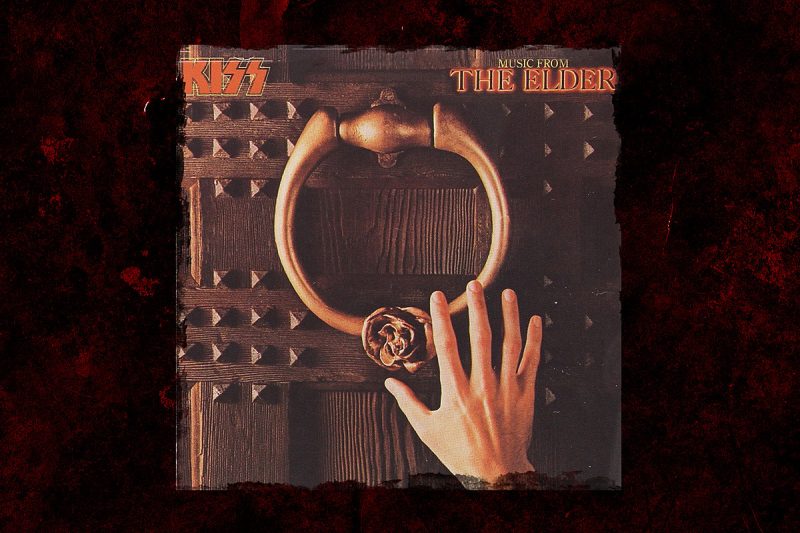
Music from “The Elder” is KISS’s version of the Atari E.T.the Extra-Terrestrial game. It’s remembered as the worst thing they ever did—their St Anger, their Ishtar, their Microsoft Zune. Its own producer has compared it to Springtime for Hitler.
I think it’s good. Turns out I’m in disagreement with everyone there, even KISS themselves. Oh well. Gene Simmons can bite me. His album’s good.
Most of the criticism The Elder receives is well out of proportion to its crimes. Yes, it has some bad songs. KISS has released albums that are uninterrupted shit from end to end, so I can live with that. Yes, it’s cartoonish in places, and the “story” makes no sense, and Paul sings in falsetto. But if you’re allergic to kitsch and are spinning KISS records, then I don’t know what to tell you.
The Elder is heavy and catchy and intricate. It shows a band trying to evolve their sound and do something new. More than anything, it’s brave. KISS was a shock and an affront, but how shocking are you being on your twentieth LP of party anthems? You might not like it, but “The Elder” is what peak shock rock looks like. I respect the hell out of it.
It’s “Bob Ezrin: The Album”. KISS was floundering in 1981: with their sales collapsing and their drummer vanishing out the exit chute, they reunited with the legendary Destroyer producer in the hopes of getting their career back on track. Unfortunately, Ezrin was high on the success of Pink Floyd’s The Wall—
(and on cocaine—let’s get that out up front)
—and he decided that only one thing could save KISS from certain death: a concept album.
As a band, KISS can be decoded in many ways. One of the most useful is “the Beatles with pyrotechnics and makeup”. Right from the start, they wanted to be the Fabber Four (Simmons often cites seeing The Beatles on Ed Sullivan as the hearing-Elvis-on-the-radio epiphany that spurred him to become a musician), and many of their questionable decisions are explained by “Paul and John did it”. The late-70s glut of KISS merchandise was no different to what Brian Epstein did for the Beatles a decade earlier, Kiss Meets the Phantom of the Park was a stab making their own A Hard Day’s Night, and when Ezrin decreed that the hour was nigh for KISS’s version of Sgt Pepper, how could Simmons and Stanley refuse?
Simmons came up with an exceptionally cruddy fantasy story, which Russell and Jeffrey Marks rewrote into a 130-page script that everyone knew would never be filmed. KISS superfan Brian Brewer bought the script at auction in 2000, and shares some details about the plot:
If you’re going describe this particular story it’s kind of on the same level as “Through The Looking Glass” [by Lewis Carroll, “Alice’s Adventures In Wonderland”]. It starts off in one era of time and you’ve got Blackwell, who’s the king and chief bad guy, and his henchman Xyte, who was actually a sorcerer for the Elders before he picked up with Blackwell. Blackwell is under attack when the script opens. The story starts with Blackwell under attack in his day, which is apparently 600 years in the past. There are allusions to a varying number of years in the script — one says 600, one says 800, one says 500 — they jump around, but on an average it seems to have been set about 600 years in the past. Xyte created another world inside Blackwell’s mirror chamber with the rose, which was a ring that the Elders created with magical powers and…
Actually, let’s just pretend there is no story and discuss the music.
The album is split between heavy rockers, conceptual pieces, and soft stuff. Ezrin is a pretty overwhelming creative force on here (along with Lou Reed), and the music is full of his signature touches—like that muted electrocardiogram bassline on “A World Without Heroes”.
“Fanfare”/”Just a Boy” throws KISS fans into the deep end. This is flowery twelve-string guitar stuff that sounds more like Renaissance Faire filk than hard rock. “Odyssey” is a torpid progressive piece with strange-sounding vocals from Paul Stanley. He seems to be trying to growl like Louis Armstrong in “What a Wonderful World”. It’s an okay song, but the key is clearly wrong for him. I wonder why Ezrin (normally a consummate perfectionist) didn’t insist that deep-voiced Simmons handle the track.
“Only You” has a powerful chorus riff, as heavy and twisted as a writhing serpent, and “Under the Rose” is a tricksy 6/8 prog-rock tune. “Dark Light” is the first uptempo song, with some ad-libbed asides from Ace Frehley. He barely seems to give a fuck, and it’s wonderful. Frehley apparently hated “The Elder” from the jump, and refused to even be present for many of the sessions. Needless to say, much of the lead guitar he’s credited for was actually performed by someone else (though honestly, it’d be faster to list the “classic” KISS albums where some form of that doesn’t happen!).
The Stanley-penned ballad “A World Without Heroes” was a bad choice for lead single, but it’s a fabulous song in the context of the album, with petal-delicate strings and one of Simmons’ most emotional performances. “The Oath” turns the intensity dial to 11 and then rips it off, with crushing NWOBHM-style riffs and wild drumming from Eric Carr—am I hearing power-metal style double-bass in 1981?
The album’s nadir is the Simmons/Reed composition “Mr Blackwell”, which is slow, club-footed, and lacks any sort of hook. Apparently Mr Blackwell was meant to be the villain of the piece: a “Washington D.C. power broker” who seeks global domination or something (note that the lyrics describe him drinking alcohol, which is the mark of Cain in Simmons’ world). The song’s just an absolute stinker, and derails the momentum of “The Oath”. At least there’s the Ace Frehley instrumental “Escape from the Island” to wake you up afterward.
There’s one song left. Gene Simmons, who has been a muted presence until now, stirs to life and delivers “I”, possibly the album standout. It’s an energetic, furious rocker, full of fire and heart. The lyrics could be applied to the story’s character, but could also be a dig at Ace Frehley (“Don’t need to get wasted / It only holds me down”) who, by this point, was eyeing the exit door himself.
I’m not really a KISS guy, truth be told. I like Destroyer well enough, and usually a few songs on each of their albums. But much of their party-hearty shlock just bounces off me: it feels like a dumber American take on what British glam rock managed with far more simplicity and purity five years earlier. But maybe that’s why I respond to Music from “The Elder”. For better or for worse, it’s the album where KISS is least themselves. “The mind was dreaming. The world was its dream.”
Habfürdö is unique. I’ve never seen a film like it.... | Movies / Reviews | Coagulopath
Habfürdö is unique. I’ve never seen a film like it.
An experimental animated Eastern Bloc neo-constructivist musical romantic soap opera (ugh, one of those), it was directed by György Kovásznai, produced by Budapest’s Pannónia Filmstúdió, and watched by apparently no-one. Its commercial failure in 1980 dealt a crippling blow to adult animation in Hungary, but now it’s a beloved curio for fans of the bizarre. If you’ve seen Les Maîtres du temps and Fehérlófia and want to delve further into Hungarian animation, consider cleaning yourself off with a bubble bath.
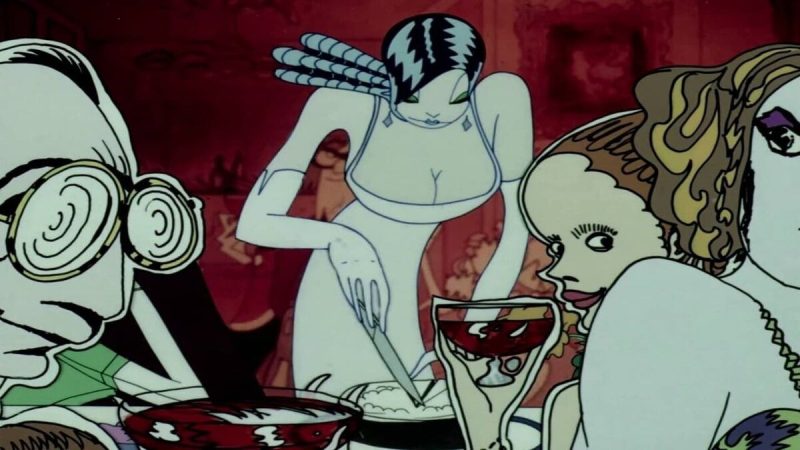
The film’s most striking aspect is its animation style: it doesn’t have one. The action rictus-spasms at 24 fps from Hergé-style Ligne claire to Dali-style surrealism to Picasso-style cubism to scrapbook collages to real-life footage. Anything goes, and it’s probably for the best that most of the film happens inside one room. Visual comprehensibility is in short supply and we need all the visual aids we can get.
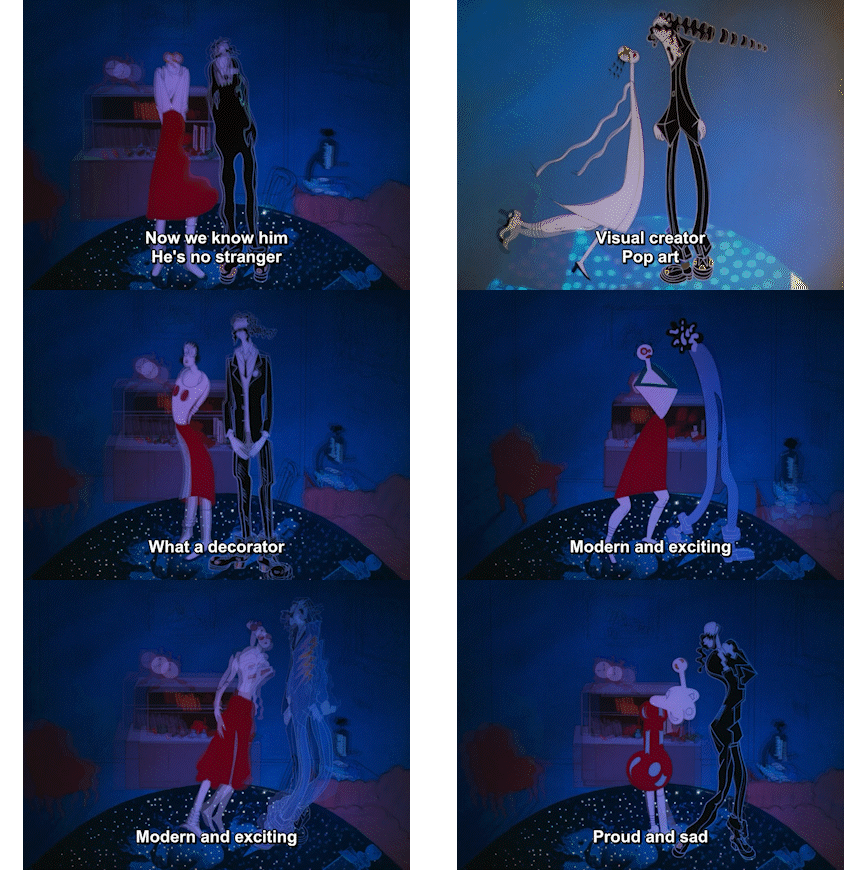
Habfürdö‘s characters slip and squirm through poses like amoebas jolted with electricity. They exist in permanent flux, morphing to reflect their emotions (this gives us a window into what they’re actually thinking; as opposed to their dialog, which is largely a tissue of self-deceptive bullshit.)
Admittedly, “characters changing shape to reflect their emotions” is the oldest trick in the book, but I’ve never seen it done to the extent that Habfürdö does it. In animation, “off-model” refers to when a character deviates from a standard model sheet. Habfurdo’s characters have no model to be “off” from.
What about the story?
The plot could fit on a postcard. Zoltan Mohai, an preening, pretentious “artist”, has cold feet on his wedding day. He hides from the bride at the house of a medical student, whom he burdens with breaking the news that the wedding is cancelled.
I’m not sure why it’s called Bubble Bath (aside from the fact that Zsolt briefly hides inside one). Maybe it’s a clue to the nature of the social relations on the screen. These are vain, silly people living comfortable middle-class lives. People inside bubbles, in other words, one needle-prick away from existential extinction. And although the scenario generates complications (the jilted bride misunderstands what’s happening, and Anna begins having feelings for this preening stranger herself), it’s ultimately all nonsense, a churned-up froth that dissolves on contact with reality.
Technically, Habfurdo is an “idiot plot”—the whole situation would be defused if these people would have one conversation. But the fact is, they can’t. They refuse to confront who they are, and what they actually want.
Why does Zsolt want to escape his marriage to Klára Horváth? Mainly because of a perceived insult from her family. Her mother or someone once referred to him as a “window dresser”, which wounds his pride (he’s a serious artiste!). Yet…it’s true that he’s a window dresser. When he barges in through Anna Parádi’s front door, that’s how he introduces himself! He’s locked in a roomful of mirrors, despising his own reflection.
Likewise, Klára’s marriage-obsession (and sexual promiscuity) come from a desire to project a certain self-image to her social circle. She gloats that the “old maids” at the hospital where she works at are jealous of her debutante’s lifestyle. In the end, she’s making decisions because of what other people think. Left to her own devices, she’ll construct a relationship that’s flawless from the outside and miserable to the ones trapped inside it.
Economist John Maynard Keynes once imagined a beauty contest where women are judged by a panel. The twist: each of the judges is rewarded if their chosen woman is the overall winner. This scenario (which Keynes applied to the stock market) would quickly devolve into farce. The judges would ignore their own preferences, and would only think of of what the other judges prefer. It wouldn’t be a contest of beautiful women, it would be a contest of judges who are judging beautiful women. Today, we call that sort of problem Goodhart’s Law. When a measure becomes a target, it ceases to be useful as a measure. Klára doesn’t care about her own happiness. She only cares that the “judges” (her social peers) think she’s happy.
Habfürdö isn’t a character study. There is no effort at psychological realism. Characters are written the way they are drawn: as ludicrous, bizarre freaks. Everything they do is abhorrently strange, yet we see the social parallels.
The dirty secret behind animation (even “realistic” animation) is that it’s essentially a bag of tricks. Think of the “Milt Kahl head swaggle”. When have you ever seen this gesture in real life? Or the Dreamworks Face. If you saw a real person make that expression, you’d assume they were suffering a stroke. But when those things appear in an animated world, we assign meaning to them. (head swaggle = character has smug confidence, Dreamworks face = character is sassy and full of ‘TUDE and also you should probably skip this movie). They are visual shorthand. They don’t depict real life, they hint at it.
Habfürdö’s characters are written in the same stylized way: unrealistic on the face of things, but it nudges your mind to toward topics that are too realistic for comfort. It’s the old divide of how you can be truthful without exactly being factual. More than anything, Habfürdö is a truthful film. Bubbles might seem insubstantial, but they hint at a powerful chemical reaction. Ignore them at your peril.
You soon discern that the point of the movie isn’t these characters, it’s modernity, and urbanism, and the pressures faced by men and women who live like termites in gray apartment complexes. I’m sure that it would make more sense to someone raised in the land of “Ghoulash communism”. I got the sense that much of the film was flying over my head.
But Habfürdö mostly doesn’t take itself seriously. The plot is casually constructed. A fourth character is introduced, a boxer called Nandi. He is absolutely pointless. He ends up getting drunk and passing out.
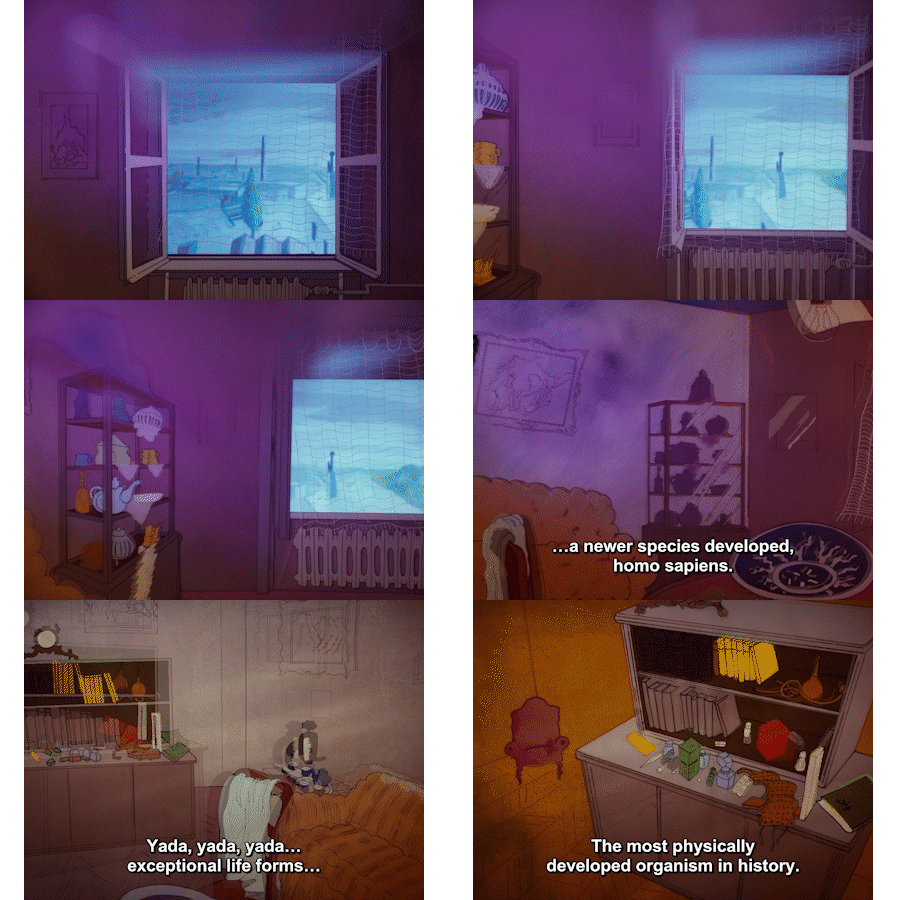
And sometimes the movie’s experimental nature excuses its excesses. The film begins with a wildly overambitious 3D panning shot over medical student Anna Parádi’s apartment. In a Disney movie, it would have looked inexcusably sloppy. In the context of Habfürdö’s abstract style, it works.
Habfurdo is an odd beast. Even now, I’m not sure I have a handle on what it’s trying to do. Habfürdö‘s visuals have a restless joy that infects the viewer. It makes me happy. I think that’s enough!
“Put a pen in Satan’s claw […] and he could... | Books / Reviews | Coagulopath
“Put a pen in Satan’s claw […] and he could do no worse”—Louis-Sébastien Mercier, of Sade’s Justine
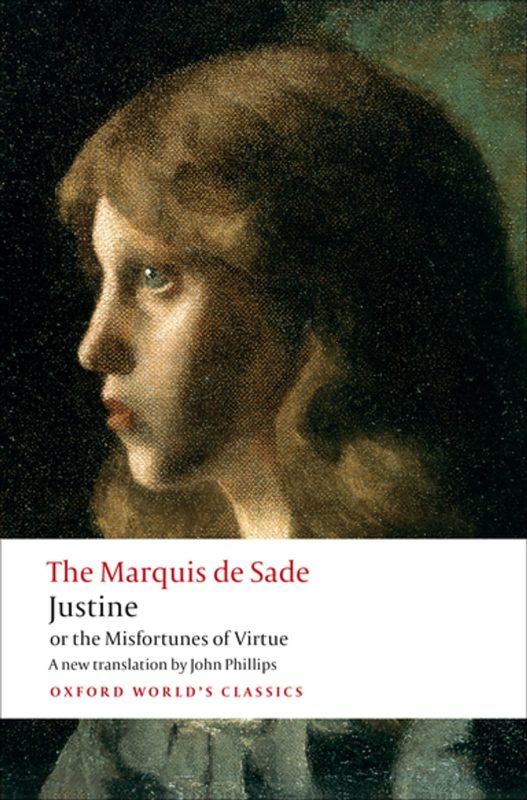
Justine defies description. Not because it’s disgusting, but because it doesn’t exist. Or, at least, not in the same way that the 2016 Kia Cerato in my driveway exists.
Sade wrote three versions of the book. Each has a wildly different text, and a century-and-half of censorship has caused them to be fragmented, bowdlerized, bootlegged, mistitled, misattributed, etc. There effectively is no “Justine“. Instead, there’s a diffuse nebula of Justinelike texts that share a story (a saintly girl falls on hard times and is abused) but otherwise vary in nearly every detail.
The earliest Justine dates to 1787, and is a mere 50,000 words long. The Marquis was entombed in the Bastille’s Tour de la Liberté for buggery and torture, and wrote it in about two weeks. Titled The Misfortunes of Virtue, it’s uncharacteristically tame. Sex acts are mostly hinted at. Sade alludes to “lewd and exhausting labours”, “foul exercises”, or “the most considered excesses of brutality and lewdness” and lets your imagination fill in the blanks. Instead of a sodomy scene he’ll write “the hapless girl was ignominiously defiled while never ceasing to be a maid”. Ever the pioneer, he knew the “anal doesn’t count” rule long before Catholic schoolgirls got in on the game.
Was Sade censoring his work to appease the Bastille guards? No; he’d already written The 120 Days of Sodom in the same cell. Sade’s prison life, despite his whining to the contrary, was uncommonly comfortable. His social class (and the efforts of his longsuffering wife) meant he was allowed a massive wardrobe, paintings, perfumes, a bookshelf groaning with hundreds of classics, and even a collection of wooden dildos fashioned by a Parisian cabinetmaker. The guards weren’t reading his writing, or didn’t care. Instead, Sade toned down the rough stuff in the hopes that Justine would reach a wide audience. Fate, however, had different plans.
On the 2nd of July, 1789, the Marquis tried to incite a riot. As punishment he was transferred to an insane asylum, and had to leave his possessions behind (including his manuscripts, which his wife was unsuccessful in retrieving). When the Bastille was stormed on July 14, the contents of Sade’s cell (including the dildos, presumably) were “burned, pillaged, torn up and carried off”. Justine was lost, spun away into the winds of the 19th century. How it survived is unclear to me, but Guillame Apollinaire rediscovered the manuscript in a collection of papers at the National Library in 1909, and it was finally published in 1930.
Back to Sade: he was released from the asylum as a virtual pauper. His chateau had been seized, his wife had finally kicked him to the curb, and he was forced to work as a prompt in a Versailles theatre for 40 sous a month. In an attempt to make money, he rewrote the lost book as Justine, ou les Malheurs de la vertu (“The woes of virtue”), and in 1791 published it anonymously.
This new Justine was much longer (120,000 words), and more explicit. It was a bestseller by Sade’s standards: it saw five printings in the 18th century alone, and has been widely translated into other languages. If someone in the Anglophonic world references Justine, this is probably the one they’re thinking of.
The new Justine both gains and loses. Sade’s prose is sharper and the scenes hit harder. But where the 1787 manuscript moves through the story at a gallop, the 1791 gets bogged down in pornography and philosophy (for Sade, the two were largely interchangeable). It’s hard to read at times, like a Playboy where each page is made of iron and weighs five pounds.
Justine always had problems, and they’re harder to ignore when the book is a double feature starring itself. For one thing, it’s written in first person perspective. It doesn’t make sense that prudish Justine would describe her abuse in such obscene, titillating detail. And sometimes less is more—depravity has the curious property of seeming more awful when it’s not described on the page.
And because it’s Sade, the action is frequently interrupted so a villain can deliver a long speech denouncing morality and religion, and then Justine will respond with an equally long speech defending those things, and so on, back and forth for several pages. It’s like reading an insufferable debate on an internet forum (“BIBLE CONTRADICTIONS-MAGIC SKY FAIRY DEBUNKED!”), where everyone is an annoying seventeen-year-old with a good vocabulary.
Sade could be the most fascinating of men, but he could also be the most tedious. Justine captures his dual nature well. His mordant wit was always his best side, and this is foregrounded in the new edition. The original 1787 manuscript ends with Justine dying horribly—immediately after being rescued!—and a (sarcastic) moral lesson.
And now, reader, having read this tale, may you extract the same profit from it as this reformed woman of the world. May you, like her, be persuaded that true happiness lies in virtue alone and that, though God allows goodness to be persecuted on earth, it is with no other end in view than to prepare for us a better reward in heaven.
The 1791 manuscript ends the same way…but more so.
O you who have wept tears upon hearing of Virtue’s miseries; you who have been moved to sympathy for the woe-ridden Justine; the while forgiving the perhaps too heavy brushstrokes we have found ourselves compelled to employ, may you at least extract from this story the same moral which determined Madame de Lorsange [Juliette]! May you be convinced, with her, that true happiness is to be found nowhere but in Virtue’s womb, and that if, in keeping with designs it is not for us to fathom, God permits that it be persecuted on Earth, it is so that Virtue may be compensated by Heaven’s most dazzling rewards. [emphasis mine]
If you don’t get the joke, Justine has been killed by a bolt of lightning.
In 1797 Sade was evidently still broke or still unhappy with Justine (or both), because he rewrote it a third time. Now it ballooned into a four volume, 290,000 word orgy of excess, complete with fascinating illustrations (whose artist is still unknown). It was published in a ten volume edition, with the other six volumes being a companion book Juliette.
This monstrosity remains untranslated to this day. As I don’t read French, I can’t comment on what he changed. Apparently the viewpoint shifts from first person to third, which is a good idea. Sade originally wanted Justine to be an epistolary novel similar to Rosseau’s Julie. This aside, there’s no reason we need to hear the story from her perspective, and it limits the possibilities.
The 1797 Justine/Juliette wombo-combo is famous for attracting the ire of Napoleon, who described it “the most abominable book ever engendered by the most depraved imagination” (lucky he never read Spare by Prince Harry) and ordered the anonymous author’s arrest.
Sade thought his identity was safe. As usual, he was his own worst enemy. He feuded with a prominent literary critic, who publically exposed him as Justine’s author. The Paris Gendarmarie raided his publisher’s office soon after, and caught Sade with a manuscript of Juliette in his hand. Sade boomerang’d back into prison, and his books were burned en-masse.
(Incidentally, I’ve read that the police found notes hinting that that Sade was attempting to write a fourth version of Justine. Why did he spend so much time on this one book? He never attempted to rewrite The 120 Days of Sodom or Philosophy in the Boudoir, to my knowledge. Did he consider Justine his masterwork?)
There’s a kind of irony to Justine’s history. The book that destroyed its author. Sade comes off as a Frankenstein-like figure, undone by his own creations. His scandalous defiances (of church, state, family, and the Revolution) plunged him into circumstances, that seem…well, Sadean.
On 8 December 1793, Sade was arrested for counter-revolutionary activities. […] Shuttled from prison to prison during the early months of 1794, Sade finally ended up at Picpus near Vincennes, a well-appointed former convent. It was here, from his cell window, that the devant or ‘former’ Marquis watched as many of his fellow aristocrats mounted the steps of the guillotine, which had been moved to the Picpus location from Place de la Révolution (the present-day Place de la Concorde) because of the stench of blood, their corpses piled into a mass grave that had been dug in the prison gardens. A large lead urn placed under the guillotine to collect the blood was emptied at Picpus every evening.
Sade, The Libertine Novels – John Phillips, Pluto Press
…as well as comical. Isn’t this literally a joke in Monty Python’s Life of Brian?
Sade himself escaped the guillotine thanks to bureaucratic confusion. In July 1794 his name appeared on a list of prisoners to be collected from Paris jails for judgement and execution that day, but as he failed to respond when his name was called, he was marked down as absent. Within a short time, the political climate had changed again with Robespierre’s own fall from grace and execution, and Sade was freed on 15 October 1794.
Ibid.
Justine offers itself as a case study in the futility of censorship. Napoleon tried to stamp it out. For a hundred and sixty years, you could get arrested for publishing Justine in France. But each chop of the axe that fell on Justine only succeeded in multiplying it. It’s probably the most widely translated and read of Sade’s work.
But it’s also not quite the book Napoleon—or Sade—believed it to be.
The standard line on Justine (which I believed myself before reading it properly) is that it’s a sarcastic, didactic anti-morality tale showing how “crime doesn’t pay” philosophy itself doesn’t pay, and it’s best to be evil. Justine’s goodness does her no good. Instead, we should be wicked, like her sister Juliette.
…But if you actually pay attention to the book, you’ll see that few (if any) of Justine’s problems are caused by her moral principles. She’s simply getting unlucky, over and over again. Juliette wouldn’t have fared much better in her shoes.
This is a scenario that repeats throughout the book: she accepts someone’s help because she has no choice, and it turns out that her savior is a villain. But that’s not a failing on her part. Alone and destitute, Justine stays with a group of monks. They turn out to be running a sex cult, imprisoning young women who (it’s implied) they murder once they’re too damaged to be of further use. How is Justine to blame for not knowing that? Or for the bolt of lightning that delivers her to her grave? Sade rails and vituperates against Rousseanian morality. But the only through-line you can take from Justine is “never let bad luck happen to you”.
And she’s strong. Her sister Juliette abandons her principles. Justine doesn’t. Her arguments are mostly intelligent and reasonable, and although Sade seems to think that the male libertines are demolishing her naive worldview with Facts and Logic, they aren’t. Once or twice, a libertine even admits that she makes a good point.
You can’t pervert morality without, on some level, accepting it as true. And although lots of writers regard Sade as the first truly modern writer (Barthes regards the lightning bolt as a symbolic “killing” of classical and romantic literature, as represented by Justine), a more complicated picture emerges from his books. Sade was artistically indebted to the same past whose values he rejected.
120 Days of Sodom is basically The Decameron—a census-like listing of earthly pleasures and pains at a remote villa. Likewise, Justine is quite Gothic in character. It’s a “damsel in distress” story that whisks the reader through a variety of settings (castles and dungeons and monasteries) that remind of The Castle of Otranto as much as anything. Sade was a modern man, but we got modernity directly from the past, and you can see old ideas (both literary and otherwise) sewn like whipstitches through his work.
A big part of Gothicism is the sense of rotting glory. And rotting religion. Even when Gothic mainstays like Lewis and Shelley aren’t explicitly blasphemous, they subtly communicate that religion’s certainties are becoming old and tattered. Does Frankenstein’s monster have a soul when he’s made of spare parts? Isn’t Dracula simply a perverse Christ (note that Bram Stoker capitalizes Dracula’s pronouns…), albeit one who seemingly gives his followers far more power than Christ gives the Christian?
Sade never went “full Goth”—he shunned the supernatural and employed romanticism only to mock it—but he never went full modernist, either. How could he? The past was too rich a source of absurdity and horror for him to ignore.
In the end, he’ll be remembered the way he wanted: as a provocateur. Like any troll, the point of Sade isn’t his writing, it’s our reaction. He lives in our outrage. Condemning him makes him stronger. He never met a fire that didn’t turn him into a phoenix. Sade himself called for his books to be burned!
An article of 27 September 1792 praises the author’s ‘rich and brilliant’ imagination, while exhorting young people to ‘avoid this dangerous book’ and advising ‘more mature’ men to read it ‘in order to see to what insanities human imagination can lead’, but then to ‘throw it in the fire’. In a letter to his lawyer, Reinaud, Sade himself conceded the immorality of his new novel: They are now printing a novel of mine, but one too immoral to send to a man as pious and as decent as you. I needed money, my publisher asked me for something quite spicy, and I made him [a book] capable of corrupting the devil. They are calling it Justine ou les malheurs de la vertu. Burn it and do not read it if by chance it falls into your hands: I renounce it.
The Marquis de Sade: A Very Short Introduction by J Phillips · 2005 Oxford Academic
We live in permissive times. You don’t go to prison for sodomy anymore. Authors still deal with outrage mobs, but usually it’s white women with weird hair explaining that YOU DID A RACISM and YOU DON’T EVEN UNDERSTAND THE INTERSECTIONAL NATURE OF THE MULTIPLICITY OF YOUR OFFENSES. While this is terrifying, it is very hard to get arrested for writing a book today.
This should have been the golden age of Sade. The moment where the world finally caught up with him.
Instead, his dark grandeur has completely collapsed. All that’s left is anticlimax and bathos. He’s now a literal cartoon character. His descendants have reclaimed the title of Marquis, and are now busy whoring out the family name to things like champagne and “sinfully rich” chocolates. Sade was valuable as forbidden fruit. Now that he’s legal…nobody wants him. Johnny Rotten was right. If you want to destroy the power of a swastika, wear one.
Sade often said that the more criminal his behavior was, the more it excited him. And us too, apparently. Ultimately, bland cultural amnesty was precisely the hell Sade did not believe in.