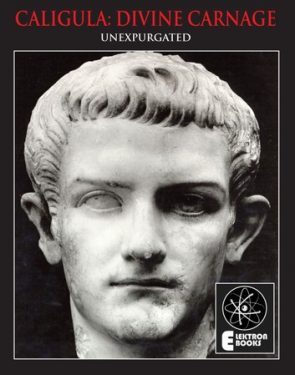
Did you buy this book expecting to learn about the Roman Empire? You’re in for a treat – there’s stuff in here that not even historians know.
For example, that Caligula’s sister died at age twenty three due to a “surfeit of buggery” with her brother and “seven outrageously well-endowed studs” (p34), and how when Caligula travelled he “amused himself by taking potshots at the dull-witted peasants in the roadside fields, wielding a sort of projectile-shooting bazooka” (p38), or how, in the arenas, skilled gladiators could decapitate a man and then direct the pumping jets of blood to spell “Caligula” on the sand, with the falling head forming the dot on the letter i. (p74).
But it wasn’t all fun and games. The most prized animal in the arenas was the “Libyan lion…eleven feet in length, with enormous paws armed with razorsharp (sic) claws of sabre-size dimensions, even their engorged testicles were as large as a man’s head”. Scary. The only way the Romans could subdue the Libyan lion and its engorged testicles was for a “particularly handsome slave to present his shapely, exposed anus to the lion’s mighty sexual apparatus; then, once the act of copulation (which invariably proved terminal for the unfortunate slave, due to unsustainable blood loss) reached its critical point and the lion was momentarily distracted, a gang of a hundred or more whooping slaves would wrestle the lion to the ground and throw a net over it”. (p83)
Divine Carnage is hilarious; one of the funniest books I’ve read in recent memory. I’m fighting (and losing) a battle just to fill this review with my favorite parts. Nearly every page of this book has entertainment value: which is good, because it’s a bit light on history. And literacy.
What’s this book supposed to be? A hoax? A work of surrealist metafiction? A parody of the “edgy history” trend? One of Creation Books’ typical scams?
The back cover has the words “ORGY OF DEATH GLADIATOR KILL”, with all capitals and no punctuation. The copyediting was done by someone stabbing a keyboard with a gladius; there are spelling and grammar errors on nearly every page. The phrase “plebian scum” is used so often it becomes a tic.
Also, the book was written by time travellers: James Havoc’s foreword is copyrighted 1999, but it mentions the “recent” Russell Crowe movie Gladiator, which came out in 2000.
Much of Divine Carnage was clearly composed while drunk – you can see the author’s mind wander down an alley and start free-associating while staring at an empty glass. For example, we’re told about the Imperial “thumbs up for life, thumbs down for death” custom, with an aside that the emperor’s thumb was actually penetrating a slave’s rectum. (But then you wouldn’t be able to see in which direction it’s pointing…)
Never mind that, though. Who are the authors of this masterpiece?
Jeremy Reed is a “Jersey-born poet, novelist, biographer and literary critic”. Stephen Barber is a longtime Creation Books hack-for-hire who has written a dozen titles along the lines of “transformative future sex death semiotics in the films of Uwe Boll”. Neither is a historian, but they attack the project with gusto. Jeremy Reed heroically cites four books as “…an invaluable sources of reference (sic)”, though his final sentence is candid: “There is no definitive life of Heliogabalus, and I have attempted to resassemble (sic) aspects of his character most likely to resonate in the current times.” Stephen Barber cites no books at all, just the “newly-excavated” Butrinte Caligula, which must be newly excavated indeed, considering that Google offers no corroboration that it exists.
Divine Carnage is the first in the Blood History series that marked Creation Books’s twilight years as an actual publisher. The second book was Flesh Inferno by Simon Whitechapel, and the third was The Bloody Countess, which is a reprint of a 1960s title by surrealist poet Valentine Penrose (whether Creation Books obtained the necessary rights from Penrose’s estate is an open question). The fourth book, sadly, exists only in our imaginations.
It’s likely that Divine Carnage was meant as a continuation of Tinto Brass’s Caligula, which shares its extemporized take on history and lack of good taste (James Havoc mentions this film in the foreword). Surely there’s a kid somewhere who relied on Divine Carnage as research materials for his O-levels. Hopefully that kid did alright.
I’d be remiss not to quote my favorite line from the book, on p96. “Commodus was certainly the first post-modern Roman emperor”. When I read that, it made my entire day. Creation Books ripped off a lot of people, but they did not rip off me. Not here.
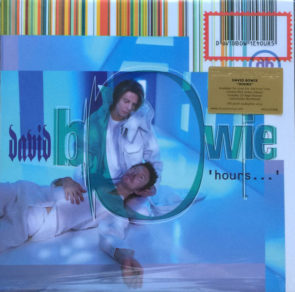
Every culture has a beloved national dish that amounts to “take all the leftovers and put it in a pot”. Hours is David Bowie’s version of that, an unfocused collection of tracks from a videogame, an unfinished Reeves Gabrels solo album, plus some other crap, with a production job so lame it ruptured time and space.
Look at the cover. You already know how it sounds. Tepid, breezy, housewife-hooking AOR pop rock with no edge or bite. Bowie tried to get TLC to guest on “Thursday’s Child”. I don’t know what’s sadder: that he seriously had that idea or that it probably would have worked.
“Thursday’s Child” is the first single. It features a lame R&B-inspired backbeat, gratuitous female backing vocals, and greasy, syrupy synths. Someone once said that synths are to American musicians what firewater was to the Native Americans. I agree, and wish they were what smallpox blankets were for the Indians.
“Something in the Air” is six minutes of boredom and glitchy sound effects. I don’t know what Reeves Gabrels is playing on guitar. It doesn’t relate to the music in any way. It’s like they recorded him noodling at soundcheck time and put it on the record. This was Gabrels’ final studio release with Bowie, quitting while he was behind.
“Seven” is an acoustic song with very loud slide guitar parts. Not bad, but anyone could have written it.
“What’s Really Crappening” is Bowie’s infamous “cyber-song”, meaning its recording was broadcast via livestream. There were probably people who racked up a $40 phone bill over their 56ks listening to Bowie make this – they should have watched the video of the dancing baby instead. The lyrics were partially written by a fan, Alex Grant, who won a contest on Bowie’s website. Nobody can find any trace of Grant now. He may have entered the witness protection program.
“Brilliant Adventure” is etc…
You get the idea. I dislike hours greatly, there’s something cold and dead about it that I don’t hear in any of the other “bad” Bowie albums. Even Never Let Me Down and Tin Machine I have odd charm that renders them lovable from a certain perspective, but this has none (and no artistry either). This is a strong contender for the worst thing Bowie ever recorded on a major label.

The digital sampler is one of the great musical instruments of its ages, nearly equal to the electric guitar. Or maybe it’s an anti-instrument – rather than creating music, it takes the music of other people, and fascinatingly tortures it to death.
The Akai MPC sampler is to music what the AK-47 is to firearms – a mass-produced weapon that allowed peasants to get into the game. Not knowing a damned thing about music was no longer an obstacle to making it. Illiterate rappers could slice parts out of someone else’s tracks, reconstruct them into Frankensteinian monstrosities, and play the results to a crowded dancefloor. Sampling culture reveled in taking music out of its natural environment, and shoving square pegs into round holes. It put Beethoven’s Fifth over hip hop beats, and uncool dad rock over souped-up breakbeats. Much of the Mona Lisa’s effect comes from the fact that you must pass through an austere gallery before you see it. It would have a different impact if you saw it in a sewer. Sampling works by the same principle: it allows us to hear old music in a new way, breaking preconceptions and forcing the mind into unfamiliar paths.
Bowie’s 1997 album makes a fetish out of sampling. Most of Reeve Gabrels’ guitar riffs are actually recorded samples. Wild scratchy noises spray like jets of graffiti from an aerosol can: these are saxophones, sped up and glitched in the studio.
It’s also supposed to be a celebration of jungle music, a style he was quite enamored with at the time. In the press, he referred to it as “the great cry of the twentieth century”. On tour he split the set into two halves – a rock set and a drum ‘n’ bass set. Critics didn’t like it, and neither did his fans. After he noticed that most of his audience left after the rock set ended, he defiantly put the drum ‘n’ bass set first for the remainder of the dates. Jungle was pretty trendy and oversaturated by this point, which didn’t do him any favours with the cognoscenti. It was as he’d decided in 2001 that rap-metal was the great cry of the twenty-first century.
Regardless, Earthling is aggressive, cartoonish, excessive, and brilliant at times. Most of the tracks speed along like little mechanical rabbits, flurries of breakbeats trying to throw you out of the groove. “Dead Man Walking” proves itself the strongest cut, with a tough KMFDM groove mixed with introspective lyrics: Bowie is pondering his own sell-by date. “Law (Earthlings on Fire)” is also pretty strong, ending the record on an apocalyptic note. The music seems to be blasting from lamppost speakers while chlorine gas swirls below.
“Seven Years in Tibet” is rather long-winded, featuring a kick and snare sample that seems inspired by Iggy Pop’s “Nightclubbing” (or maybe it is that kick and snare! I’m not sure). The song plods along, with massive gravitas, before exploding into an incandescent fireball of guitars. Bowie was a Free Tibet supporter for many decades: “Silly Boy Blue” on his first LP deals with it, and although he forgot about all those early songs, he never forgot Tibet.
“I’m Afraid of Americans” is more KMFDM-sounding material, with Bowie using synths the way he used Ronson’s guitars in the past, as riffs for him to emote over. The song was a rare chart hit in the United States. For the last time, they had to be afraid of him.
Although the two sound nothing alike, Earthling was made in the same spirit as Low. “How can I make human musicians sound like robots?” Low achieved this with motorik, synthesizers, layered drums, and Brian Eno. Earthling uses computers. For the first time, Bowie was cut on ones and zeros. Right around the corner were BowieNet, Bowie Bonds, BowieBanc, and all the rest.
Earthling is a fascinating example of an album that doesn’t particularly want to be loved or hated, just remembered. There was nowhere to go from here. How do you follow up excess? Even more excess? Bowie course-corrected after this with the stripped back …hours, landing so hard back on earth with that he buried the record in the ground. His subsequent records tended to be conservative and calculating, carefully doling out “experimentation” one pinch at a time. Earthling is a special moment: the final time Bowie truly went mad in the studio.