 Ah, unrequited love. Boy signs his name on a love letter. Girl signs her name on a restraining order. I used to think that only humans experienced one-sided attractions, but lately I’ve realised that words do, too.
Sentences that mention Megadeth often also mention Metallica, but the reverse doesn’t apply: sentences that mention Metallica almost never mention Megadeth. One is far more famous than the other, so the attraction only flows one way. Likewise, sentences that mention The Hidden Fortress also usually mention Star Wars, but sentences that involve Star Wars almost never mention The Hidden Fortress.
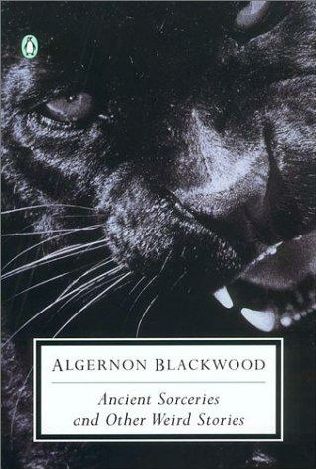
This same rule applies to early 20th century weird fiction author Algernon Blackwood. It’s hard to find anything about him that doesn’t immediately compare him to HP Lovecraft. Perhaps not the strangest comparison in the world: they wrote about the alien, the eldritch, the unknowable. And they were both masters at keeping unspeakable terrors offscreen while not leaving the reader feeling cheated.
But Blackwood was different to Lovecraft. He wrote more ghost stories. He could be playful and mischievous. But most of all, his stories sometimes had a sense of quiet, unpretentious realism, as though he was writing about things that really could happen. His real life fascination with sorcery and the occult shines through in his fiction. When man is pitted against monster, Blackwood takes the side of the monster.
This collection has nine of Blackwood’s tales. “The Wendigo” and “The Willows” are very famous stories about brushes with the unknown. “The Man the Trees Loved” is a curious, whimsical offering – more similar to Lord Dunsany than anything in Weird Tales. “An Episode in a Lodging House” is about a renter using an ancient spell to bring down the boundary between worlds.
But my favorite two stories are two of the lessor known ones. “The Man Who Found Out” is a brilliant wind-up and release about a secret that causes anyone who learns of it to kill themselves. And the horrific “The Insanity of Jones” is about someone who begins to suspect that his boss murdered him in a past life. Both of these stories are tight, lean, and spellbinding.
Blackwood’s writing has aged well, and he’s well worth reading for reasons other than the fact that HP Lovecraft liked him. There’s more complete volumes of Blackwood’s stories, but this has enough to give a good introduction to his work.
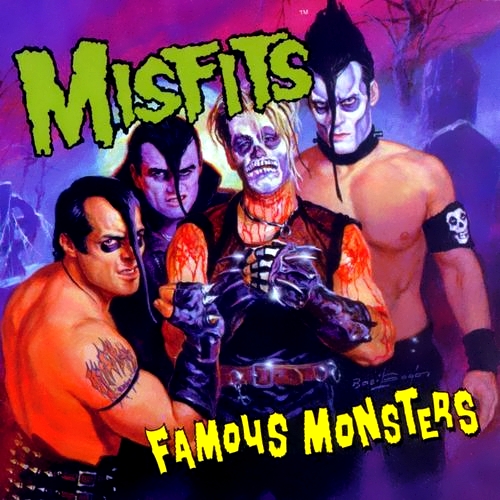 There are no rules. Legal battles. Turning forty. A new singer. Sophomore slump. The seminal monster punk band takes all these ingredients and turns it into their best album ever.
A bold claim, but Famous Monsters backs it up. It’s the same great Misfits songwriting, now with modern production, a more expressive singer, and an even greater attention to melody and violence. Where Walk Among Us fired a machine gun at random, Famous Monsters takes precise aim and scores a perfect spread at a duly licensed gun-range because safety is important and these guys have Roth IRAs to manage now, doncha know.
Okay, the early spontaneity is missing, but the band sounds so good now it doesn’t matter. Doyle’s guttural guitars merge with Jerry’s bass to create a crushing bulldozer of sound, with Dr Chud’s drumming being downright inhuman(oid?). Replacement singer is Michale Graves is an astonishing find. His voice is rich and gleamingly smooth, like punk rock’s answer to Caruso. The band really should have worked harder to hold on to him.
The run of songs that starts from track 3 and finishes with track 7 is incredible, from the cruising power and energy of “Dust to Dust” and “Scream” to the coked-up thrashing of “Witch Hunt” and “Crawling Eye”, this is the stuff the Misfits are all about. Essential!
The later songs aren’t as strong, but they show the band’s more diverse side. Nobody these days knows how to mix punk with anything except ska and pop, but the Misfits would always convincingly combine their signature style with genres like NWOBHM and surf rock. Here we get a mini doo-wop epic called “Saturday Night”, and a plodding Cure-esque album closer called “Helena”
It has a few too many songs with few too little ideas, but that’s something you get used to with punk rock. Grognards will never accept any version of the band that doesn’t have Danzig behind the microphone, but everyone else will probably find Famous Monsters to be the strongest and most consistent Misfits album.
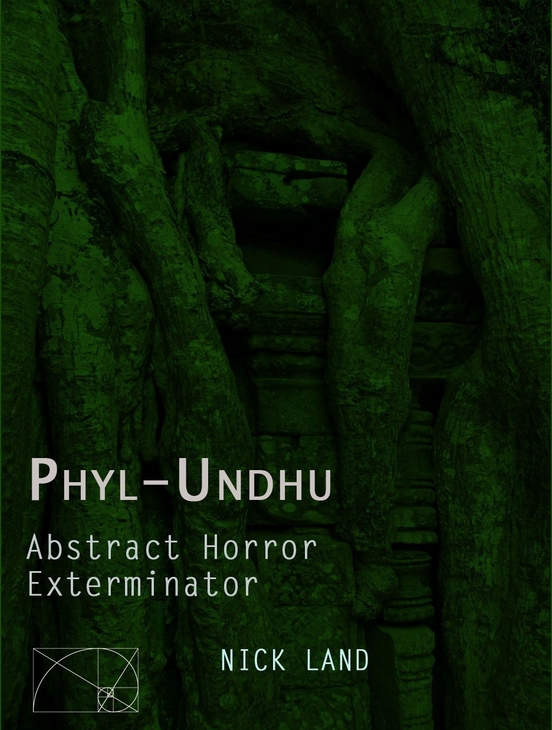 When you judge a book by its cover, you’ve got to be open to the chance of a mistrial. Phyl-Undhu’s title made me think it would be another attempt to stick electrodes on Lovecraft’s corpse and make him jump and dance for a few moments. Instead I got an extremely dense, detailed and scary story, with an excellent ending.
The story’s about a virtual-reality videogame that seems to take over peoples’ lives. Not through hypnosis or any sort of conventional addiction, but by being fascinating, confusing, and unsolvable.
None of the characters are sure how to beat it, they only know that they have to find “Phyl-Undhu”. The game is described as a massive environment that – like Stephen King’s Midworld – is both alien and very familiar. I liked Land’s invocation of apocalyptic size. That’s another nice touch often missed in horror stories about electronic games – a huge game like Skyrim can sometimes trick you into thinking it goes on forever, and that idea has a certain eerie power.
Playing the game occupies one corner of the story. The other corners are filled with philosophical fluff from Nick Land’s head, such as transhumanity, solipsism, and the “Fermi Paradox” (which questions why, in a universe replete with life’s building blocks, we’ve never seen signs of it anywhere except Earth). Many of these elements play into the larger story about the game, but in a way that doesn’t slow the momentum or drag things down.
The ending came and went, and it took a few moments for the full implications to sink in. I won’t spoil it, but it’s very, very good. Nick Land understands that a story’s end should NOT be the end, that it should take up residence in your mind and keep you thinking long after the pages go quiet.
I’m not very familiar with Nick Land, only knowing him as an “alt philosophy” person in the same category as Mencius Moldbug and Nick Bostrom. This is his first overt fictional work (as far as I know), although nothing he does can really be classified easily. In this case “futuristic philosophical horror” seems the closest fit, but it’s still a bad one. You’ll have to read for yourself.