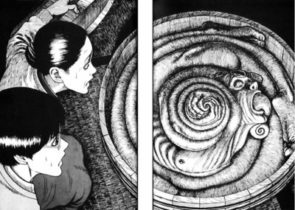
Uzumaki is the horror manga: the benchmark, the standard. It’s intense, imaginative, horrifying, and oozes dread and revulsion. Nothing made before or since beats it. Junji Ito says that he created Uzumaki because he wanted to write a story set in a small town like where he grew up. I wouldn’t personally have the courage to track this sort of stuff through my childhood memories.
It’s another canter for horror’s tireless workhorse: the Big Secret in a Small Town. Kirie Goshima’s perpetually nervous boyfriend Shuichi is having premonitions of destruction enveloping their small coastal village. He might not be fully in touch with reality. But what to make of Shuichi’s father, crouched down beside a wall and ignoring anyone who tries to talk to him as he looks into the spiral of a snail shell?
Soon, events began happening (and escalating), leaving it clear that something is happening to the town of Kurozu. People are dying terrible deaths. They might be the lucky ones. Spirals hang over everything.
Uzumaki was serialized in Big Comic Spirits starting in 1998, and there are slight concessions to the format – the way each issue is a self-contained story, with its own challenges and characters. The twenty chapters of Uzumaki fly by at the speed of light, whether it’s spent in the somber reveries of “Twisted Souls”, the slow burning psychological terror of “The Spiral Obsession” pts 1 and 2, or the funny and imaginative “The Snail” and “Medusa”. “Jack in the Box” dispenses with all subtlety and throws gore around like feces in a monkey cage, while “Mosquitoes” and “The Umbilical Cord” find Kirie experiencing a gruesome and unsettling convalescence at the town’s hospital, revealing just how deep the spiral curse has its hold in Kurozu.
The best chapter is the third one, “The Scar.” Shuichi is being stalked by a succubus-like girl with a spiral-shaped scar on her head. This story combines all of Junji Ito’s skills into something that seems low key but ends up being truly insane. Unfortunately, the big reveal has since become Ito’s most famous image, which spoils it a bit.
Uzumaki also demonstrates Ito’s excellent grasp of pacing and momentum, and his awareness of the ticking clock that happens inside the world of comic panels. There’s a powerful scene in Ch.2 where a spiral-phobic woman has removed every spiral from her body (starting with cutting off her curly hair, and then slicing the whorls of skin from her fingertips). She emerges from her self-mutilation happy, because she thinks she’s cut away every spiral from her body. …As she talks, the comic panels keep zooming in on an anatomy chart behind her…and the conspicuous spiral inside the inner ear. This scene is so well done (and unpleasant, because we can see what’s coming) that it shocked me, and convinced me that Ito is a genius of some kind.
The first two volumes advance the plot in increments, and set the stage for the third volume, which is a long plunge into hell. Ito shows off the breadth of his influences here: HP Lovecraft, Sakyo Komatsu, Katsuo Umezu, even Ishirō Honda in places. We soon have an idea that there won’t be a good ending for Ito’s characters. The ending disappointed me at first but now it seems like a mathematical equation that has been invoked and followed to an inevitable end. What can two people do against geometry? The forces are totally incommensurate.
The final chapter is a little story that seems to take place earlier in the timeline (as deduced from Kirie’s long hair). Shuichi has discovered an all-new spiral galaxy in the night sky, and soon afterwards people gain the ability to read each others’ thoughts. A decent story, but kind of unfocused and not as punchy as the others. I think of “Galaxies” as Uzumaki’s bonus track.
Uzumaki really took me by surprise when I first read it. It’s astonishing. No matter how bored you might be with horror, there’s always something capable of short-circuiting your logic and reason defences and taking a path right to your primitive, reptile brain. And maybe that path also follows a spiral.

People often say that Junji Ito’s skill as an artist sometimes exceeds his skill as a storyteller. His imagery is larger than life. His characters and plots are usually very stock. If that’s the opinion you have of Junji Ito, prepare to have it left utterly intact by this 2002 volume (which I read from scanlations, as it has no official English release), which features scary art and stories that are slightly more substantial than nothing.
The results are kind of scattershot. The opening story “The Woman Next Door” is probably the best thing on here. Our heroine Mimi finds herself sharing an apartment building with a strange and threatening woman, and it evokes a powerful atmosphere even if it doesn’t really have an ending. Straight after that we get the 11 page “The Sound of Grass,” which is as unsatisfying as a 0.5 course meal.
“Graveman” is a waste of paper, featuring one of Junji’s worst premises to date (a bodybuilder flexing his muscles in a graveyard) and far too little payoff at the end. I don’t know what he was thinking here. His filler isn’t usually this bad.
“The Seashore” takes a while to get going, but has a powerful ending and some great art. “Alone with You” is the tale of a dead mother who comes back to haunt her daughter, and it also gets the job done.
The volume ends with a frustrating story called “The Scarlet Circle”. Mimi has found an underground room in an abandoned house with a strange circle on the wall. Soon, she realises it’s a gate to another world. The story is really fascinating and spooky…and it finishes in what is a strong contender for the shittiest and most obnoxious Junji Ito ending to date. This is a slight step up from “She woke up and it was all a dream.” I don’t know if he cut the story off short due to a deadline or whatever, but the alternative is that he genuinely hates his fans.
From what I understand this volume was inspired by various Japanese folk tales. Fair enough. Japanese folk influences have always informed Junji Ito’s work (his story “The Red String” being a particularly obvious example). There’s a nice little afterword done in the style of those gag comics in Uzumaki where he explains his creative process. Too bad he doesn’t tell us where the ending to “The Scarlet Circle” went.
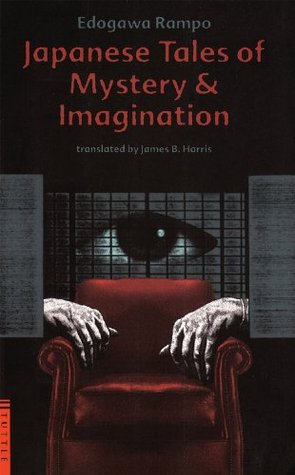
I wonder how much great literature we’re missing out on because of language barriers. Probably a lot. Whenever someone performs the task of hauling Japanese novels into the Western world, it’s like we’re being given a momentary glimpse into some ancient treasure room.
Japanese Tales of Mystery and Imagination is collection of early stories by Japanese mystery writer Edogawa Ranpo, as translated by James B Harris. As is always the case, Western terms like “mystery” fit him imperfectly. He is a thinker and a manufacturer of ideas. After reading this volume, my mind felt stretched, as if Ranpo had physically gotten in there and enlarged it somehow.
“The Human Chair” is astonishing, a bizarre tale about an ugly man who crafts a chair with a hidden space inside for him to sit. Finally, he can enjoy physical contact with beautiful women (unknowingly on their part), and he seems far better suited as a chair than as a human being. The story’s ending irritated me at first, but I’m now starting to believe it it merely clashes with my prejudices about narratives.
“The Psychological Test” and “The Twins” are dense and involved crime stories, told from the perspective of the criminal. “The Hell of Mirrors” dispenses with subtlety and unloads horror with both barrels, and manages to be as shocking and frightening as Poe classics like “The Black Cat.”
“Caterpillar” is the story of a soldier whose limbs have been blasted off his body and of the wife who cares for him. This was written ten years before Johnny Got His Gun but leaves a similar impact. Suehiro Maruo has made a fantastic manga adaptation of this story (check out Junji Ito’s take on “The Human Chair” while you’re at it). “Caterpillar” is tragic, not a story so much as a scenario that can only be followed to its inevitable unhappy conclusion.
But my favorite story is “Two Crippled Men”. Leisurely told and understated in tone, it is about a man who walks in his sleep…talks in his sleep…and eventually commits crimes in his sleep. The ending twists in a way that genuinely shocked me. This was the story where I began to believe that Ranpo is a genius.
Ranpo’s approach to these stories is very “Japanese”. Elegant, a bit baroque in his approach, but with a drive and focus that’s often surprising in its intensity. Someone should translate more. And still more after that.