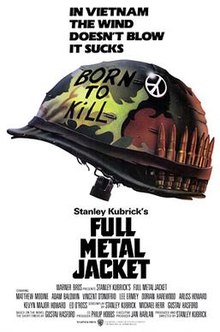
Fire a .22 round and a casing will go plink on the ground. If you pick up this casing, clean it, crimp it, fill it with powder, and seat a new primer and bullet, it will be as good as new.
But when you fire and reload the same casing ten or twenty times, eventually it will not be good as new. The metal will become embrittled, prone to cracking and spalling; the walls will be thin, fluxed outward by temperature and pressure; the primer might no longer sit properly; and it will be liable to misfire. There’s variability both in material – in general, brass casings handle repeated firing better than steel or aluminum ones – and in individual casings. Either way, metallurgy will distort your casing past the point of no return. You can never unfire a bullet.
Gunfire changes bullets. It also changes the men firing them. It’s a common pop culture conceit that war irreversibly transforms men – hauls them across an event horizon to sub- or super-humanity. Veterans return to their families and they’re not the same: they quiver and twitch, they’re prone to explosions of anger. Audy Murphy is the US Army’s greatest war hero, credited with 240 kills. He came back a post-traumatic stress case who slept with a gun under his pistol – a gun he would use to threaten and terrorize his first wife. She’s lucky his kill count isn’t 241.
Full Metal Jacket is a latter-day Kubrick film about the above transformation. It depicts the lives of several soldiers (or rather, aspirant soldiers) subjected to the furnace of the Vietnam war. Some crack. Others “survive” in biological terms but jettison parts of their humanity. All seem to have lost something in the end.
It’s fifty percent a great movie. Most films are zero percent a great movie, so that’s not bad. But it’s impossible not to watch it without regret: Full Metal Jacket ends up being much smaller than its shadow. If only it were great all the way through.
Nearly everyone agrees which half of Full Metal Jacket is good. The boot camp scenes at the start – focusing on the relationship between a bullying drill sergeant and a fat, clumsy recruit – are as compelling as anything ever Kubrick put to film. They’re hilarious, cringeworthy, raw, and so thematically complete that when they end, it feels like the movie should also end. It’s actually a surprise when it doesn’t.
R Lee Ermey is fantastic, and carries the movie on his shoulders. He struts up and down lines of terrified recruits like a demonic rooster, reeling off pungently vile insults like stanzas of metered poetry. I’ve heard veterans describe boot camp as “the funniest place you’re not allowed to laugh”, and I think about that when Ermey says stuff like “unorganized, grab-asstic pieces of amphibian shit” and “slimy little Communist shit twinkle-toed cocksuckers“, ready to dump all the shit in the sky upon the first private to crack a smile.
How accurate a portrayal of the boot camp experience is this? I remember a discussion on IMDB’s defunct comments bored – half the vets were saying “This is fantasy” and the rest were saying “This was my experience, exactly.”
Certain things seem right, based on what I’ve heard from friends. Dumping a recruit’s entire kit all over the floor because one little thing isn’t squared away. Punishing an entire class for one recruit’s screw-up. These scenes have a ring of truth. Ermey’s behavior has a cruel kind of logic behind it: he’s weeding out “non-hackers”. In his mind, if you’re going to snap under pressure, you might as well do it at Parris Island, rather than in the field, when the lives of your brothers are on the line.
Vincent D’Onofrio also inhabits his role well: that of a helpless wide-eyed frog getting smashed to pulp by a baseball bat. After weeks of abuse, his eyes start changing, and the drill instructor thinks he’s finally taking instruction. Movie viewers, of course, are aware of dramatic arcs and might guess that something else is coming.
Later, when Joker graduates boot camp and goes to Vietnam, the movie literally loses the plot. None of its events are motivated by anything much. It grinds out some new ideas and characters, but next to D’Onofrio and Ermey’s dynamic they’re not interesting or memorable. I don’t seem to be alone in that assessment. On the film’s IMDB page, the top-voted quotations are overwhelmingly from the early scenes. Down the bottom you’ve got lines spoken in Vietnam by guys I don’t even remember being in the movie.
These scenes are tonally inconsistent. The part where Joker has to write propaganda (“we have a new directive from M.A.F. on this! In the future, in place of “search and destroy,” substitute the phrase “sweep and clear”!) is straight out of Dr Strangelove. Then there’s a moment where a gullible soldier has his wallet stolen by a wacky karate-chopping Vietnamese street gang. Other scenes play their material very straight, without a hint of satire.
A lot has been written about Vietnam, and the way it reflects the final destruction of Clauswitz’s notions of war. No more battle lines. Your enemies dress like civilians. They use women and children, forcing you to make terrible decisions. Your fellow soldiers behave barbarously. Up is down and left is right. You want to escape, but even when you do, the war follows you home, haunting you. What’s it all for?
Kubrick’s film starts out purposeful and ends confused, muddled, and existing just to exist. In this sense it’s the perfect depiction of the Vietnam war.
“…putting Sade back on the bookshelf” is how Le Figaro describes this book. If anyone has A Sentimental Novel on their bookshelf, it’s with a fake cover, the spine turned inward, and probably an explosive self-destruct device fitted so the the book can be safely 451’d if the police come knocking.
Robbe-Grillet’s final work is short and lacks a narrative. It’s a sequence of pornographic vignettes, where nymphets of questionable legality are defiled by middle-aged male châtelains exactly like the author (don’t ask questions). This is the kind of book where you hear the word “nubile” and the author isn’t trying to be funny.
On one hand, I approve of books written by maniacs. On the other, the world has moved past the Marquis de Sade, and Robbe-Grillet just retreads familiar ground for the most part. It’s well-written (or flattered in translation), but to what end? Bataille, Huysman, and Comte de Lautréamont wrote far more imaginative and creative work a century ago, and they lived a century ago. Robbe-Grillet spent a lifetime championing le nouveau roman. Was he trying to champion le vieux romain, too?
A Sentimental Novel is hard to analyse. Airy and light. Floaty. There’s an intentional lack of substance to the book that makes it strangely affecting, but which also renders it averse to study. Barthes described Robbe-Grillet’s style as “a theory of pure surface” (or I think he does – I can’t find a source for this quote), and that’s very evident: A Sentimental Novel is a neverending plain of surfaces, with your eye forever bouncing off them. The prose displays everything, but displays nothing. We get descriptions of reflections glissading across a set of shears as they snip away a nipple. Whose shears? Whose nipple? Why? It’s all heat. No light.
In this sense, at least, Robbe-Grillet leaves his inspiration behind. Donatien Alphonse François’s books were always clearly about something: they’re notoriously full of political and philosophical rants (to the point where they’re turgid and boring). But a critic will have to dig very deep to find meaning in A Sentimental Novel, and any interpretation is probably 90% critic, 10% book.
I’m personally not impressed by writers that word-vomit imagery and burden the reader with the task of “interpreting” it. It’s not that the author is lazy (effort doesn’t matter in art. It’s not weightlifting). It’s that if the meaning is all coming from my own mind, why do I need Alain Robbe-Grillet in the picture? I enjoy thinking about books, and analyzing them, but I’d ask that the author at least meet me halfway by taking responsibility for the things on the page. A Sentimental Novel could be a Sade written by a computer. There’s no crests, no rises and falls, no build-ups, nothing.
I’m sure that if I stare at A Sentimental Novel for long enough, I’ll discover its genius. I’m also sure that if I stare at a piece of toast long enough I’ll see Jesus’s face.
Does transgressive literature have a future at all? Maybe it’s in the too-gay-to-function Dennis Cooper, the computer-mangled sentences of Kenji Siratori, the alt-lit of the web, the heart-freezing paralysis of Michel Houellebecq. Writers who are doing something new, however incompetently.
Even average writers like Palahniuk and Ellis are able to find new angles to exploit, such as capitalism, mass media, and so on. They’re not just rewriting Sade for the millionth time. Meanwhile, here’s Robbes-Grillet toiling alone in an abandoned mine, seeking gold in a shaft that was mined out a century ago.
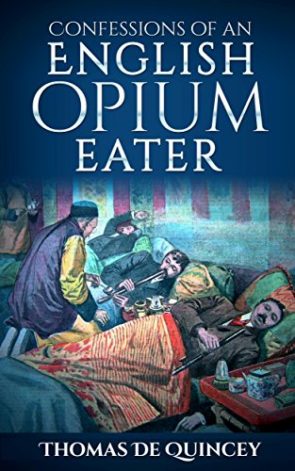
This 1821 book introduces one of the most famous and well-loved heroes in fiction. It stars in Junky by William Seward Burroughs, Trainspotting by Irving Welsh, Fear and Loathing in Las Vegas by Hunter S Thompson, and Requiem for a Dream by Hubert Selby, and countless others besides.
You’ll find the book’s hero in a green pod behind the amaranthine petals of a Papaver somniferum poppy plant. The resin inside the pod is called opium, and it contains the analgesic alkaloid known as morphine. When this alkaloid is ingested, injected, or snorted, it attaches itself to receptors in nerve cells, inhibiting neurotransmitter release, and giving you a pretty good weekend in Vegas.
Opioids have uses, but they’re also dangerous. Take enough, and you forget to feel pain. That’s the plan. Take too much, and you literally forget to breath. Sometimes that’s the plan, too.
“Among the remedies which has pleased the Almighty God to give to man to relieve his sufferings, none is so universal and so efficacious as opium” – Physician Thomas Sydenham (1624-89)
Opium (whether smoked or consumed in the liquid form of laudanum) was the cat’s pajamas in Romance-Era Britain. It was an effective painkiller in a world with a lot of pain. Additionally, it was fashionable: Romantic writers tended to view it as a gateway to a mystical oriental experience that only a cultured and wordly mind could appreciate.
But many opium users were clearly addicts. Confessions of an English Opium Eater is a rare bird: a Romantic account written by an ex-addict with the self awareness to know it.
It’s not packed with outrageous sin and depravity. Nor is full of incoherent drooling about the divine fractal oneness of the cosmos (etc etc). It’s a conventional narrative, and some of the most fascinating parts don’t involve drugs at all. You’ll learn a lot about how things were in England at the time, or at least I did.
The beginning section describes the author’s early life and matriculation, followed by his descent into poverty and homelessness that’s basically self-inflicted (he picks a fight with a bishop who he believes has insulted him, and loses his lodgings). He subsists at the margins of society, eating berries and earning money by writing love letters for illiterate young people. Apparently you could make a living doing that at one point.
De Quincey writes affectingly of the conditions affecting London’s lower classes, particularly orphans and prostitutes. A lot of the book could be viewed as proto-Dickensian. There’s a terrifying sense of atomization to this dark gaslit world that has no modern parallel – once De Quincey loses track of a person, he can usually never find them again. Friends just disappear, like they were never there. These people have no fixed address, no way of receiving mail, and sometimes not even a surname. But they’re loyal to each other – often De Quincey gets out of trouble with the police because a helpful urchin or streetwalker vouches on his behalf.
His fortunes improve at the intercession of some moneylending Jews, and while trying to establish a trade, he winds up on Oxford Street, buying opium to help the pain of a toothache (ironically, he becomes an addict perfectly legally, and only after he escapes the underground). He describes his first dose like this:
I took it—and in an hour—oh, heavens! what a revulsion! what an upheaving, from its lowest depths, of inner spirit! what an apocalypse of the world within me! That my pains had vanished was now a trifle in my eyes: this negative effect was swallowed up in the immensity of those positive effects which had opened before me—in the abyss of divine enjoyment thus suddenly revealed.
“Abyss of divine enjoyment” is both paradoxical and religious in tone. But drugs are paradoxes, combining the holy and profane. They midwife beautiful literature, midwife insanity and necrotizing fasciitis. And the religious connotations aren’t strange: religious ecstasy and drug trips look very similar to the outsider, and perhaps the psychological effects are similar.
Across the Atlantic, the Civil War was brewing, where countless tons of opium would be used to treat battlefield injuries. It would be called “God’s Own Medicine”. Later doctors would refer to opium’s primary alkaloid as morphine, after Morpheus, Ovid’s God of sleep and dreams. The last and most devastating of opium’s children is heroin, derived from hero, who were traditionally men with divine ancestry. Drugs are debased spirituality inside a dirty needle.
De Quincey’s tail leads us on in familiar directions. Higher dosages. Higher thrills. He takes 1,000 drops of laudanum a day! He reads Kant, and actually understands him! There’s some great writing about his drug-created hallucinations. These have potential to drag, but they’re kept brief enough that they don’t. If the first section is proto-Dickens, the second is proto-Timothy Leary.
But things start going bad. The dreams become extremely disturbing nightmares.
The waters now changed their character—from translucent lakes shining like mirrors they now became seas and oceans. And now came a tremendous change, which, unfolding itself slowly like a scroll through many months, promised an abiding torment; and in fact it never left me until the winding up of my case. Hitherto the human face had mixed often in my dreams, but not despotically nor with any special power of tormenting. But now that which I have called the tyranny of the human face began to unfold itself. Perhaps some part of my London life might be answerable for this. Be that as it may, now it was that upon the rocking waters of the ocean the human face began to appear; the sea appeared paved with innumerable faces upturned to the heavens—faces imploring, wrathful, despairing, surged upwards by thousands, by myriads, by generations, by centuries: my agitation was infinite; my mind tossed and surged with the ocean.
De Quincey might have actually killed a man in this period. While on an opium trip, a Malaysian gentleman knocks upon his door. Neither of them can talk to each other, but as a show of brotherhood, De Quincey hands him a large slab of opium.
I was struck with some little consternation when I saw him suddenly raise his hand to his mouth, and, to use the schoolboy phrase, bolt the whole, divided into three pieces, at one mouthful. The quantity was enough to kill three dragoons and their horses, and I felt some alarm for the poor creature; but what could be done? I had given him the opium in compassion for his solitary life, on recollecting that if he had travelled on foot from London it must be nearly three weeks since he could have exchanged a thought with any human being. I could not think of violating the laws of hospitality by having him seized and drenched with an emetic, and thus frightening him into a notion that we were going to sacrifice him to some English idol. No: there was clearly no help for it. He took his leave, and for some days I felt anxious, but as I never heard of any Malay being found dead, I became convinced that he was used to opium; and that I must have done him the service I designed by giving him one night of respite from the pains of wandering.
Was the Malaysian man really “used to opium”? Or was this a self-serving fiction to ease a guilty conscience? Whatever happened to the Malaysian man, he returns to haunt De Quincey’s nightmares, along with a host of other spectres.
The inevitable part where he hits rock-bottom is dealt with only briefly. That’s my main issue: the tale feels lopsided and front-heavy, giving too much weight to his lodging disputes while neglecting the story’s main thrust of addiction. In a later edition, he expands his experiences, but apparently the earlier version is the better one. More words doesn’t always equal more meaning, as any reader of Stephen King can tell you.
So, an interesting read, and an educational one, but perhaps not always a truthful one. I’ve always wondered how much of a drug experience comes from the user, instead of the drug. Thanks to the placebo effect, drugs can be a self-fulfilling prophecy. Haven’t we all seen someone at a party drink one beer and suddenly start slurring his speech and groping girls’ asses? He’s not drunk. He just thinks he’s drunk. He’s granting himself permission to let go. The beer could have been tablewater – all it really did was act as an emotional go sign.
De Quincey didn’t know of the placebo effect, but he was aware that drug experiences are idiosyncratic toward the user.
If a man “whose talk is of oxen” should become an opium-eater, the probability is that (if he is not too dull to dream at all) he will dream about oxen; whereas, in the case before him, the reader will find that the Opium-eater boasteth himself to be a philosopher; and accordingly, that the phantasmagoria of his dreams (waking or sleeping, day-dreams or night-dreams) is suitable to one who in that character.
Roland Fisher famously described Aldous Huxley’s 1954 drug book The Doors of Perception as “99 percent Aldous Huxley and only one half gram mescaline”. The same might be true for De Quincey’s adventures, over a hundred years earlier. The fault, in the end, lies not in our doors, but in ourselves.
The God, uneasy ’till he slept again,
Resolv’d at once to rid himself of pain;
And, tho’ against his custom, call’d aloud,
Exciting Morpheus from the sleepy crowd:
Morpheus, of all his numerous train, express’d
The shape of man, and imitated best;
The walk, the words, the gesture could supply,
The habit mimick, and the mein bely;
Plays well, but all his action is confin’d,
Extending not beyond our human kind.
Another, birds, and beasts, and dragons apes,
And dreadful images, and monster shapes:
This demon, Icelos, in Heav’n’s high hall
The Gods have nam’d; but men Phobetor call.
A third is Phantasus, whose actions roul
On meaner thoughts, and things devoid of soul;
Earth, fruits, and flow’rs he represents in dreams,
And solid rocks unmov’d, and running streams.
These three to kings, and chiefs their scenes display,
The rest before th’ ignoble commons play.
Of these the chosen Morpheus is dispatch’d;
Which done, the lazy monarch, over-watch’d,
Down from his propping elbow drops his head,
Dissolv’d in sleep, and shrinks within his bed.
The Metamorphosis, Book the Eleventh 11:891 Ovid