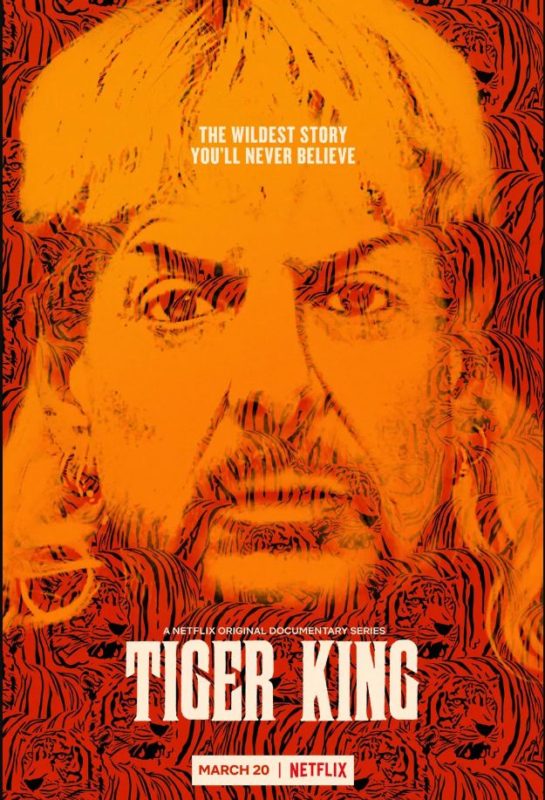
You’ve heard your friends talking about this Netflix documentary, and I suggest you see it right now, before it saturates the water cooler ecoystem and it loses its shock value. It’s sad that nobody can watch The Sixth Sense in 2020 without knowing that Bruce Willis is a ghost. I’d hurry up and watch Tiger King before it gets spoiled for you.
It’s one of the most insane things I’ve ever seen. The people in it hardly seem real. I was constantly veering between shock and laughter. “…he’d come and rub them balls in my face” gets spoken at an eulogy. A man shoots himself in the head barely off camera, and it’s not even the fifth craziest thing to happen in that episode. There’s a straightfaced discussion about whether a human body can be put through an industrial mincer.
Basically, it’s about a war between owners of big cats, which culminates in a tangle of attempted (and perhaps successful?) murders. Joe Exotic owns a zoo. Carole Baskin owns an “animal rescue” that is indistinguishable from a zoo. Both of these people have a lot of shady history: we get the sense that they’re both dangerous, as well as incapable of walking away from any situation where they see themselves as the loser.
Owning a big cat is legal in most US states: but not in a same way that owning a head of lettuce is legal. The animals are as dangerous as their owners (one of Joe Exotic’s weirdly devoted employees loses an arm in a tiger cage) and there are laws against breeding them. Joe is clearly on the wrong side of these laws, but he needs to breed them, because it’s the only way his zoo can remain profitable.
The documentary educates you on the brutal economics of the tiger business: an adult tiger costs several thousand dollars per month to feed, and you can’t do anything with them except exhibit them. The real money is in tiger cubs, which are small enough to be cuddled and petted. Joe Exotic claims he can make a hundred thousand dollars from a newborn cub.
However, profitable cubs age into unprofitable tigers. Joe’s zoo in Wynnewood Oklahoma (aka Backup Florida) had a total 176 tigers, saddling him with staggering food bills and forcing him to breed still more cubs. The Chinese saying “he who rides on the back of a tiger can never get off” describes Joe’s basic dilemma: he’s running a tiger-based Ponzi scheme that will basically never be profitable (except in the short term). Unless he euthanizes grown tigers, which he’s pretty clearly doing.
He might have escaped notice for this, but he also starts targeting human prey. Supposed animal rights activist Carole Baskin may have fired the first shot in their war (she objects on moral grounds to the breeding of tiger cubs), but he escalates their feud to ridiculous, Wile E Coyote levels, piling up incriminating evidence against himself. The series straight away spoils the ending – Joe Exotic makes a call from his Fort Worth prison cell – but there’s no way it could have ended any other way. It’s a testament to the man’s unnatural charisma that he got away with so much for so long.
It’s hard to describe how fun and exhilerating Tiger King is. Even thinking about a few of my favorite moments overwhelms me with options. It’s like digging a hole to find gold, but the dirt you’re casting aside is also gold, and your pickaxe is made of gold too.
It’ll give you a lot to think about, too. Joe Exotic would probably still be a free man if he hadn’t effectively lynched himself via social media. But his self-exhibiting impulses were the only reason he was ever successful: albeit in a quasi-legal fashion. And in this sense, is he any different from the tigers he kept?
About ten years ago, there was a “furry” called Stalking Cat who took his feline obsession to ghastly extremes, undergoing over fourteen body modifications to become a tigress before committing suicide. Joe Exotic succeeded where Stalking Cat failed. Spiritually, he became a tiger.
The main role of tigers, in our culture, is to stand out and attract attention. If they were boring, they’d already be extinct. They survive because people love them. Joe Exotic was the ultimate charismatic megafauna. We adulated him, we feared him, and eventually, we put him in a cage.
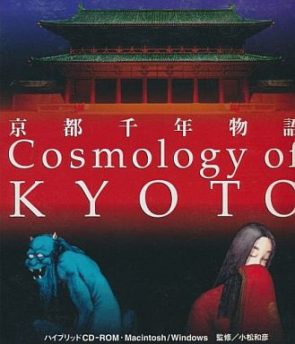
Look up “unique” in the dictionary and you’ll see Cosmology of Kyoto. Only if you use a special dictionary, though. One that has “unique” defined as Cosmology of Kyoto.
Released in 1993, it was sold as a game and is more accurately described as an interactive work of art. It’s moody, confusing, dark, and stylized. You could put it in a class with Dark Seed, Bad Mojo, and Haruhiko Shono’s collective work; games that aren’t remembered with much love but are still remembered.
How did it achieve rapid (if fleeting) fame? Via a technique I call “through the Mac-door”. By 1993, The Macintosh was losing favor as a platform for gaming. A dwindling market share and Apple’s apathy towards gaming had turned it into a dumping ground for “edutainment” dribble and ports of obsolete PC titles, and the occasional original Mac game (even if was a “””game””” wrapped in numerous air quotes) would make waves just because there wasn’t much to choose from.
Without fail, some marketing genius would notice the hype and wrongly conclude that the game was amazing and needed to be rushed to DOS, Windows 3.1, Windows 95, Amiga, and your kitchen toaster right goddamn now, usually with tragic results. If shitty games were AIDS, the Macintosh was a HIV infected needle in DOS’s perineum. But odd games entered the DOS ecosystem through the Mac, too. Games seemingly made in a fever dream or on drugs. This is one of them.
Cosmology of Kyoto takes you on a morbid journey through the Japanese middle ages. Heian-era Japan is now mostly associated with court writers like Murasaki Shikibu and Sei Shonagon, but Cosmology has little time for the courts: it’s focus is the streets and gutters, and the plight of the common folk. Supernatural monsters pose an omnipresent threat.
You create a character before you can play, choosing between “Single” or “Married” and between “Male” or “Female” (you can already tell we’re not in modern Japan because there’s no “Trap” or “Catgirl”). You can also change your facial features, although I didn’t have much luck in not making myself look like a dyspeptic Vladimir Putin. You’re also naked, but fear not: just like in real life you’ll soon find a rotting corpse whose clothes you can steal.
You wander the land, interacting with stuff using a classic “hotspot” based point-and-click interface. You talk to Buddhist monks, samurai, common folk, children, and demons. I died pretty fast: a pissed-off samurai cut off my head, and my soul went to hell.
Another historical aside: adventure games were split at the time in how they handled death. There was the Sierra style (failure = instant death = game over, encouraging the player to plan their actions carefully) and the LucasArts style (you couldn’t die, encouraging the player to experiment and do as many things as possible).
Cosmology charts a third path: you can die, but if you play your cards right you can escape hell and be reincarnated back into the main game. Which you’ll want to, because hell’s pretty bad. The game’s art style has a strong ero-guro influence, with lots of graphic and grotesque imagery. Many Mac titles are for kids. This one isn’t.
By now, Cosmology’s true purpose becomes clear: explaining Buddhism to the gaijin.
I’ve seen people claim that the game has no point, or cannot be finished. Neither is true. You win Cosmology of Kyoto by discovering the source of the demon infestation (I think at the Imperial Palace), and gaining enough karma to break the cycle of death and rebirth. Kind acts like donating money to beggars increase your karma. Swordfighting and stealing decreases it. If you have too much negative karma, you’re reincarnated as a dog when you escape hell.
This emulation of Buddhist spirituality makes it comparable with western RPGs such as Ultima IV, although there’s also a dark, sinister “Tachikawa-ryu” aura of sex and death that’s classically Japanese, and completely missing from Richard Garriott’s famed series.
If esoteric spirituality isn’t your thing, there’s a wealth of historical depth to Cosmology. The game comes with a full encyclopedia of Japanese history and folklore, and the map is a near perfect recreation of Heian-kyo. I guess Cosmology is a kind of backdoor “edutainment” title, fulfilling the Macware stereotype. Maybe this is another reason for its surprising (if short lived) popularity: it’s a cultural experience. A tech support experience, too. As with many classic adventure games, the hardest puzzle in 2020 was getting it to install and run.
Is it worth playing? I don’t know. I think these sorts of weird-ass games are more fun to be aware of than to actually dive into. I don’t need to go to hell: knowing it exists is enough.

Imagine there’s a wall, right in front of you. It has always been there. You can’t walk or see through it. Other people pass through easily. The wall only exists for you.
My wall is hip hop. The condition amusia stops people from enjoying music. I may have selective amusia for hip hop. It’s not that I dislike it or find it annoying; my brain doesn’t recognise it as music. Listening to Lil Uzi Vert’s much-hyped Eternal Atake felt like reading Egyptian hieroglyphics and seeing birds and snakes and ears of grain: I have understanding, but it’s of the wrong sort and won’t let me decode the language. I have ample exposure to hip-hop: I’ve been listening to it unwillingly through car windows and gym PAs and TV shows for nearly thirty years. I should get it by now, and the fact that I still don’t makes me feel disabled.
I don’t have opinions on this album, I have questions, many of them stupid.
1) What’s the appeal of listening to someone else brag about owning things? Rap aficionados always defend this as rags-to-riches storytelling, but most rap isn’t about striving to be rich, it’s about simply being rich. The first song (and the second, and the third) reduces to”I drive a cool car”. So what? Where’s the struggle? Uzi could have gotten that Mercedes-Benz from his dad, for all I know.
2) Why do all rappers now have “Lil” in their name? My understanding is that the ubiquitous rap cognomen was once “Big” (Big Daddy Kane, the Notorious BIG, Big Boi) and now it’s “Little” (Lil Yachty, Lil Peep, Lil Peep). When did this shift occur? Is Biggie Smalls the transitional fossil?
3) Why are so many of these “Lil” rappers actually…not Lil? Lil Yachty is 1.8m tall. Lil Peep was 1.85 m tall. Lil Uzi Vert is just 1.63m, but he’s built like an NPC bodybuilder. Are they “Lil” in the sense of being young and hungry? What will they do when they turn 40 or 50? Don’t they think they’ll live that long?
4) Should these albums come with a glossary for idiot white people? At one point Uzi says “Man, she asked for some racks” and I thought his girlfriend was asking for breast implants in the weirdest way possible. Actually, a rack is a thousand dollars.
5) Why are the most memorable parts of rap always borrowed from things that aren’t rap? The “hit” of Eternal Atake is “That Way”, which samples the vocal hook of “I Want it That Way”. I won’t say Uzi just steals the chorus of a Backstreet Boys song – he interpolates it in a fairly creative way – but it’s still not exactly is. Samples can enhance a song, but when the only interesting thing about a song is its samples, shouldn’t you just listen to the original track?
6) Is this what growing old feels like? The years becoming a slow-acting acid that melts away my eyes and ears and nose, gradually destroying any connection to current culture? Locking me inside my head, until all I can do is look inwards? The older I become, the more I remember the past. And the more time I spend in the present, the less time it spends in me.