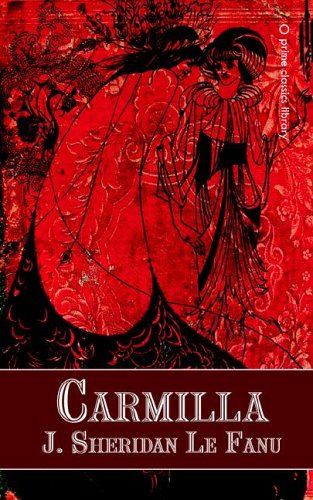
 One of the books you’ve read even if you haven’t, because it’s influenced everything. A story about a vampire written before Dracula, Carmilla is set in a castle in Austria, right next door to Hungary, where the word vampire originates in the form of vampir. Hungary also furnished us with a person who was close to a real life vampire: Erzebet Bathory, who legends said bathed in the blood of virgins. Bathory had no immortality, but she nonetheless partook in the vampire contract: great power can be yours, but first you must be willing to feed on blood.
But these ideas are far away from Carmilla, which is whimsical, even a bit romantic in places. Le Fanu’s gothic horror is comforting and cossetting, full of soft corners and velvet edges. Laura, daughter of an English serviceman, strikes strikes up a friendship with an odd girl called Carmilla, who seemingly never ages, and becomes filled with rage when she hears a Christian hymn.
The romantic elements are between two female characters, and although Le Fanu writes for a 19th century audience, he obviously means to imply a sexual relationship. I’m reminded of how Hollywood’s Golden Age took place during the Hays censorship code, and it led to a lot of subtle and clever movies – with directors having to suggest or hint at things rather than say them out loud.
Modern readers will probably find Carmilla to be a bit dated. The conflict and resolution is speedily handled, propelled along by a few chance meetings that could be called very convenient for the plot. When the dust settles, it seems like it was all over much too easily.
Even worse, Carmilla is curiously shallow and unevocative. A vampire story needs an atmosphere. It needs to evoke the chilliness of the Alpine range, or the loneliness of the Carpathian forests, or the stately derelict of a crumbling castle. Carmilla is a “who? whom?” kind of story, driven almost entirely by character interactions, and it lacks the strong anchor of a convincing environment. The world Carmilla evokes is as thin as the paper it’s printed on.
Carmilla is a good example of a 19th century gothic story, but it’s probably more interesting for what it inspired than what it is. Soaring mountain peaks sit atop tons of necessary but unspectacular rock and gravel, and it’s often the same with books. Carmilla wasn’t state of the art even when it came out – The Monk by Matthew Lewis was written 75 years earlier, and is far stronger in most respects.
Le Fanu will probably never escape Carmilla’s shadow, although he published many other short stories and novellas. It’s probably best remembered as a literary version of Blade Runner: a fairly average film that changed everything.
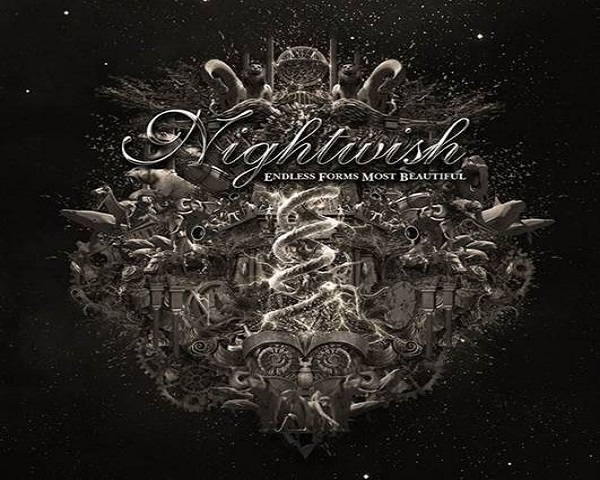 If you’re a Nightwish fan in 2015, I have a question about your fingernails. Are they chewed ragged, or have you gnawed them away completely by this point?
The last four years have seen levels of melodrama and self-parody normally reserved for Manowar. An uninspired studio album. A failed feature film. A frontwoman who left the band so abruptly there’s still skid marks around the microphone stand. A drummer forced into retirement by chronic insomnia. The announcement that Richard Dawkins would feature on the new album. A concept album about Scrooge McDuck. Tuomas crying because people had the cheek to listen “Elan” on February 10 instead of February 13 like he’d planned.
The stars were aligned for Endless Forms Most Beautiful to be the most pretentious and obnoxious Nightwish album to date. It isn’t. Honestly, sometimes I think it could stand to be a bit more pretentious and obnoxious.
New vocalist Floor Jansen is kept in cruise control mode, and her performance lacks both Tarja’s emotion and Anette’s chest-belted power. The production is scaled back to match, with a less savage guitar attack and quieter drums. Into the gaps flow an increased number of orchestral parts, mixed with Celtic instrumentation from new member Troy Donockley.
“Shudder Before the Beautiful”, an animated uptempo rocker similar to “Dark Chest of Wonders.” There’s a quote from Dickie Dawkie, Pip William’s trademark orchestration, and then Emppu Vuorinen’s guitars crash in to heart-racing effect. There’s duelling guitar/keyboard solos…when was the last time a Nightwish album had those? A powerful start to the album.
Lead single “Elan” is a delicate and fragile song. This song about triumphant human endeavor seems more like a guttering candle that could go out at any moment. “Alpenglow” works the same formula to better effect, featuring the album’s strongest chorus. Songs in a similar vein include “My Walden” and “Edema Ruh”. The first is a chance for Donockley to go hogwild on his uillean pipes and so forth. The second is a tribute to the novels of Patrick Rothfuss.
The album’s heavier side has some of the deadness and dryness we’ve come to expect. So many bands have done the “Rammstein + orchestra” thing by now that it’s hard to muster much excitement, no matter who’s singing it. “Weak Fantasy” has an Latin-influenced middle section to break up the chugging. “Yours Is An Empty Hope” is the album’s fastest song, with lots of vocal hysterics from Marco Hietala and another nod to “Dark Chest of Wonders” in the riff development.
“The Greatest Show on Earth” doesn’t quite pay for its 24 minute lodging, but it’s a strong song, telling the story of the evolution of life via symphonic metal and spoken parts by Richard Dawkins. It’s a bit like “A Song of Myself” from the last album – the “song” gets in, does it’s thing, gets out, then we drift off into a land of pure symphony and sectional development, unencumbered by the need to restate a refrain or remind the listener of what has gone before.
At worst, Nightwish is holding steady – an achievement, considering the battering of the last few years. At best, they’ve exceeded Imaginaerium and are approaching Dark Passion Play in quality, although Endless Forms Most Beautiful lacks an epic as good as The Poet and the Pendulum, or radio fodder as good as Amaranth.
It’s clearly not a return to the band’s glory days, though. I think we all know what needs to happen if that’s to be the next step.
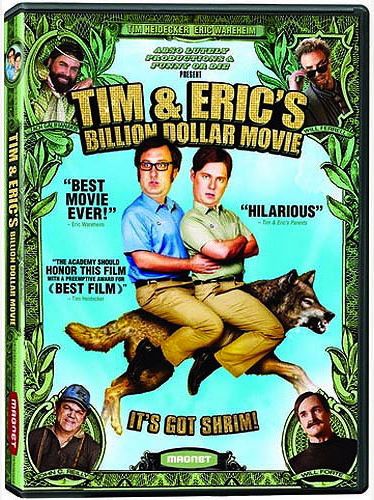 Tim and Eric’s comedy is about weapon-grade awkwardness. They’re the kings of off-kilter timing, inexplicable malapropisms, garishly slapdash special effects, and reaction shots that last two seconds too long. Their style resembles banal daytime TV fed through some sort of cosmic dislocator so that everything is 10-15% off.
Although in this case, it’s more like a banal direct to video movie. The premise: the Schlaaang corporation gives Tim and Eric a billion dollars to make a movie, which they squander on diamonds, helicopter rides, and a $500,000 a week spiritual guru. When they deliver a ridiculous 3 minute film starring a Johnny Depp impersonator, an enraged Tommy Schlaaang orders them to pay back the billion dollars. Destitute, they end up hiding at a derelict mall while ducking Schlaaang’s thugs.
Tim and Eric adjust to their new home, which is filled with such oddities as a used toilet paper store, a sword salesman who earns money by not selling swords, and a man-eating wolf that stalks the food court. They make friends, and enemies, and learn an important lesson: sometimes you gotta bring knives to a gunfight.
Some scenes perfectly nail the uncomfortable Tim and Eric vibe (there’s an almost impossible to watch scene where Eric starts to loudly masturbate off-camera, and it doesn’t let us go until he reaches his climax). Other scenes drag like hell, and have little energy. There’s a scene where Tim and Eric are trying to buy the mall from a neurotic Will Ferrell, and he forces them to watch Top Gun not once but twice. It probably sounded hilarious on paper. On screen, you’re thinking “okay…feel free to go somewhere with this any time, boys.”
This movie exposes the limitations of the Tim and Eric format, which is that they have trouble sustaining interest in their schtick for long periods of time. They were at their best in Awesome Show, Great Job, where they bombarded you with sketch after sketch. While you were still recovering from a left hook, in swings the right. But the artistic strictures of film means they have to keep scenes going, and going, and going…and the cider goes flat. They rely on the unexpected, and too much of the unexpected means your tastes adjust downward like a pupil under a bright light. Their ironic kitsch starts to seem like genuine kitsch. Their awkward pauses and affectations seem like random stupidity.
It’s fun to be in Tim and Eric’s world, but honestly you don’t want to be there for long. Billion Dollar Movie is like spending 94 minutes on a roller coaster. Fun at first, but after a certain point you just want to get off.