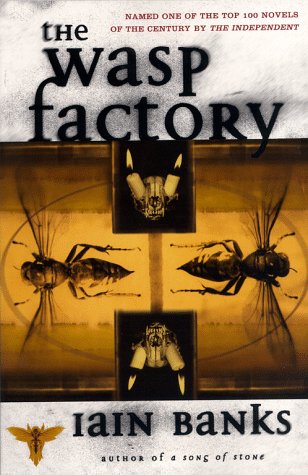
 The Wasp Factory is a like a very small dog with a very loud bark. Although I’d heard lots of hype about how it’s evil and shocking and transgressive, it proved to be a small novel about nothing. Sixteen year old Frank lives with his father on an island. He conducts odd shamanistic rituals. He mounts animal heads on poles. He bumps off a few kids in scenes of PG-13 rated gore. Storytelling is crude and uninvolving, characters abuse each other and abuse the reader, and the twist at the end is not as interesting as it thinks it is.
There’s a good deal of violence, mostly against animals. Frank’s brother likes hurting dogs, and Frank himself enjoys setting rabbits on fire. The book contains enough cruelty against rabbits to make El-ahrairah cry. I think Iain Banks was going for “dark antihero” here but Frank just comes across as juvie justice system fodder, totally dislikeable and unsympathetic. A short story about this character would have been interesting. A novel’s length with Frank felt like going on a long car ride with a person who needs a bath.
The title refers to a strange device Frank has constructed from a clockface. He releases wasps from a glass jar into a series of tubes, each leading to one of twelve deaths (four o’clock leads to a spider, 12 o’clock leads to fire, etc). A cool idea, but ultimately the book isn’t about the Wasp Factory. What it is about is an open question. Lots of themes and ideas are introduced but none of them seem terribly material to the overall story.
I liked Frank’s brother, who makes Frank look like a model citizen. The brother is returning from an insane asylum, and he threatens to disrupt Frank’s well-ordered system of rituals. He also stars in the book’s most chilling and disturbing scene (the one in the hospital), but eventually even he fades out of the story, as Iain Banks clears the stage to make his big point about…something beyond me.
Banks once said that The Wasp Factory is a meditation on childhood innocence. In other words, you’re not supposed to do anything except read it and connect Frank’s experiences with your own childhood atavisms. But Frank is an impossible character to identify with, he performs one improbable action after another like a puppet jerked around by an over-enthusiastic puppeteer. Nevermind relate to him, I couldn’t even view Frank as a person that might exist.
At its best moments, The Wasp Factory has a misanthropic “who gives a fuck” attitude that I enjoyed. Mostly it seems directionless, as if it isn’t sure what the point is but just ploughs on regardless. It exists in its own Wasp Factory, with all twelve exits being “wastes the reader’s time.”
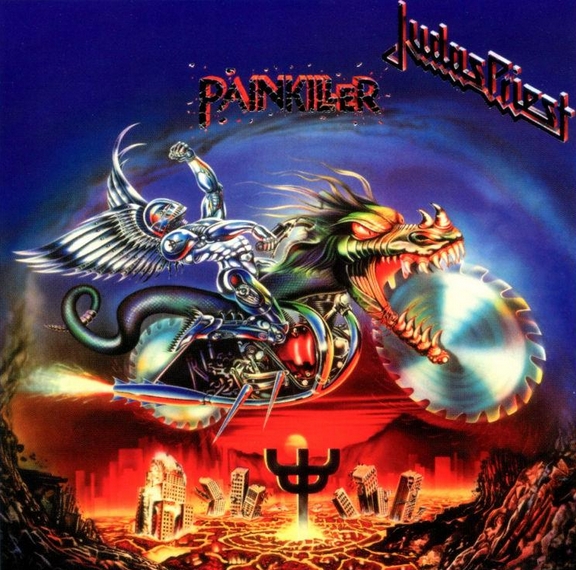 The only word that describes Painkiller is “mighty”. It serves as the last word on 80s metal, an amazing elegy of speed and power.
A lineup change has taken place from the last album. Dave Holland was good at simple AC/DC 4/4 beats, also good if you’re a social worker who enjoys dealing with molested children and wants there to be a profusion of them, but he was, frankly, an alarmingly boring drummer. In his place is Racer-X skinsman Scott Travis. He preserves the punchiness always associated with Priest’s drumming, but gearshifts the intensity way, way up. The one man artillery assault opening “Painkiller”, the fast double bass of “Leather Rebel”, the stadium-filling snare hits of “Touch of Evil”, and numerous other moments reveal that he is good news for the band.
Painkiller is full of songs that listen well on their own, but the correct way to listen to it is in one go, so that the energy builds and transfers from one track to the next. “Painkiller” is a well-known classic featuring amazing vocals and guitar work, “Hell Patrol” is a bit more restrained, and “All Guns Blazing” and “Metal Meltdown” are vicious and thrashing. “Leather Rebel” sports a signature speed-picked pentatonic riff that’s been copied by everyone from Gamma Ray to Bobby Price (“Donna to the Rescue” – Doom OST).
After track 5 the album officially goes from “great” to “epochal”. “Nightcrawler” is “The Sentinel” with a weaponry upgrade – an impressive mixture of heaviness and atmosphere. “Between the Hammer & the Anvil” features my all-time favourite Judas Priest riff and another incredible vocal job from Rob Halford. But the album’s best moment is “A Touch of Evil,” which slows the tempo to a crawl while Tipton and Downing bludgeon a signature 80s guitar riff through your skull. The instrumentation, the vocals, the songwriting, and Chris Tsangarides’ scorching production all come together in a paroxysm of classic Judas Priest greatness.
There’s a bonus track on some version of Painkiller called “Living Bad Dreams” which is an all-out power ballad. It’s good, but not great. There’s a “live” version of “Leather Rebel” (I have a feeling they punched it up a bit in the studio).
This would be the last Halford-fronted Priest album for fifteen years. It seems Painkiller succeeded in burning Halford out. He would go on to explore musical projects more “alternative” (Fight, Two) and his earstwhile bandmates steered Judas Priest’s style away from Painkiller’s ultra-fetishised 80s metal. Even now, Judas Priest has never fully revisited Painkiller territory. Maybe that’s the final proof of the album’s power…it scared off the men who wrote it.
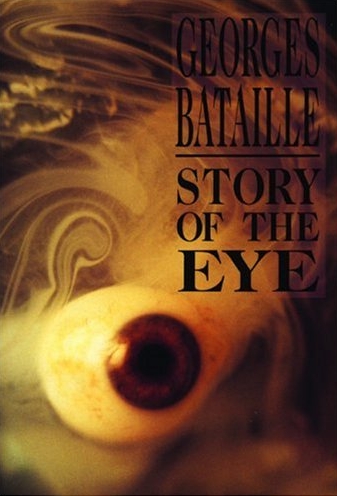 Story of the Eye is an short erotic anomalysm from the 1920s. I say erotic, but the emotions it stirred in me were disgust and disquiet. I read it in an hour, and when I put it down, I felt like my hands had been touching hospital waste.
It’s about an unnamed man and a not-unnamed woman (Simone), who engage in relations vaguely resembling sex. Much what they do is unnatural and illegal. Other characters include the mentally retarded Marcelle, a bullfighter, and a priest. People die in this story. Bataille juxtaposes these deaths with more fucking so that copulation and expiration seem like two sides of the selfsame coin. Some of what happens serves a symbolic purpose, although often it’s not clear what the purpose is.
Backstory helped me understand Story of the Eye. Bataille’s father was blind, and it seems his father’s huge, sightless eyes were a formative experience for the young man. Eyes (and eyelike objects, such as eggs and testicles) are everywhere in this story…even in its title. Bataille’s father also liked to piss himself, and thus Story of the Eye contains enough urine to hydrate Bear Grylls on a triple Ironman. Bataille also uses the book to get in some shots at social mores like mental institutions and organised religion. All the protagonist and his amorata want are sexual gratification. Priests and gaolers want to fix people.
I believe CS Lewis wrote something about how dangerous “fixers” are. If you just want to satisfy your lust you will reach a moment of consummation and then stop, but if you have a lofty and righteous goal then you’ll continue on forever until the world is a charnel house and a crematorium. In this way, Baitalle absolves his perverted main characters of their sins…or at least renders them venal.
The book’s final pages see Simone strangling a Catholic priest as part of a goetic sex ritual, and we are clearly not meant to feel sympathy for the priest. It seemed like a parody of a archetypal Western ending. Batman punching out a bank robber, John Wayne delivering frontier justice from a .45, something like that. Good guys win, bad guys lose.
But when all is done and said, Story of the Eye doesn’t seem to be about anything. Bataille presents us with a series of gross and disturbing sequences, and they’re mostly (and deliberately) meaningless, either that or they are so clouded in metaphor that only Bataille understood them. Likewise, if you’re expecting a story that builds to a conclusion – any conclusion – then the joke’s on you, my friend. Story of the Eye was written to transgress boundaries, never mind what it finds when it crosses them.
Story of the Eye is rightly legendary. Reading it is an experience that can’t be forgotten. However, I feel it’s only a partial experience. Story of the Eye’s secrets could likely only be decoded in full by the author: a man who is fifty years dead.