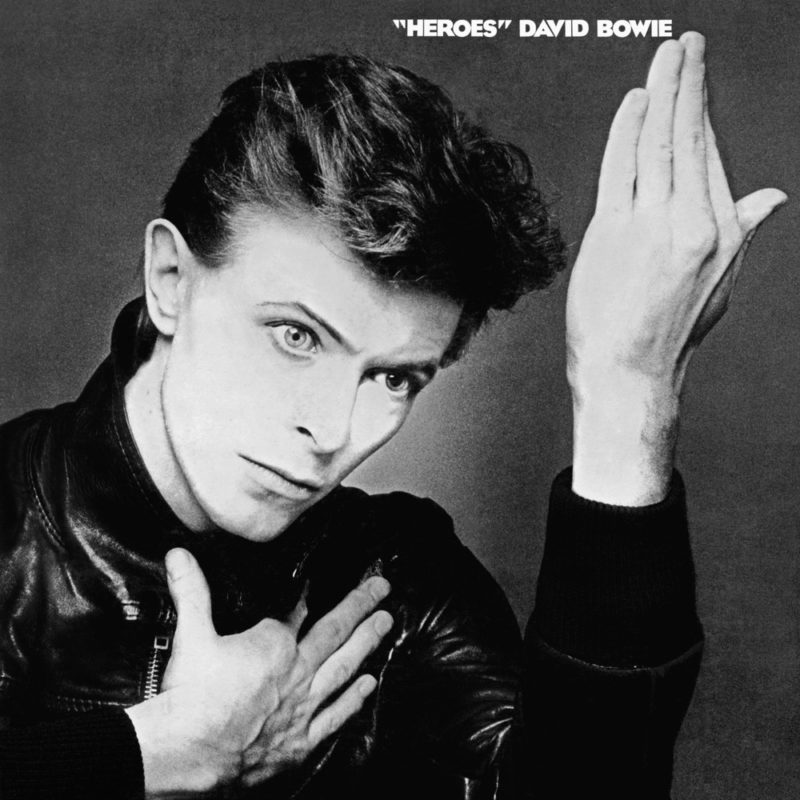
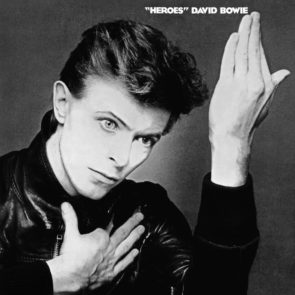
 “Heroes” doesn’t equal the height of Low, but it’s an incredible album in its own way. Bowie created astonishing work in Berlin, and “Heroes” carved his name even deeper in the wall.
The opening track is snaky and serpentine, with Bowie spelunking down to the lower end of his range (“…gone wrong” slides to C#2, one of his deepest studio notes). “Heroes”‘ songs fall into two categories: the ones that make sense on their own, the the ones that make sense as part of “Heroes”. This is one of the former.
By contrast, track 2, “Joe the Lion”, is the latter. I can’t listen to it without the rest of the album: it sounds agitated and broken and gives the listener no relief at the end. But it does provide effective contrast for the krautrock-infused nostalgia of the next track: it’s like driving over a broken road, which changes to smooth blacktop.
The title song is the obligatory classic, which has survived overplay through massive sonic depth. There’s much to discover inside “Heroes”, between Carlos Alomar’s fill-in lines and Brian Eno’s electronic squawks. The song’s like an infinitely unfolding sheet of paper, containing yet more scribbles inside each unfurled fold. The lyrics are broad, and on the page sound faintly mocking, although no trace of this comes through on the record.
Functional harmonists describe music as a journey made of chords. When you listen to the tonic chord containing the key signature, you’re at home (in the Beatles’ “Yellow Submarine” this chord underlines “in the town…”). The subdominant chord is like leaving home to go on a journey (“…where I was born…”), the dominant chord is like arriving at your destination (“…lived a man…”) and then you might go home again back to the tonic (“…who sailed to sea.”).
Maybe my ear is bad, but little of “Heroes” makes sense when analysed in this fashion. There’s nothing that sounds like home, or a journey, or a destination. Notes swirl like squid ink, sometimes coagulating into chords, more often becoming pure texture. Even interesting. The album’s explorative nature is irresistable, even when it leaves the listener behind.
“V-2 Schneider” opens with air-tattered wailing, reminiscent of London during the blitz. The V-2s (German “Vergeltungswaffe”, “Retribution Weapon”) were long-range ballistic missiles, fired across the English channel at London, where they killed an average of two limeys per missile. The other side of the story was the 12,000 forced laborers who died in the production of the missiles. As with many purported Nazi superweapons, the V-2 was far more lethal to its builders than its targets. “Schneider” is “Florian Schneider-Esleben”, one of the founders of Kraftwerk: Bowie finally removed the letter c from his covert krautrock borrowings, making them overt.
“Sense of Doubt” is very dark, featuring a piano microphoned so that every note cleaves space with the power of an axe. A glittering synth line is introduced, as black as polished anthracite. I assumed this was Brian Eno’s work, but the song credits only Bowie. Much of the Berlin trilogy’s instrumental work was creating through procedural experimentation – the composer(s) drawing a card with instructions on it (“Use an unacceptable color”) and trying to attach a song to that scaffold. This isn’t unlike the process used by the Oulipo group to write books – although the Oulipists have yet to produce their Berlin Trilogy.
Traces of life stir in the shadow of this track. “Neukoln” is Bowie going “hey, remember when I used to play the saxophone?” and pairing it with yet more brutalist sonic architecture. His expressiveness seems like a plant weaving through cracked concrete.
The pattern of songs/ambience was used before in Low, which is part of why I prefer it. Even at its best, “Heroes” is retracing his own path, not forging a new one. The only difference is the final track, “The Secret Life of Arabia”, which is actually a song again. Maybe there is a journey to “Heroes”, but instead of in the chords, it’s in the songs. But there’s no sense of home when you follow those twinkling stars, just oddness and neurotic experiments. Or has home changed while you were away?
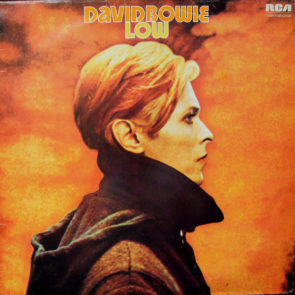
Keeping up with the Jones. After an artistically creative and personally devastating period in LA (full-cream milk, red peppers, and cocaine are a balanced diet, right?), Bowie went into hiding in Europe. Low is meant to meant to suggest “keeping a low profile”. He failed. Keeping a low profile would necessitate a bad album, and Low is simply unforgettable.
They “There’s old wave, there’s new wave, and there’s David Bowie” In a record store, they might say “there’s David Bowie, then there’s Low”. Nomimally the first of the so-caled “Berlin Trilogy” (despite parts of it being recorded in France), Low doesn’t quite sound like anything else he’s done.
Side A has songs, bending punk rock, art rock, . Bowie has seldom written better songs, and Eno’s technical wizardry makes the music seem otherwordly. This is most noticeable on “Speed of Life”, which has varispeeded delay that sounds like strobing flashes of light hitting the Hubble telescope from a distant cosmic object.
The songwriting is sparse and free. Entire songs are threaded together with simple ingredients: a single hook, or rhythm, or texture, but are all the more impactful for it. Lead single “Sound and Vision” has no words until the halfway point, and they’re just minimalistic automatism. No references to the Kabbalah or homosexuality. Just Bowie looking at blue light through his window, waiting for ideas.
“Be My Wife” surprises with familiarity, jarring you with a conventional verse/chorus pop song. Bowie was so good at being fake that there’s often a creepy, uncomfortable sense that he’s dropping the mask and momentarily sharing real feelings, knowing that nobody would ever know. The harmonica-driven instrumental “A New Career in a New Town” spins away the remaining grooves much as “Speed of Life” began them: in adventurous fashion.
Side A is an amazing achievement for Bowie, for Eno, and for rock. It is also Low’s worst side.
Side B deeply, profoundly well-realised, a haunting exploration of sound. It’s ambient music made jagged and broken, like a priceless Qianlong Vase smashed on the floor, allowing the viewer to find whatever beauty they may in the fragments.
People often refer to it as “the instrumental side”, which isn’t right, as only “Art Decade” lacks lyrics and vocals. But they’re brilliant, unforgettable pieces of music, and showcases just how much atmosphere Brian Eno could evoke with tape loops and a one-finger melody.
The dominant ambient piece is “Warszawa”, evoking a city of rust and memories, ancient fumes pouring from its skin. Futuristic Minimoog lines counterpoint church bells and religious chanting in a strange, brutal language from another world. It’s six minutes long: hermetic, cthonic, and almost impenetrable upon first listen. You have to peel it back like a palimpsest, and I’m still not sure I fully get it. David Bowie used to play this live. As a set opener, no less.
“Warszawa” was written by a four year old. Well, the first three notes, anyway. David needed to attend court to square away some matters from the Los Angeles fiasco, leaving Brian Eno to try and come up with something. Tony Visconti’s four year old son wandered into the studio, discovered the piano, and plonked out three notes – an A, a B, and a C. Suddenly inspired, Brian Eno dashed to the boy’s side and completed the melody. I don’t see Visconti’s son credited in the album booklet. The tyke should sue.
The album’s remaining pieces gently come down from this crescendo. “Art Decade” is chilly and still, its melodic ideas frozen like images under glass. “Weeping Wall” has very busy instrumentation, its elements sometimes clashing and other times working in harmony. “Subterraneans” is deep, slow, and forbidding. If the album was a day, this would be the deepest watch of the night.
There’s bonus tracks, too, if you get the right version of the album. “Some Are” seems like a marriage of the two halves of the album, while “All Saints” is extremely harsh – industrial ambient rock as corrosive as drain cleaner. I’ve heard rumors that “All Saints” was recorded a long time after Low, and indeed, it sounds very different in its production approach. You get a remixed version of “Sound and Vision”, which belongs in a bin.
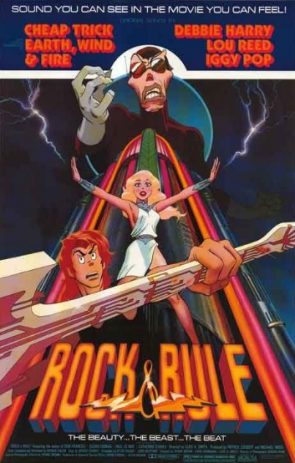
This is a 1983 Canadian post-apocalyptic science fiction fantasy musical adult* cyberpunk neo-noir animated furry i hope i die
The plot is incidental (and embarrassing); cartoon mice save the world through the power of rock. It’s based on a 1978 Nelvana TV special called The Devil and Daniel Mouse, but updated to be edgy and dark and very, very serious. The songs are pretty thin, and guitars are wielded more often as weapons than as instruments.
But there are good moments, too. Some nice animation, and occasionally great character design. I say “occasionally” because it partakes in animation’s most onerous trend: Humans with Dog Noses. Who started the HWDN craze? Carl Banks? The Beagle Boys were obviously cartoony, but here we have straight-up humans with dog noses. It looks ridiculous, and immediately deep-sixes the edgy, dark, serious premise.
Dog noses are the first of many questionable artistic choices. The supporting characters are drawn like funny animals, but the lead characters are drawn realistically. They don’t seem to exist in the same world, and when whenever a lead and a support stands together the sharp disjunct between the two styles is all you can focus on.
My favorite part of the movie is everyone’s favorite part: the villain Mok. He steals the show with one of the most innovative character designs I’ve ever seen in an animated movie: a pastiche of Mick Jagger, Lou Reed, and Thin White Duke-era David Bowie. His face is an unimaginably complex manifold of vertices and angles, blending the feminine and masculine (and canine, but I’ve made my point), and the animators deserve kudos for keeping his ridiculousness on model. The movie suffers greatly whenever Mok’s not on screen, although there are fun computer-generated visuals and Debbie Harry does the best job she can.
The story in brief and in full: Mok (“the only Ohmtown rocker to go gold, platinum, and plutonium in one day!”) is seeing his commercial success wane, and hatches a plan to summon a demon from hell so he can…I dunno. I seriously have no idea what he’s trying to do, but we never understood what David Bowie was trying to do in real life, so there you go.
He kidnaps the female singer from a shitty glam rock band, because only her voice can complete the satanic ritual. Her dislikeable male co-singer has to rescue her along with some bumbling comic relief characters, who are more like comic constipation. Mostly, the movie succeeds in making you groan and cringe, such as when we find out they’re playing at Carnage Hall in Nuke York.
Bootlegs credit the film to Ralph Bakshi, which is false, yet also true, because this sort of movie probably wouldn’t exist without him. The success of Wizards and Fritz the Cat ushered in a few brief years when studios gave a bit of rope to animated films that weren’t obviously for children.
The rope had apparently played out by 1983, and Rock & Rule feels tampered with. The Gibsonian cyberpunk atmosphere is leavened with moments of wacky slapstick that could have been spliced in from Goof Troop (they couldn’t, for chronological reasons, but the vibe is similar). In particular, Mok’s henchmen ride around on rollerskates, which might have been an effort to save money on animation. When your characters are on wheels, it doesn’t matter if they slide around on the frame.
If a studio meddled with Rock & Rule, this is understandable. The film is confused and hard to market, and I’m still not sure who it was for. But it didn’t make any money even with all the commercial compromises, so why did they even try? Go for broke on your crazy post apocalyptic rock musical furry whatever! I’m reminded of this exchange from Karate Kid:
“I’d get killed if I go down there!”
“Get killed anyway.”
* (“Adult” means two fully-clothed characters feeling each other up, implied drug use, a Satanic pentagram, some intense imagery, and one character calling another “dick nose”, which if true would still be an improvement over dog noses.)