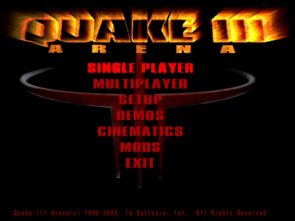
I don’t know if the third Quake is a better game than I and II, but it’s certainly less of a game. They cut away any story mode, focusing it like a laser on its deathmatch experience. You run in circles, trying to kill enemies more times than they kill you. The sarcastic way people described Doom and Quake is now a literal reality.
The result is a first person shooter of incredible purity. Playing Quake III Arena is like breathing pure oxygen – liberating, and destructive to your health. As soon as a stage loads, your mind enters a trance state, and your body falls away. Only three things remain: a left hand on the WASD keys, a right hand clicking the mouse, and an eye orchestrating the violence. The circuit sparks and crackles, the connections fusing together, and when the match ends, it takes a few seconds for the hands-eye unity to remember it has a body.
The game was meant to be played with other people. It has a single player mode, but it’s not a good one and you sense the game is laughing at you for picking it. You play against “bots”, which aren’t smart but are difficult in an abusive fashion. Turning up the difficulty means they gain split-second reflexes and superhuman accuracy – they simply never miss with the railgun, which isn’t fun.
As with past Quake games, there’s a game-inside-the-game, and mastery of competitive online play requires exploiting oddities in the code like rocketjumping (surfing the blast of an exploding rocket), plasma climbing (scaling walls with blowback from the plasma cannon), circle-jumping (pirouetting to add massive velocity to your next jump), and more. The developers would probably spit out their Adderall-laced coffee if they saw what modern players do with Quake III.
A game like this isn’t about content, but about balance. While Doom’s juice came from “yay, cool weapon” and “yay, cool map”, Quake III’s design requires an analytical approach: “are the weapons equally strong, or does one dominate? Are the maps laid out in a way that leads to fair gameplay, or can you just camp a spawn spot and fight off all comers?” Single player is about indulging orgiastic power fantasies, while multiplayer is about fair play and rules. It’s hard to get both right with the same game engine, and maybe it was for the best to ditch a story mode.
The graphics were great, almost to the point of undercutting the game’s minimalist ethos. This game reduced your Riva TNT to sludge. But the lighting, shadows, and all looked very good for the time, with the only competitor being Unreal Tournament.
Thomas Aquinas once said “I fear the man of a single book.” The idea is that you can be unstoppable by doing one thing very well, and Quake III Arena does indeed do one thing very well. “It’s just mindless violence!” – some developers tried to dignify their games away from that, but id Software was apparently taking notes for their next design document.
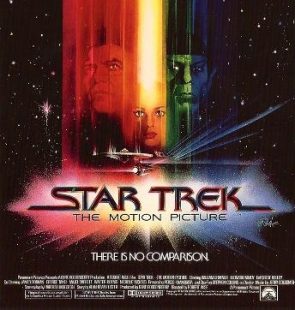
A cloud of iridescent energy slides across the galaxy, destroying all in its path. As it approaches Earth, James Tiberius Kirk bullies Starfleet into giving him control of the Enterprise, one last time. Incidentally, did James go through boot camp? Hard to imagine a guy called Tiberius doing push-ups and getting yelled at by R Lee Ermey. When your name is Tiberius they probably promote you straight to captain.
Star Trek: The Motion Picture is great, if in a troubled way. It’s like a titan, ready to collapse under its own weight. The philosophical method of”structuralism” seeks to understand things through their relationship to other things (eg, a ship’s mast can only exist if there are sails and a hull, otherwise it’s just a wooden pole), and Star Trek: The Bowel Motion Picture can only be understood in light of its own difficult creation.
Let’s start at the beginning. Once, there was a television show called Star Trek. It was both unpopular and cancelled. Half a century later, it’s the defining science fiction series of the silver screen.
How did this reappraisal happen? The same way the Velvet Underground became popular: they sold a few thousand copies, and all of those people started a band. Star Trek’s audience was tiny, but it consisted was of scientists, writers, activists, and other people who wielded a disproportionate impact on the tastes of 1970s America. Their beloved show was dumpstered, but these people were too aggressive to let it be forgotten. They rang phones. They wrote letters. The megaphone-wielding minority soon had the show firmly established in syndication, and a slow critical reassessment began: this thing is actually really good.
Star Trek was often campy, but never cynical or insulting. The writing was often broad, but was never boring. Gene Roddenberry was brilliant at directing attention away from the show’s weaknesses (its budget) and toward its strengths (screenwriting, and Shatner, Nimoy, and Kelley’s acting).
With voltage gathering for a continuation for the series, Paramount Pictures and Roddenberry began working on a pilot. It was a mess. Writers were commissioned, and their scripts rejected. Actors were hired, and their parts written out. Sets were built, then stripped down. I’m stunned that Burbank’s air was declared safe to breathe after so much burnt cash.
Finally, just weeks before shooting was due to start, Close Encounters of the Third Kind hit the box office like a wrecking ball. The prevailing cultural winds now favored movies instead of TV. Paramount panicked and changed their plans: when Star Trek returned, it wouldn’t be as a TV series but a motion picture.
This spelled disaster for Roddenberry. There was not enough time. The production was thrown into chaos, and the planned pilot was hastily refitted into a two hour movie, with a script written as they went along.
The result is a odd experience, stretched and deformed. It’s a Star Trek television episode viewed through a funhouse mirror: you can recognise the shape, but it’s 50% wider than it needs to be. The opening sequence is thrilling: three Klingon ships are evaporated in an impressive visual effects sequence. Exciting. Star Trek was back, now with a budget!
But then we get an hour of “character development”, meaning James T Kirk butts heads against the Enterprise’s dull new captain, while the plot spins its wheels and goes nowhere. We also meet a female alien called Ilya, who talks and talks and talks and sets records for uninspired character design. I’ll buy that a man with pointy ears might be an alien. Ilya’s literally just a woman with a shaven head. You can find plenty of aliens like her at the local slam poetry meet.
The film’s strengths are its visuals: something that was never a strong point with the original show. Douglas Trumbull and a young John Dykstra slather the frame with luminous rainbow hues (Trumbull previously worked on 2001: A Space Odyssey, and the film owes a lot visually to that one, including a “smash cut from rainbow fluorescence to stark white” moment that matches 2001’s Star Gate sequence). The more practical effects are beefed up as well. A tiny Burbank sound stage is make to look like an absolutely massive cargo bay thanks to forced perspective (those tiny figures in the background? Children.) I think this is the first time we’ve seen a Star Trek space battle where both ships are composited into the same frame (as opposed to a shot/reverse shot of the Enterprise firing and another ship blowing up.)
The story is a bit perfunctory, and the imagery seems to transcend the characters until they’re reduced to spectators, gaping at the wonders of the cosmos. Maybe that’s the attitude Star Trek always tried to evoke. More likely, it’s a disguise for the fact that this was supposed to be a TV pilot, and they just plain didn’t have enough story.
I once saw a film called American Movie, about a pair of young indie filmmakers. One of them has a memorable monologue: “There’s no excuses, Paul. No one has ever, ever paid admission to see an excuse. No one has ever faced a black screen that says: ‘Well, if we had these set of circumstances, we would’ve shot this scene… so please forgive us and use your imagination.’ I’ve been to the movies hundreds of times. That’s never occurred.”
He should have seen Star Trek: TMP. It has excuses. Many of the visual effects (although stunning) don’t serve a purpose beyond “we don’t have any actual story to put here, enjoy these flashing abstract colors”. Big chunks of the film are a laser light show in space, intercut with shots of the crew looking awed. For a while, you share their awe. But then it feels like it’s time for something to happen.
Calling a movie “The Motion Picture” sounds either presumptuous of horribly underconfident: you’re either suggesting that it will be the definitive one, or the only one. In the case of ST:TMP, I can’t even call it A Motion Picture, as it’s been recut and re-released many times. The film is now legion, I’m not sure if the original version is exists today in a purchasable form. Although it’s a different sort of Star Trek, I enjoyed it a lot.
(It’s worth noting that Orson Welles voiced the cinematic trailers for this movie. One year later, he’d be voicing Manowar songs, and commercials for frozen peas.)
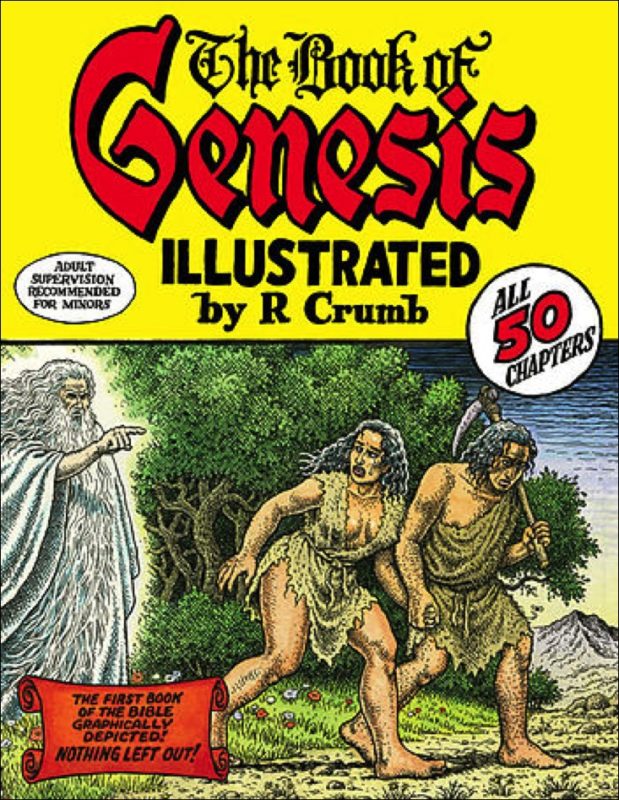
The Book of Genesis is a 224-page graphic novel by noted cartoonist Robert Crumb, based on the book of the same name by noted deity God. It’s literally the full text of Genesis, painstakingly hand-lettered in (and around) cramped panels of Crumbian imagery. It’s all here: the famous stories, the less famous stories, and even the “Jokshan begat Dedan, who begat Ashirum, who begat…” genealogies. Not a verse has been cut, no matter how boring or inappropriate for the comic medium.
Nothing like this has been done before, and hopefully nothing like this will be done again.
While reading The Book of Genesis, a nagging issue kept bothering me. The point. Where is it? What is it? What is any sort of reader supposed to get uot of this? Crumb spent four years working on a product with no entertainment value at all. Maybe he feels pride in being the first person to adapt Genesis unabridged as a comic book, just as the first astronaut to land on Pluto will feel pride, despite it being a dull lump of rock.
So why doesn’t it work? Biblical-themed comics tend to either be didactic, cloying efforts by believers (Jack Chick’s tracts being the most famous example) or angry polemics by atheists (see Jesus and Mo and a thousand other webcomics). I assumed Crumb – who has perfected body duplication technology so that he can be a fly in every jar of ointment – would be in the second group, and that the Book of Genesis would be full of gleeful blasphemy.
Instead, it’s exactly what I’ve described: a comic version of Genesis. Not a single other adjective applies – perhaps not even “good” or “bad”. This is a huge problem: the stories of Genesis are so familiar and famous that artists have stripped them to their bones. If you’re attempting to tell (and sell) the tale of Noah’s Ark or Jacob and Esau once again, you damned well need a second adjective!
Despite doing the art, Crumb leaves no trace of himself in the book. Does he like the stories he’s writing down, letter by letter for fifty straight months? Does he hate them? What emotions do they inspire? Is he realizing any spiritual truths? Is he growing even more sure of his decision (at age sixteen) to become an atheist? I have no clue. I’m not Crumb’s biggest fan but I understand why he’s liked: he has a style, and it’s a compelling one (nobody else could have written Fritz the Cat, for example). But he approaches this project with all the verve of a manga letterer making a thousand yen a page. There’s no creative elan to be seen here.
His imagery is trite, cribbed from Michelangelo, Ignatius of Loyola, and Cecil B DeMille. God has white hair and a beard. He creates the earth like a wizard casting a spell in a Saturday morning cartoon. The Garden of Eden looks like Bambi. The Ark is a large floating shoebox. There are some unintentionally funny parts. During the genealogies, he needs to come up with a visual element, so he just draws headshots of what these dozens of people might have looked like. It looks like the fighter select screen in an SNK fighting game.
Crumb’s form constantly works to undercut him. The Bible’s stories are big and epic, and they would have benefited from double-page spreads, not tiny panels. Again, there’s unintentional laughter. During the flood, we see drowned people and animals, floating face-up in the boiling sea. It would have been a striking piece of art, except it’s too small. They look like toys bobbing in a child’s bathtub.
If I could guess at Crumb’s purpose, it was to provide a comic that contains no exegesis or interpretation whatsoever. The mere act of editing a work, by definition, changes it, so by leaving everything in, he was free from the charge of distorting the Bible. However, Genesis is quite a long book, and cramming it into a comic makes it virtually unreadable. So much text crowds the page that it induces claustrophobia. Combined with Crumb’s signature art style (itchy, hairy, and uncomfortable) and you have one of the most unpleasant experiences I’ve had so far in a graphic novel.
Occasionally, he takes a few small liberties. Potiphar’s wife is depicted as a harridan, not remotely beautiful. The city of Sodom is obviously (and anachronistically) Babylonian, with Ishtar Gate inspired architecture. The passages at the end where Crumb discusses some of the stories are quite interesting, but again he keeps his feelings close to his chest. And that’s something nobody wants to see from Crumb.
The Book of Genesis is a little like a sculpture of the Brooklyn Bridge made of toothpicks, more interesting for its existence than its function. “For verily I say unto you, till heaven and earth pass away, one jot or one tittle shall in no wise pass away from the law, till all things be accomplished” (Mt. 5:17-18). Well, it’s been accomplished. And now I will move ahead to never thinking about it again.